





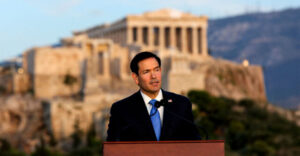
The U.S. Secretary of State, Marco Rubio, referred to his visit to Athens and the importance of strengthening Greek-American relations in a series of posts on X, sending a message of further deepening cooperation between the two countries in the areas of defense, security and energy.
Following his meetings with Prime Minister Kyriakos Mitsotakis and Foreign Minister George Gerapetritis, as well as the conclusion of the 6th U.S.-Greece Strategic Dialogue, the head of U.S. diplomacy reviewed his time in Athens, describing Greece as a “source of inspiration” and stressing that the two countries will continue to advance their shared security, strength and prosperity.
Rubio’s epic posts on Instagram
In a series of epic posts featuring striking footage of the Acropolis and the Parthenon, along with clips from his engagements, US Secretary of State Marco Rubio has summed up his visit to Athens. He also took care to portray the West’s ‘enemies’, personifying them in Fidel Castro, Nicolás Maduro and Joseph Stalin.
The top US diplomat showed his appreciation for Greece and Greek civilisation, not only through his landmark speech on the Pnyx but also through his posts, which were aimed not just at Greek and American audiences but at the West as a whole and Western civilisation, which he said was ‘worth defending’.
Rubio posted footage of his meeting with his Greek counterpart, Giorgos Gerapetritis, and also included part of the blessing ceremony at the US embassy. He framed the video with shots of the Hellenic Police DIAS team escorting his motorcade, as well as moments from his speech on the Pnyx.
In another post, which is essentially a trailer for his speech on the Pnyx, Marco Rubio has set the video to emblematic shots of the Acropolis, alongside images of the West’s landmark achievements, such as space exploration, the discovery of America and the Allied victory in the Second World War. In the same video, however, Rubio also addresses the decline of the West, with footage of protests and clashes in various parts of the US and Europe.
Referring to his meeting with Kyriakos Mitsotakis on Wednesday evening, he said they discussed “ways the United States and Greece can enhance energy cooperation, expand cooperation in defense and law enforcement, and strengthen fair burden-sharing within NATO.” “America First, stronger with our allies,” he added.
Met with Greek @primeministergr Mitsotakis to discuss ways the United States and Greece can boost energy cooperation, expand defense and law enforcement cooperation, and reinforce NATO burden-sharing. America First, stronger with our allies. https://t.co/js8RZmZnTL
— Secretary Marco Rubio (@SecRubio) October 8, 2026
For bilateral relations, he stressed that U.S.-Greece cooperation continues to benefit both countries: “In Athens, we addressed challenges and advanced our shared security and prosperity.”
The U.S.-Greece partnership continues to deliver for both countries. In Athens, we addressed challenges and advanced our shared security and prosperity. https://t.co/wPiY56yLIV
— Secretary Marco Rubio (@SecRubio) October 8, 2026
Regarding the 6th Strategic Dialogue, Marco Rubio wrote on X that Greece and the United States advanced new agreements that deepen defense and security cooperation between the two countries. “As America celebrates 250 years of independence, Greece, the birthplace of democracy, remains a source of inspiration. Together, we will continue to advance our shared security, strength, and prosperity,” he wrote.
On the occasion of his speech at the Pnyx, he reiterated that the West is at a crossroads and that the decisions made over the next decade will shape the next century. “On Wednesday, I traveled to the Pnyx, a hill overlooking the imposing columns of the Acropolis in Athens. There, I delivered a simple message: The West is at a crossroads. The decisions we make over the next decade will shape the next century,” the U.S. Secretary of State wrote on X.
The U.S. commitment to the Greece-Cyprus cable, Turkey and the F-35s
Earlier today, a senior diplomatic source sent a clear message that “the ‘sensitivities’ of third countries do not constitute a right,” in the wake of U.S. Secretary of State Marco Rubio’s remarks on the Greece-Cyprus electricity interconnection, the Great Sea Interconnector (GSI), during his visit to Athens.
Referring to energy interconnection projects and “pointing to” the GSI, the U.S. Secretary of State noted that “these projects are complicated by the sensitivities of other countries in the region.” Asked to comment on the specific reference, the senior diplomatic source was clear: “Sensitivity does not mean entitlement.”
The remark carries particular weight, as it reflects Athens’ position that the reactions or “sensitivities” of third countries toward the electricity interconnection cannot create rights or restrict rights arising from International Law.
Regarding the U.S. position on the project, the senior diplomatic source referred to Marco Rubio’s repeated statements regarding the U.S. commitment to energy interconnection projects.
The U.S. commitment to the GSI and “private diplomacy”
As noted, Washington’s position in favor of the project is clear, while the U.S.-Greece relationship and alliance provide the framework within which this commitment is expressed.
Regarding the U.S. Secretary of State’s reference to “private diplomacy,” the same source noted that certain issues cannot, by their nature, be made public, as they concern sensitive information and foreign policy and security considerations.
What the United States and the State Department will do, should any issue arise concerning energy interconnectivity, is not something that can be publicly disclosed, it was stressed, as diplomacy would come into play in such a case. Regarding the resumption of work on the GSI, it was clarified that this does not depend on the Greek government or any Greek entity. Once the relevant request is submitted by the competent company, the Greek side is ready to proceed with the prescribed procedures and the necessary permits, in accordance with International Law.
The U.S. commitment to the GSI and “private diplomacy”
The assessment of Marco Rubio’s visit to Athens was particularly positive and, according to the senior diplomatic source, it operated on two levels: on the one hand, it confirmed the high level of U.S.-Greece relations and, on the other, highlighted the two sides’ shared understanding on a range of critical international issues.
On Wednesday, I traveled to the Pnyx, a hillside overlooking the towering columns of the Acropolis in Athens. There, I delivered a simple message: The West is at a crossroads. The decisions we make in the next decade will define the next century. https://t.co/G91uSBHY6H
— Secretary Marco Rubio (@SecRubio) October 8, 2026
It was stressed that a stable channel of communication has now been established between the two governments, particularly between their foreign ministries, while special reference was made to the personal relationship that has developed with the U.S. Secretary of State, which, as noted, is based on mutual respect and appreciation.
Rubio’s visit was described as a standalone visit, with it being noted that the U.S. Secretary of State spent two nights in Greece.
The talks focused on two main areas: bilateral relations and international developments. The second part included extensive discussions on the wider Middle East and North Africa, Ukraine, international security and freedom of navigation, as well as other areas of tension.
The agenda specifically included developments in Lebanon, Syria, Libya, Gaza, the West Bank and Iran.
The senior diplomatic source stressed that Marco Rubio has an in-depth knowledge of Eastern Mediterranean issues, which meant that the discussion did not have to start “from scratch.”
F-35s: The legislative obstacle for Turkey
Extensive reference was also made to the possibility of Turkey returning to the F-35 program.
The senior diplomatic source noted that there is currently a legislative framework in the United States preventing the sale of F-35s to Turkey, making specific reference to CAATSA and the issue of the Russian S-400s.
The source recalled that until 2019, Turkey was a co-production partner in the F-35 program, but was subsequently excluded.
From the Greek side, it was stressed that Athens cannot determine the decisions of a third country regarding defense equipment and its relations with its customers. However, the current legal framework in the United States is specific and constitutes a factor that cannot be ignored. At the same time, Greece is moving forward with its own long-term defense planning, with the upgrade of its F-16s and the acquisition of F-35s forming key elements of it.
Greece as an energy hub
A significant part of the talks focused on energy, where, according to the same source, Greece and the United States share an understanding of the need for the greatest possible diversification of energy routes.
Athens supports projects involving pipelines and energy interconnections, with the aim of strengthening energy security and independence.
Through these interconnections, it was stressed, Greece is emerging as an energy hub of particular importance for Central and Eastern Europe, while there is a clear commitment to further strengthening its position in Southeastern Europe and the Eastern Mediterranean.
Cyprus: The goal is to restart substantive talks
The Cyprus issue was also part of the discussion with the U.S. Secretary of State.
The senior diplomatic source stressed that the Greek government has made a significant effort to ensure that the Cyprus issue returns as a priority on the agenda of the UN Secretary-General.
Athens’ main goal remains the resumption of substantive talks, while particular importance is also attached to the process of selecting the next Secretary-General of the United Nations.
As noted, it is particularly important for Greece that the next Secretary-General include the Cyprus issue among his or her key priorities.
Regarding the election process for the new UN Secretary-General, the senior diplomatic source recalled that at least nine votes are required in the Security Council and that none of the five permanent members may exercise a veto. As noted, the informal processes that have taken place so far are beginning to reveal possibilities for convergence around certain candidacies.
Freedom of navigation and the Strait of Hormuz
Finally, particular emphasis was placed on freedom of navigation, against the backdrop of developments in the Strait of Hormuz and, more broadly, the security of international maritime routes.
The senior diplomatic source stressed that freedom of trade and navigation is not an issue concerning only Greece or the United States, but the entire global supply chain.
Any disruption to maritime routes could have serious consequences for energy availability, supplies and prices worldwide.
Particular importance was attached to the Strait of Hormuz, as, it was noted, any restriction on free passage could set a precedent for other parts of the world.
If maritime routes, and particularly international straits governed by the Law of the Sea, are turned into areas of control and restriction, the consequences for international stability could be extremely serious.
For Greece, the issue is particularly important both because of the size of the Greek merchant fleet and as a matter of principle concerning freedom of navigation.
Finally, it was clarified that, so far, the United States has not requested Greek participation in any new mission in the region.
The Greek side has, however, made clear that it is positively disposed toward providing assistance, which could also include the provision of infrastructure, subject to two basic conditions: that peaceful conditions prevail and that there is the consent of the parties concerned, so as to also ensure the safety of Greek personnel.
Ask me anything
Explore related questions




