





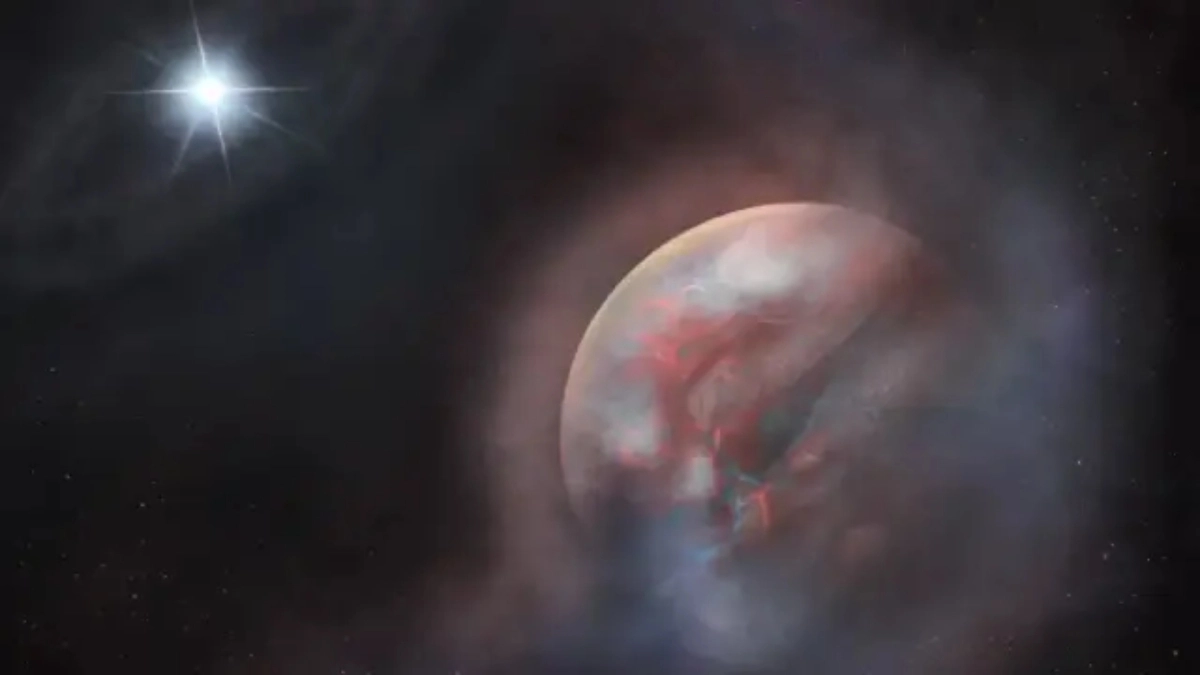
An unexpected discovery around a white dwarf is giving astronomers evidence of a world that may have formed from the very material its star expelled into space as it was dying. The team, led by researchers from the University of Warwick, studied the white dwarf HS 0209+0832 and detected an unusual chemical signature in its atmosphere.
The findings suggest that the white dwarf is likely “feeding” on material from a giant planet that formed after the death of the original star. The researchers describe it as a “second-generation planet,” because it did not form together with the original planetary system, but rather from material ejected when the star reached the end of its life.
The chemical signature that revealed the “phoenix”
The white dwarf has a particularly unusual composition. Elevated amounts of zinc and copper were detected in its atmosphere, while levels of niobium are more than 1,000 times higher than those observed in the Sun. These elements are associated with the so-called s-process, a series of nuclear reactions that creates heavy elements during the final stages of a star’s life, when it expands and becomes a red giant. This chemical signature does not match that of an ordinary planet that formed alongside the original star.
Instead, it is consistent with the possibility that the white dwarf is consuming material from a planet that formed from the very material the star had ejected as it was dying.
When a Sun-like star exhausts its nuclear fuel, it sheds its outer layers. The remaining core turns into a white dwarf, an extremely dense stellar remnant. In the case of HS 0209+0832, researchers estimate that some of the material ejected did not simply escape into space. Instead, it appears that a new disk of material formed around the white dwarf, within which the new planet could have formed.
This, however, is not easy to achieve. According to Jamie Williams, the study’s lead author, an isolated star sheds its matter approximately symmetrically when it dies. To form a disk suitable for planet formation, scientists believe that a second star may have been needed to gravitationally influence the material and keep it in orbit.
It orbits its “dead” sun every 4.4 days
Among other sources, the researchers used data from the Hubble Space Telescope and NASA’s TESS space telescope.
TESS detected a recurring variation in the brightness of the system, with a period of approximately 4.4 days, a finding consistent with the presence of a giant gas planet in a very close orbit. The distance from the white dwarf is so small that its intense radiation “boils away” the planet’s outer atmosphere. Some of the material being lost from its atmosphere appears to be falling back toward the white dwarf, which could explain the chemical signature detected in its atmosphere.
The discovery is particularly interesting because white dwarfs are extremely common stellar remnants. Researchers estimate that more than 95% of the stars in the Milky Way are ultimately expected to evolve into white dwarfs.
This raises an interesting question: could there be other “second-generation planets” orbiting dead stars?
Indeed, scientists say the discovery could provide a new way to search for them: astronomers could look for the same distinctive chemical signature in other white dwarfs.
And there is an even more striking prospect. The Sun is expected to evolve into a white dwarf in about 6 billion years. Researchers are therefore wondering whether, after its death, a second-generation planet could also form in our own stellar system from the material the Sun will have shed.
For now, however, scientists refer to it as a candidate second-generation planet. Confirming the nature of the system is the next step in the research, with researchers also searching for further evidence using the James Webb Space Telescope.
Ask me anything
Explore related questions




