





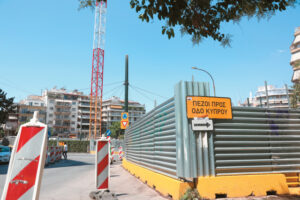
The tunnel-boring machine (TBM) for Metro Line 4 had stopped four times between March and May before becoming immobilised in Kypseli, after ground subsidence recorded during excavation exceeded the levels anticipated in the project’s design.
The revelation came during a press conference yesterday at the Ministry of Infrastructure and Transport, attended by representatives of Elliniko Metro, the construction consortium, the Technical Chamber of Greece and Kypseli residents. It adds a crucial piece to the timeline of problems that ultimately led to the suspension of work on the project. Subsidence is not unusual in metro construction, but in Kypseli its extent and the damage caused to buildings have kept tunnel excavation at a standstill for more than five months. No specific date has yet been set for work to resume, and responsibility for the damage has not been established.
The TBM will now return to operation only after a rigorous technical assessment. As Minister of Infrastructure and Transport Christos Dimas made clear, work will restart only if an independent assessment confirms that the planned measures are adequate, with residents’ safety taking priority. This approach raises the prospect of further delays to the project, the extent of which will become clearer once the TBM resumes work.
Expert team strengthened
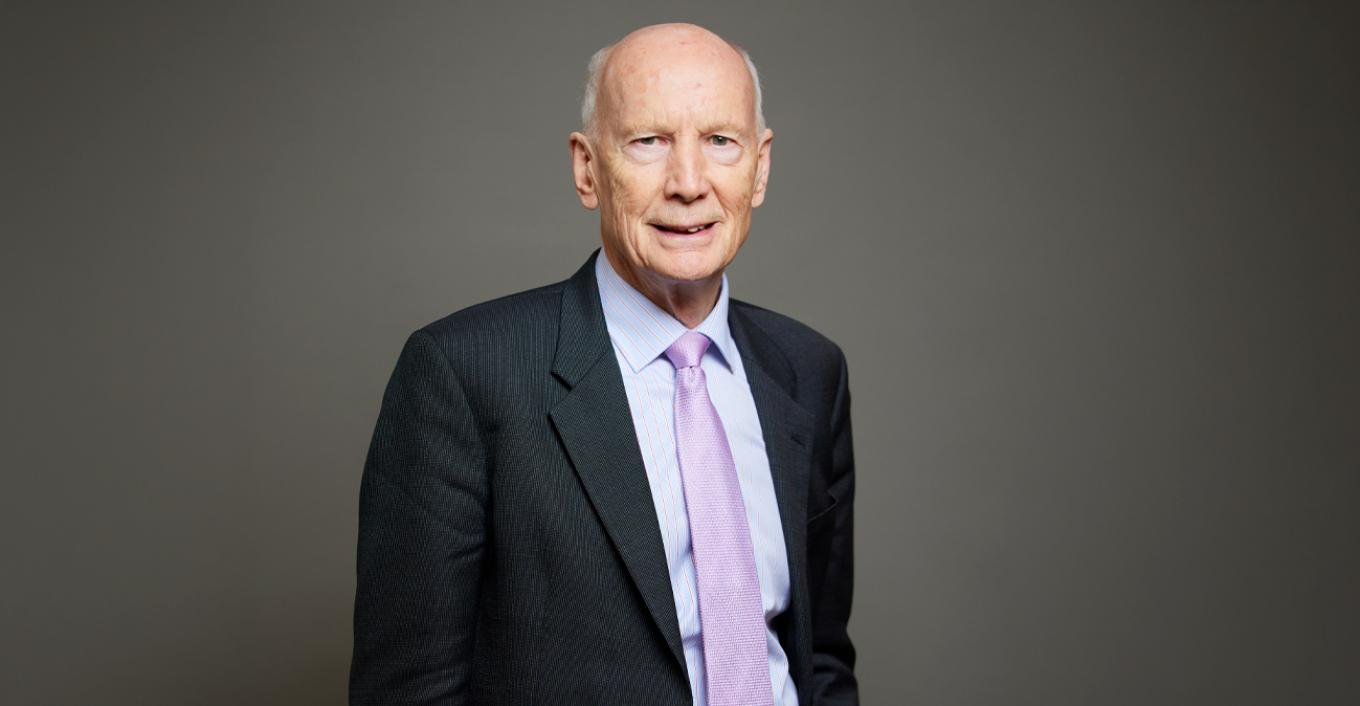
Against this backdrop, the ministry and Elliniko Metro are expanding the team of specialists brought in to ensure that excavation can continue safely. As announced yesterday, British tunnelling expert Lord Robert Mair is joining the team. He is one of the world’s most highly regarded specialists in tunnelling and underground construction in densely built-up urban areas. His involvement adds another layer of technical scrutiny before the go-ahead is given for a safe restart.
With more than 50 years of experience, the emeritus professor of civil engineering at the University of Cambridge has worked on major projects including London’s Jubilee Line Extension and Crossrail. He also helped introduce the technique of controlled grouting to limit ground settlement, which was used, among other applications, to protect Big Ben during the construction of underground railway tunnels.
Professor Vasilis Marinos of the National Technical University of Athens is already part of the technical team as an adviser to Elliniko Metro. The Technical Chamber of Greece (TEE) has undertaken expert assessments of the buildings, with interim reports on 14 properties already delivered to Elliniko Metro.
The construction consortium has brought in emeritus professor Michalis Kavvadas of the National Technical University of Athens and Lars Babendererde, vice-president of the International Tunnelling and Underground Space Association (ITA) and a specialist in tunnelling machinery.
As explained yesterday, the proposal being assessed to get the tunnel-boring machine (TBM) moving again rests on two main changes. The ground ahead of the machine will be reinforced before excavation begins, and the machine will operate under stricter parameters at every stage. Meanwhile, every building the TBM will encounter along the remaining route has been surveyed and its protection requirements studied. The full methodology is expected to be presented openly to residents and the municipality before work resumes.
Once the green light is given, the TBM will initially advance in small, controlled steps, with enhanced real-time monitoring. If any measurement exceeds the prescribed limits, the machine will stop and the data will be reassessed before it moves again.
AVAX chief: No proof of a mistake
The chief executive of construction company AVAX, Konstantinos Mitzalis, distanced himself yesterday from the suggestion that subsidence alone constitutes proof of an error or technical failure.
Asked what had gone wrong, he drew on his experience of major construction projects, arguing that even when designs are of the highest standard, conditions can emerge during construction that could not have been anticipated.
“In all these major engineering projects I have built, despite excellent designs, there have always been issues during construction that even the best designers could not have foreseen,” he said, adding: “There is something that nobody can know before it comes to the surface. That does not mean a mistake was made.”
Asked directly whether there had been an error or a technical failure, he declined to endorse either explanation. It was also clarified that the area’s challenging geotechnical characteristics were known and had been taken into account in the designs.
A specific study is prepared for each section of the excavation, setting out the measures to be taken, the construction parameters and the relevant limits. What can change even over distances of 50 or 100 metres, however, are individual characteristics of the subsoil, such as its permeability.
TEE president Stasinos: Interim reports and building damage
Mr Stasinos presented an overview of the condition of the buildings, as the Technical Chamber of Greece is responsible for assessing properties that have sustained damage. A total of 87 buildings lie within the excavation’s zone of influence and are being monitored, while damage of varying extent and nature has been identified in 20 of them.
Interim TEE reports have been drawn up for the 14 buildings covered in the first phase. According to Mr Tachiaos, around four to seven of these have sustained more serious damage, while the remaining buildings have suffered less severe problems.
The interim reports are important because restoration work does not have to wait until the final expert assessments are completed. It was clarified that work can already begin on most of the buildings, “if not all of them”.
In the vast majority of cases, the damage consists of cracks in walls, plasterwork and joints. Some properties, however, require more detailed investigation and more extensive intervention.
Mr Stasinos stressed that the aim is not simply to seal the cracks caused by the incident, but to leave the buildings in better condition than they were in before the work, once the repairs have been completed.
This also raises questions about the cost and the extent to which the work is covered by the project’s insurance contracts, or whether additional expenditure will be necessary. Mr Stasinos was quick to clarify, however, that the intention was not to upgrade buildings to 2026 standards, but to carry out interventions that would improve their structural resilience compared with their condition before the ground movements caused by the TBM.
The four to six buildings directly above the point where the machine stopped require the greatest care. This is where the most significant subsidence was recorded, and the tunnel has not yet been completed beneath them. They are therefore being treated as a priority.
Before work can resume, these buildings must be protected wherever the individual study being prepared for each one identifies specific measures as necessary. Restoration work on them can begin as soon as the tunnel-boring machine has moved away.
Owners’ consent
One of the factors that will determine how quickly repairs can proceed is the consent of property owners.
Mr Stasinos stressed yesterday that work on an apartment block requires a coordinated approach and cannot be carried out piecemeal, floor by floor. As he explained, it is not possible to start work on the fourth or fifth floor without the necessary consent for interventions on the lower floors.
Mr Mitzalis said AVAX had teams available to expand the repair work immediately, in cooperation with residents and Elliniko Metro. Properties in three buildings have already been repaired, while work on the others can proceed as surveys are completed and owners agree on the scope of the interventions.
Residents’ frustration
The reference to consent nevertheless prompted objections from representatives of Kypseli residents who attended yesterday’s press conference. Their frustration centred on the fact that, months after the problems first emerged, there was still no clear answer about the actual causes of the subsidence or whether responsibility for the damage to buildings would be assigned, and to whom.
They also objected to the consortium’s suggestion that, in some cases, repairs had not progressed or had remained incomplete because the necessary consent had not been secured from residents.
Residents countered that their reservations did not amount to a refusal to have the damage repaired. Rather, they said, their concerns related to the extent of the inspections carried out and the need to know the full range of interventions required in their buildings.
The dispute highlighted the lack of trust that has developed after months of uncertainty, at a time when both the political leadership and the Technical Chamber of Greece are stressing that cooperation with property owners is essential for the work to move forward.
Ask me anything
Explore related questions




