





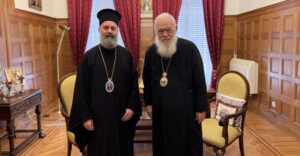
The future of Hellenism in Australia, the preservation of the Greek language and cultural traditions among younger generations, and the strengthening of the diaspora’s spiritual ties with Greece were at the heart of discussions held on Tuesday, 13 October, between Archbishop Makarios of Australia and Archbishop Ieronymos II of Athens and All Greece. The meeting took place at the headquarters of the Holy Archdiocese of Athens in a warm and fraternal atmosphere, reaffirming the ecclesiastical cooperation and mutual respect that unite the two hierarchs.
Beyond its formal, ceremonial character, the discussion highlighted issues central to the contemporary experience of Greeks living abroad. These included how national and cultural identity can be kept alive in a multicultural environment, how younger generations can remain connected to their roots, and the role the Church can play in this effort.
The challenge of preserving Greek identity among younger generations
According to an announcement by the Archdiocese of Australia, the two archbishops exchanged views on the future of the Orthodox Church and Hellenism in Australia, placing particular emphasis on the challenges facing younger generations. Preserving the Greek language and traditions is one of the most important issues for diaspora communities. For families of Greek descent, connecting their children and grandchildren with Greece depends not solely on their ancestry, but also on the opportunities they have to learn about the language, history, culture and values that shape Greek identity. In this context, Greek-language education, cultural activities, participation in community life and engagement with historical and religious traditions can serve as bridges between generations.
The challenge is even more complex in a society such as Australia, where multiculturalism is a defining feature of social life. Preserving Greek identity must go hand in hand with the smooth integration of younger Greeks into Australian society, without one aspect coming at the expense of the other. The aim, therefore, is not simply to preserve traditions, but also to establish meaningful connections between young people and their Greek heritage through modern approaches to education, communication and cultural participation.
The role of the Church in the diaspora
The Orthodox Church has long been one of the main institutions around which Greek community life in Australia has developed. Parishes, church communities and the educational and cultural initiatives established around them have helped preserve religious traditions, the Greek language and the collective memory of successive generations of migrants. Today, however, this mission is taking on new dimensions. Younger people’s relationship with their heritage is shaped by a different social and technological environment, while their needs and expectations do not necessarily coincide with those of their parents and grandparents.
Finding new ways to communicate with younger generations, encouraging young people to participate in community life and connecting tradition with the questions facing contemporary society are therefore important challenges for ecclesiastical institutions. It is within this broader context that the two archbishops’ discussion about the future of the diaspora and the Church’s ability to continue serving as a point of reference for Greeks in Australia should be understood.
During the meeting, Archbishop Ieronymos expressed his concerns about the future of Hellenism and Greece in an international environment undergoing constant change. He also expressed his conviction that God’s grace would continue to bless the Greek nation, highlighting the importance of faith and spiritual continuity.
It is worth noting that the diaspora’s relationship with Greece extends beyond the preservation of a shared historical heritage. It also encompasses the promotion of cultural exchanges, cooperation in education, the strengthening of Greek-language learning and the establishment of stable channels of communication between diaspora communities and Greece itself. As highlighted, this is a challenge for both sides: the diaspora, which is seeking ways to maintain its connection with its roots, and Greece, which is called upon to strengthen its relationship with Greeks living abroad in meaningful ways.
The meeting was attended, on Archbishop Makarios’s side, by Bishop Athenagoras of Canberra, Bishop Eumenios of Chora, and Deacon Timotheos. Archbishop Makarios also conveyed to Archbishop Ieronymos the warm greetings of Ecumenical Patriarch Bartholomew, together with an expression of his love for him.
Ask me anything
Explore related questions




