





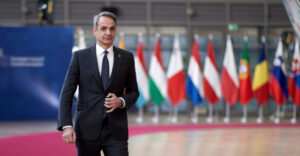
Greek Prime Minister Kyriakos Mitsotakis is putting the risk that high prices could fuel populism and extremism on the agenda of today’s European Union summit. Following the introduction of measures to support heating costs, he is travelling to Brussels to call for fiscal flexibility to provide additional support to households and businesses.
“Only solutions that ultimately deliver tangible results can close the door to dead-end populism and extremism of every kind,” he stressed in Larissa on Wednesday. His remark that “simply calling on people to turn off the lights or consume less petrol is clearly not enough” also set the tone for his intervention at the crucial European Council meeting.
Additional support beyond spending limits
The political warning comes with a specific demand: governments should be able to allocate more resources to tackle high energy prices without running up against EU spending limits. As the prime minister explained, the rules constrain member states even when they have additional funds available that they could put to use.
The flexibility Greece is seeking would allow additional measures to complement national initiatives. Mitsotakis has also insisted that these measures must be “targeted and temporary”. The Greek intervention will place particular emphasis on small and medium-sized enterprises and the needs of households ahead of a difficult winter, while maintaining fiscal stability.
“When circumstances change, political responses must change too,” he is expected to reiterate. He also believes that other European countries will ask the Commission to introduce specific support measures.
An unresolved issue
For now, however, Brussels is keeping its options open on the next steps. According to information obtained by protothema.gr, the European Commission is referring to public statements by Valdis Dombrovskis and the possibility of further discussion at the summit, without making any specific commitment to additional flexibility. Similarly, no new decision has emerged on using additional VAT revenue to fund measures outside spending limits.
The scope for special flexibility on energy security remains narrow. According to the same information, the framework outlined by the Commission covers energy transition and resilience measures, excluding subsidies for fossil fuels, cuts to fossil fuel taxation and support to offset high energy prices. Such measures can be introduced at national level, but only within each country’s fiscal limits.
The green transition amid higher energy costs
In Brussels, Mitsotakis will also raise the question of how much pressure the European economy can withstand at the same time. Climate policy was designed during a period of relatively low energy costs. Today, industry is paying more for energy and is expected to finance its transition, while governments remain bound by fiscal constraints.
His remarks in Larissa came against the backdrop of an investment supporting the green transition itself. The prime minister linked energy storage to making better use of renewable energy sources and reiterated the target of reducing electricity prices by at least 30% by 2030. At the same time, he stressed that fossil fuels would continue to play a significant role during the transition.
His warning to industry was direct. “Either we need to ease off the accelerator a little,” he said, calling for time to adapt and economically viable decarbonisation technologies. Otherwise, he argued, Europe risks pursuing a leading position in climate neutrality while destroying millions of jobs along the way.
In shipping, higher costs are also passed on to the prices of goods. Rapid decarbonisation accompanied by additional charges, without clear technological solutions yet available, would ultimately burden consumers, he stressed.
No cuts to cohesion or agricultural policy
The Greek intervention will also address the completion of the European energy market and the development of interconnections, the implementation of the Letta and Draghi reports, and faster simplification of legislation.
Regarding the next EU budget, Athens will insist that new priorities in defence, security, research and innovation cannot be financed through cuts to cohesion policy and the Common Agricultural Policy. Greece remains open to new EU own resources, provided the cost does not disproportionately burden less developed economies.
As for national support measures, Mitsotakis has set a clear limit. “We will exhaust the available fiscal margins,” he pledged, ruling out exceeding them. He linked fiscal credibility to borrowing costs for both the state and businesses, recalling how dearly Greece has paid for the crises of the past.
Alexandros Gennimatas makes his debut
The summit also marks Alexandros Gennimatas’ debut as a member of the Greek team. The experienced diplomat is taking up the role of its representative, with Greece’s upcoming EU presidency on the horizon. His first appearance in the new capacity coincides with a demanding European agenda, as the energy crisis and the scope for economic support converge with negotiations over the next EU budget.
Ask me anything
Explore related questions




