





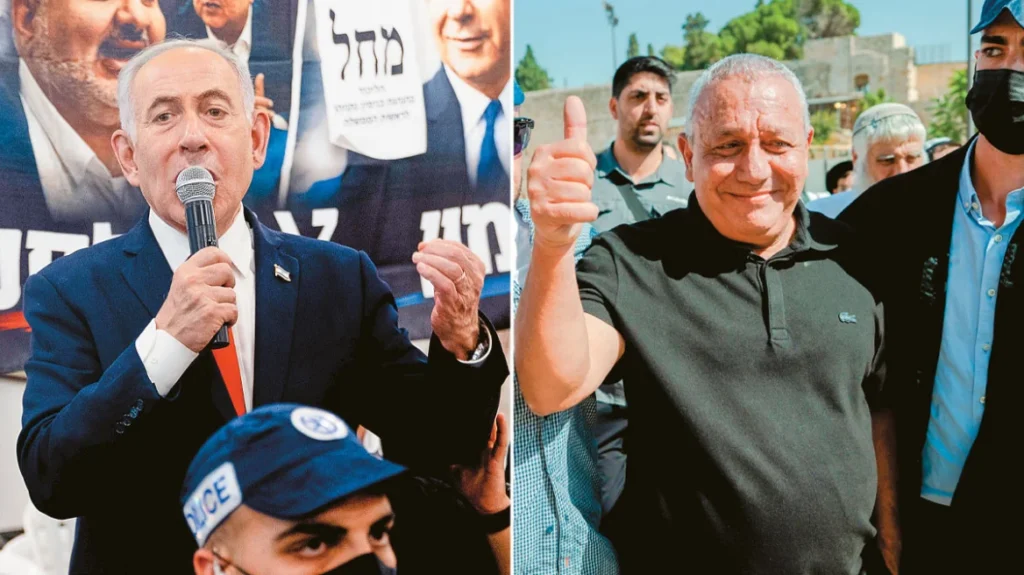
Polling stations opened in Israel today, Tuesday, October 27, in an election that could bring Benjamin Netanyahu’s long-standing dominance to an end without necessarily resulting in a change of government. Israelis are heading to the polls after three years of war, successive military operations and a profound domestic crisis that began with Hamas’s October 7, 2023, attack.
The latest pre-election polls gave a lead to former Israel Defense Forces chief Gadi Eisenkot. However, finishing first does not automatically mean being able to form a government. Despite suffering significant political damage, Netanyahu retains a solid electoral base and, crucially, a network of political alliances that allows him to pursue another term in power even if Likud does not emerge as the largest party.
Netanyahu is seeking another term against an opponent who understands Israel’s national security establishment better than many others. Eisenkot has managed to attract a significant share of voters who want a change of leadership without a radical reassessment of the country’s security strategy. His rise does not represent a general shift in Israeli society toward the left. Rather, it reflects an effort to find a different form of government led by figures from the same military and political establishment that has shaped Israeli politics for decades.
This very dynamic explains why the polls point to an election with a potential winner but no clear path to forming a government. Eisenkot’s party could emerge in first place, while Likud could retain a particularly resilient electoral base. Yet, according to most surveys, neither of the two main political blocs has the 61 seats needed for an absolute majority in the 120-member Knesset.
Israel therefore risks finding itself in a familiar political deadlock, this time with considerably greater regional and international stakes.
A solid electoral base
A poll published by Israel’s Channel 12 on October 19 gave Eisenkot’s Yashar party 24 seats, Netanyahu’s Likud 21 and former Prime Minister Naftali Bennett’s B’Yachad (“Together”) 14.
The remaining parties in the Zionist opposition bloc collectively secured 55 seats, compared with 51 for parties supporting Netanyahu. The remaining 14 seats were divided between the two Arab political formations.
Asked who would make the most suitable prime minister, 45% favored Eisenkot, compared with 33% for Netanyahu. This gap reflects the former general’s personal momentum, but does not automatically translate into a governing majority.
Netanyahu’s political resilience is perhaps the most significant feature of Israel’s electoral history over the past several decades. Despite the wear and tear of his lengthy tenure, criticism over responsibility for the October 7 attacks, his legal troubles and persistent conflicts within his government, he retains a solid electoral base and a political mobilization machine that none of his opponents has managed to decisively weaken.
His electoral strategy rests on two main objectives. The first is to turn the election from a judgment on his record in government into a choice over who can guarantee Israel’s security. The second is to portray a potential Eisenkot government as politically unstable, dependent on parties with different ideological backgrounds and possibly reliant on support from Arab lawmakers.
Netanyahu followed this approach in remarks on Thursday, October 22, when he framed the election as a choice between himself and Donald Trump, on the one hand, and Eisenkot and Mansour Abbas, leader of the Ra’am party, on the other.
This framing does not reflect Eisenkot’s public commitments: he has ruled out including Arab parties in a government under his leadership. Nevertheless, it represents a calculated political attempt to rally conservative voters around the prospect of a government that Netanyahu portrays as dangerous to Israel’s security and national identity. Support from the American president provides an additional political advantage.
Eisenkot has built his political profile around his military leadership experience, his personal credibility on national security issues and the need to restore public trust in state institutions. His military background allows him to challenge Netanyahu without appearing to represent a political line that questions Israel’s fundamental positions on Gaza, Hamas and Iran.
The alliances
This is also the main explanation for Eisenkot’s rise in the polls. Part of Israeli society wants Netanyahu to leave office without wanting a relaxation of military policy. Eisenkot is appealing precisely to these voters, proposing a change of personnel and political style.
His problem begins with the composition of the opposition. Bennett, a former prime minister and leader of B’Yachad, is a necessary but not necessarily easy coalition partner. Avigdor Lieberman, head of Yisrael Beiteinu (“Israel Our Home”), maintains firmly right-wing and nationalist positions, while Yair Golan, leader of The Democrats, represents the progressive wing of Israeli politics.
One of the most critical factors in the election is turnout among Israel’s Arab minority, which accounts for approximately 21% of the country’s population. Reuters highlighted the importance of Arab voter participation in an analysis, with pollsters estimating turnout at around 63%, up from the 2022 election.
Stronger Arab representation could make it even harder to assemble a right-wing majority by reducing the number of seats available to the other political formations. It would not, however, automatically strengthen Eisenkot’s ability to form a government.
This is the central paradox of the election. Arab parties could help prevent Netanyahu from returning to power with a parliamentary majority, but a potential numerical advantage for a broader opposition would not, by itself, be enough to form a new government.
The position of the ultra-Orthodox parties Shas and United Torah Judaism, which are traditional Netanyahu allies, is equally decisive.
The question of military service for ultra-Orthodox men has become one of Israel’s deepest social controversies. Maintaining exemptions from conscription has provoked resentment in a society where reservists have shouldered a particularly heavy share of military operations since October 2023.
For the ultra-Orthodox, preserving the existing arrangements for religious study is a fundamental political demand. For a large part of the rest of the population, the unequal distribution of military obligations has become an issue of social justice. This divide will be one of the first major tests for any new government.
The differences
The possibility of political change in Israel is attracting considerable interest in the West. However, an Eisenkot government would not necessarily mean a substantial reversal of Israeli policy on the most important security issues.
This is also the central conclusion of a Reuters analysis published on October 22, which examined the differences between the two main contenders for power regarding the Palestinian question.
Both Netanyahu and Eisenkot oppose the establishment of an independent Palestinian state under current conditions. Both believe Hamas cannot continue to exist as a military or political force in Gaza, and both accept the need to maintain decisive Israeli control over security matters.
The more substantial differences concern the West Bank and the way government policy is implemented. Netanyahu has allowed a significant expansion of Jewish settlements, while his far-right coalition partners openly advocate annexing occupied Palestinian territories.
Eisenkot does not reject settlement activity altogether, but he takes a different position on unauthorized settlements and settler violence. He has also opposed the plan to develop the E1 area, which is considered particularly important to the geographical continuity of the West Bank.
In Gaza, Eisenkot supports replacing Hamas’s rule within a defined timeframe. However, he has not committed to an immediate and complete withdrawal of Israeli forces before the organization is disarmed.
Similar continuity should be expected in Israeli policy toward Iran. Confronting Tehran is not an exclusive priority of Netanyahu’s government; it is a central component of Israel’s national security strategy, shared by a broad section of the country’s political and military establishment.
The real difference under an Eisenkot government would most likely be felt more in the functioning of institutions, relations with Western partners and efforts to limit the influence of the most extreme political forces.
The scenarios
Based on the latest polling picture, three scenarios are attracting the greatest political attention.
The first is Netanyahu remaining in power through a new right-wing governing coalition.
The second is Eisenkot becoming prime minister through a broad coalition agreement with Bennett, Lieberman and Golan.
The third is a continuation of the political deadlock. This possibility is particularly significant because Netanyahu could remain in office in a caretaker capacity until a new government is formed.
Even if the outcome is ultimately determined by the distribution of parliamentary seats, the historical significance of this election lies in its role as the first comprehensive electoral assessment of the period following October 7, 2023.
For a substantial section of the Israeli public, the central unresolved political question concerns responsibility for failing to prevent the Hamas attack and for managing the war that followed.
Netanyahu continues to face criticism for remaining in power after what has been described as the greatest failure of Israel’s security establishment in decades.
The Associated Press has noted that the experience of October 7 continues to shape voters’ attitudes. Survivors of the attacks, victims’ families and citizens who participated in military operations have been at the center of public debate.
Yet the same historical experience produces different political conclusions. For some voters, it strengthens the demand for a change of leadership. For others, it justifies support for an even tougher security policy.
Three years after October 7, Israel is being called upon to choose not only its next prime minister but also the political configuration that will govern the country during a period of persistent uncertainty.
The result will determine Netanyahu’s place in the country’s next political chapter, as well as the extent to which a change of leadership can genuinely alter Israel’s course.
Ask me anything
Explore related questions




