





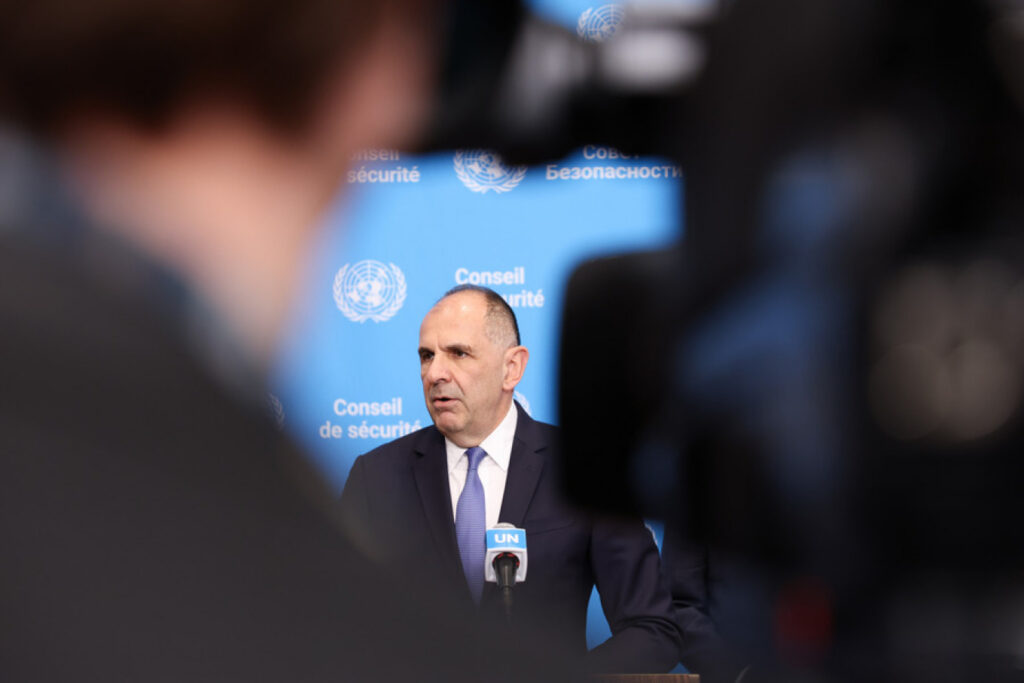
A coalition of 72 countries and the European Union has reaffirmed its commitment to protecting women and girls affected by armed conflicts and ensuring their meaningful participation in peacebuilding efforts, in a joint statement delivered by Foreign Minister George Gerapetritis at the United Nations Security Council on Tuesday, 27 October.
The declaration was presented during an open debate on the Women, Peace and Security agenda, emphasising the need to translate international commitments into practical measures that strengthen women’s rights, security and leadership in conflict resolution.
Greece is among eight Security Council members that have endorsed the Shared Commitments on Women, Peace and Security, alongside Colombia, Denmark, France, Latvia, Liberia, Panama and the United Kingdom.
Women must play a greater role in peace negotiations
At the heart of the declaration is a call for women’s full and meaningful involvement in peace processes and decision-making at every level.
“We call for the full, equal, meaningful and safe participation and leadership of women in peace processes and decision-making at all levels,” the joint statement emphasised.
The signatories endorsed the UN Secretary-General’s proposal that women should account for at least one-third of participants in peace negotiations led or co-led by the United Nations.
They stressed that female representation must go beyond symbolic participation, with women assuming substantial roles as negotiators, mediators and peacebuilders.
The declaration also called for the systematic integration of the Women, Peace and Security agenda into UN peacekeeping operations, including during transitional periods and the withdrawal of missions.
Particular emphasis was placed on maintaining the presence of women’s protection advisers and gender advisers to ensure that progress is sustained even as peacekeeping operations are scaled back.
Strong condemnation of sexual violence and calls for accountability
The participating countries highlighted the disproportionate impact of armed conflicts on women and girls, urging all parties involved in hostilities to implement effective protection measures.
They reaffirmed their commitment to upholding fundamental human rights and freedoms in accordance with international law, including international humanitarian law and international human rights law.
“We condemn all violations and abuses of the human rights of women and girls and remain committed to ending impunity by ensuring accountability for all perpetrators,” the declaration stated.
The signatories supported the development of targeted criteria for inclusion on UN sanctions lists, while acknowledging the important work of the International Criminal Court in investigating and prosecuting serious international crimes.
They also welcomed the establishment earlier in 2026 of a network dedicated to prosecuting conflict-related sexual violence.
The 72 countries and the EU condemned in the strongest possible terms all incidents of conflict-related sexual violence, as well as every form of sexual and gender-based violence.
They called for comprehensive, life-saving assistance for victims and survivors, including sexual and reproductive healthcare, psychological support and other essential services.
Protection for female journalists and human rights defenders
The statement recognised the indispensable contribution of civil society organisations, female journalists, human rights defenders and women working to promote peace.
The signatories pledged to protect them against reprisals, threats and intimidation designed to silence their voices, particularly in conflict-affected regions where advocacy for human rights can carry significant personal risks.
Another priority is securing predictable, adequate and sustained funding for the Women, Peace and Security agenda.
The countries called for increased financial support through both the UN system and official development assistance provided by individual donor governments.
They also encouraged member states to adopt dedicated National Action Plans, backed by sufficient resources and mechanisms to ensure effective implementation.
Artificial intelligence and the threat of online targeting
The declaration also addressed the growing influence of emerging technologies, including generative artificial intelligence, on women’s participation in public life.
The signatories argued that technological advances should be harnessed to empower women and expand their opportunities for leadership and political engagement.
At the same time, they rejected the misuse of such technologies to target women, particularly those holding leadership positions, or to spread hate speech and intimidation.
The inclusion of artificial intelligence in the declaration reflects growing international concern about technology-enabled harassment and the potential consequences for women’s safety and participation in democratic and peacebuilding processes.
‘You are not alone’: Message to women suffering the consequences of war
The declaration concluded with a message of solidarity addressed directly to women and girls experiencing the devastating consequences of armed conflict.
“You are not alone,” the signatories declared, reaffirming their determination to move beyond political commitments and deliver tangible improvements in women’s safety and rights.
“We, as Member States, remain committed to translating the commitments of the Women, Peace and Security agenda into concrete action to protect and improve the situation of all women and girls,” the statement concluded.
The initiative brought together countries from across Europe, Asia, Africa, the Americas and Oceania.
Among the signatories were Cyprus, Germany, France, the United Kingdom, Japan, Canada, Australia, Ukraine, the United Arab Emirates and the State of Palestine, alongside the European Union.
The joint declaration places renewed emphasis on women’s participation in peace negotiations, accountability for conflict-related sexual violence and the international community’s responsibility to provide practical and sustained protection for women and girls affected by war.
Ask me anything
Explore related questions




