





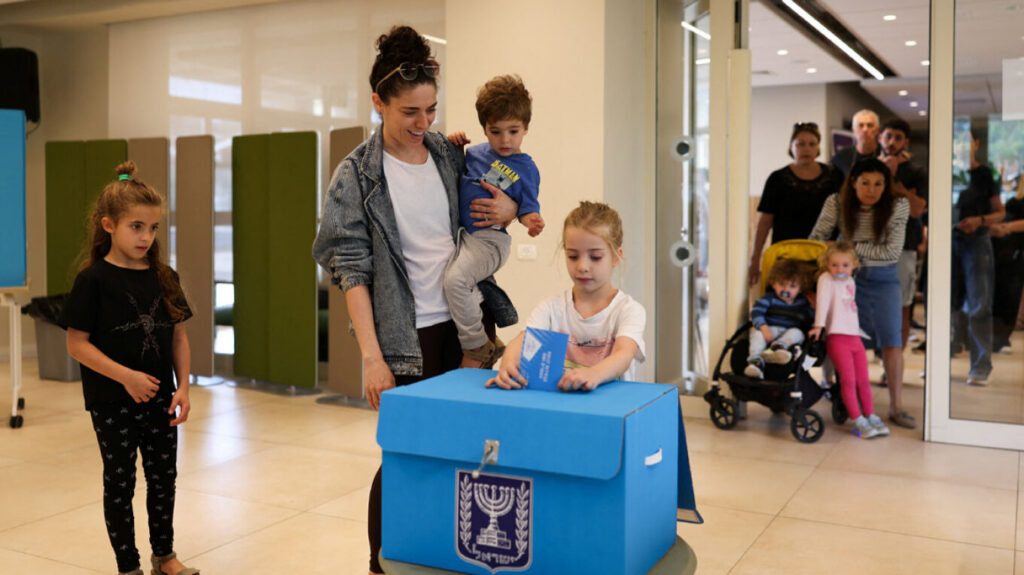
Israel’s general election has been marked by extraordinary voter turnout, escalating political tensions and allegations of electoral interference, as Israeli Prime Minister Benjamin Netanyahu fights to retain power against a fragmented opposition led by former military chief Gadi Eisenkot.
By 6pm on Tuesday, October 27, turnout had reached a historic 66.7%, according to figures reported by The Jerusalem Post, with nearly 4.9 million Israelis having cast their ballots. The number of people voting had already surpassed the total recorded throughout the previous election in 2022.
With polling stations scheduled to close at 10pm, Netanyahu’s Likud party and several of its political allies have requested an extension of voting hours, arguing that heavy queues could prevent some supporters from exercising their democratic rights.
The request has provoked a fierce response from Eisenkot’s Yashar party, which accused Netanyahu of attempting to lay the groundwork for questioning the legitimacy of the election result.
Meanwhile, Reuters reports that Netanyahu has intensified efforts to mobilise his supporters by warning of unusually high turnout among Arab voters, prompting accusations of racism and incitement from Arab political leaders.
The developments have heightened tensions surrounding an election widely regarded as a referendum on Netanyahu’s leadership following the Hamas-led attacks of October 7, 2023, and the subsequent wars that have reshaped Israel’s political landscape.
Netanyahu’s allies demand extension of voting hours
The controversy over the closing time of polling stations emerged as turnout continued to exceed expectations throughout Tuesday.
According to The Times of Israel, Likud formally requested that the Central Elections Committee extend voting beyond the scheduled 10pm deadline.
The ultra-Orthodox Shas party, led by Aryeh Deri, and Ofer Winter’s People of Israel party subsequently supported the request, citing heavy congestion at polling stations.
Shas argued that the extension was necessary to ensure that voters waiting in queues were not deprived of their right to cast a ballot.
Winter’s party also reported unusually long queues at polling stations where it expected substantial support.
However, the Central Elections Committee had already clarified that anyone arriving before the official closing time would be allowed to vote, even if the process continued beyond 10pm.
The distinction is significant because the existing arrangements already protect voters who have reached their polling stations before the deadline.
Eisenkot’s Yashar party strongly opposed a general extension, insisting that no exceptional circumstances had arisen to justify changing the voting timetable.
As reported by The Times of Israel, the party accused Netanyahu of attempting to prepare the political ground for subsequent challenges to the election’s integrity.
The Central Elections Committee has the authority to approve extensions in exceptional circumstances, although such measures are normally restricted to specific polling stations rather than being applied nationally.
At the time of the latest verified reports, no final decision on the nationwide extension request had been independently confirmed.
Netanyahu warns of Arab voter surge as accusations of racism intensify
The political confrontation has also been fuelled by Netanyahu’s increasingly urgent appeals to his supporters, particularly in response to reports of strong participation in Arab communities.
Reuters reports that the prime minister warned his political base that Arab voters were heading to polling stations in large numbers and urged Likud supporters to counter their mobilisation.
In one campaign message, Netanyahu claimed that his opponents were attempting to steal the election, without providing evidence of systematic electoral fraud.
According to Reuters, Likud campaign vehicles also travelled through Jerusalem broadcasting the Muslim call to prayer and warnings about Arab voter mobilisation.
Arab politicians condemned the tactics as racist and accused the prime minister of exploiting ethnic divisions to increase support among Jewish voters.
The Times of Israel reports that Netanyahu made repeated appeals through social media, including a live appearance on TikTok, urging supporters to abandon other activities and vote for Likud.
His campaign has portrayed the possibility of an opposition victory supported by Arab parties as a threat to the country’s political direction.
The approach recalls previous Israeli election campaigns in which Netanyahu warned supporters about high Arab turnout, a tactic that has repeatedly attracted criticism from political opponents.
For the opposition, however, increased participation by Arab citizens could be decisive in preventing Netanyahu’s right-wing and religious allies from securing a parliamentary majority.
The challenge for Eisenkot is that he has ruled out forming a formal coalition with Arab political parties, complicating the arithmetic of a potential alternative government.
Reports of interference at polling stations
Alongside the heated campaign rhetoric, a series of allegations involving electoral interference has emerged throughout the day.
The Times of Israel reports that several parties, including Yashar, Naftali Bennett’s Beyahad, Avigdor Liberman’s Yisrael Beiteinu and the Arab Ra’am party, have submitted complaints concerning suspected irregularities.
The allegations include missing or damaged ballot papers, suspected attempts to interfere with voting and concerns about activities at certain polling stations.
According to The Guardian, Yashar complained that some of its ballot slips had been removed or damaged, while Bennett’s party reported concerns about the possible use of an application to monitor voters in northern Israel.
The newspaper also cited Haaretz reporting on claims that ballot papers belonging to a party representing ultra-Orthodox voters had been concealed or removed from polling booths.
Separately, The Jerusalem Post reported that a Yisrael Beiteinu campaign stand had been vandalised in Netanya, with the party alleging that supporters of Itamar Ben-Gvir’s Otzma Yehudit were responsible.
The allegations have not all been independently substantiated.
Importantly, the Central Elections Committee has said that it has found no evidence of systematic manipulation of ballot papers, although individual complaints are being investigated and addressed.
Police also confirmed the arrest of three individuals associated with the Arab Ra’am party on suspicion of attempting to bribe voters.
The authorities have not established that the incidents represent a coordinated attempt to influence the national result.
Historic turnout across Israel
Participation has been exceptionally high since polling stations opened at 7am.
According to Reuters, turnout reached 16.7% during the first three hours, the fastest early pace recorded since 1981.
By 4pm, the figure had climbed to 55.7%, compared with 47.5% at the corresponding stage of the 2022 election.
The upward trend continued into the early evening, with the Central Elections Committee reporting nearly 4.9 million votes by 6pm.
In Tel Aviv-Jaffa, 277,751 people had voted by that time, representing 58.6% of eligible voters. Jerusalem recorded 252,038 voters, or 55.3%, while participation in Haifa reached 145,951, equivalent to 54.5%.
Turnout was also strong in Rishon LeZion, at 61.3%, Petah Tikva, at 63.1%, and Ramat Gan, at 61.9%.
The predominantly ultra-Orthodox city of Bnei Brak registered 64.3%, while Modi’in-Maccabim-Re’ut recorded 70.1%.
Several smaller communities reported even higher participation, including Timor at 91.6%, Yuval at 91.5% and Sorashim at 90.1%.
The figures underline the intensity of political mobilisation across Israeli society, although the geographical differences make it difficult to establish which political camp is benefiting most.
High turnout could strengthen Netanyahu’s coalition in traditionally conservative and religious communities, but it may also reflect a determination among opposition supporters to secure a change of government.
Knife incident involving opposition leader Yair Golan
Election day was also marked by a security incident involving Yair Golan, leader of the Democrats party.
According to The Times of Israel, police arrested a man who approached Golan in Tel Aviv’s Mesila Park while carrying a knife.
The Democrats described the episode as an attempted stabbing, but police disputed that characterisation, confirming the arrest while stating that an attempted attack had not been established.
The incident added to concerns about political tensions during an increasingly confrontational election campaign.
A 94-year-old voter dies after casting his ballot
In a separate incident, a 94-year-old man died shortly after returning home from a polling station in Ramat Gan.
Israel Kreis had travelled to vote accompanied by his daughter before collapsing at the entrance to his apartment building.
Volunteers from the emergency response organisation ZAKA attended the scene and provided assistance to his family.
The man had reportedly insisted on exercising his democratic right despite his advanced age.
His death became one of the most poignant human stories of an election that has mobilised citizens across generations.
Fresh reports of settler violence in the West Bank
Away from the election campaign, Palestinian media reported further incidents involving Israeli settlers in the occupied West Bank.
According to reports carried by The Times of Israel, two Palestinians were injured in an alleged settler attack near Khirbet Fakit in the South Hebron Hills.
Video footage circulating online showed one of the injured men with blood on his face.
Separately, three vehicles were reportedly set alight in Umm Safa, near Ramallah, during the early hours of Tuesday. No injuries were reported in that incident.
The reports highlight the continuing tensions in the West Bank, where settlement expansion and attacks on Palestinian communities remain deeply divisive political issues.
Eisenkot promises to dismantle Hamas within 18 months
The election has also brought sharply contrasting arguments over Israel’s security policies and the consequences of the war in Gaza.
Reuters reports that Eisenkot, a former chief of staff of the Israel Defense Forces, has pledged to dismantle Hamas’s military and governing capabilities within 18 months if he becomes prime minister.
The commitment is significant because Eisenkot has criticised the conduct and results of Israel’s military campaign while maintaining that Hamas cannot be allowed to retain control of Gaza.
His position illustrates that the political contest is not simply between opposing approaches to national security.
Both Netanyahu and Eisenkot have adopted tough positions towards Hamas, but they differ over political accountability, military strategy and the ability of Israel’s existing leadership to achieve lasting security.
Netanyahu has emphasised his record in confronting Israel’s regional adversaries and expanding diplomatic relationships with Arab states.
His opponents, meanwhile, argue that the security failures surrounding October 7 demonstrate the need for a fundamental change in political leadership.
The demand for an independent national inquiry into the attacks has consequently become one of the campaign’s central issues.
Financial markets respond to the election
The exceptionally high turnout has also attracted attention in financial markets.
Reuters reports that the Israeli shekel rose to its highest level in approximately five weeks as investors assessed the potential political implications of the election.
The currency’s rise came amid expectations that a change in government could affect Israel’s fiscal priorities, diplomatic relationships and economic outlook.
However, the eventual political consequences will depend not only on which party wins the most seats but also on whether a stable government can be formed.
Years of warfare, increased defence expenditure and pressures on public finances have made economic recovery another major challenge for the incoming administration.
Final opinion polls suggest no clear majority
Despite the large numbers heading to polling stations, the final pre-election surveys suggest that neither of Israel’s principal political camps is guaranteed a parliamentary majority.
A Channel 12 poll projected 23 seats for Eisenkot’s Yashar party, 21 for Netanyahu’s Likud and 15 for Bennett’s Beyahad party.
The Democrats were projected to win 10 seats and Yisrael Beiteinu eight.
According to that survey, the opposition bloc would control 56 seats, Netanyahu’s allies 50 and two Arab political formations a combined 14.
Channel 13 offered a similar picture, allocating 54 seats to the opposition, 50 to Netanyahu’s bloc and 16 to Arab parties.
Public broadcaster Kan projected 22 seats for Yashar, 20 for Likud and 14 for Bennett’s party, again pointing to a fragmented parliament.
Not all polling organisations agreed, however.
Surveys published by Channel 14 suggested that Netanyahu’s political allies could secure as many as 64 seats, enough to retain a narrow majority.
The differences between the surveys underline the uncertainty surrounding the election, particularly given the unprecedented turnout.
Another decisive factor is the 3.25% electoral threshold.
Several smaller parties have been polling close to that level, meaning relatively minor changes in support could determine whether they enter parliament.
The exclusion of even one party could substantially alter the distribution of seats and the balance between the competing blocs.
The battle for 61 seats and the prospect of prolonged uncertainty
Israel’s electoral system makes coalition governments the norm rather than the exception.
The Knesset has 120 seats, and a governing coalition generally needs the support of at least 61 members to command a parliamentary majority.
Even if Eisenkot’s Yashar emerges as the largest party, that would not automatically give him the ability to form a government.
His potential coalition partners span the political spectrum, from liberal and centre-left parties to more conservative groups united principally by opposition to Netanyahu.
The role of Arab parties could prove particularly important, especially if neither of the two main blocs secures enough seats to govern independently.
Reuters has reported that Arab political leaders hope strong voter participation will increase their influence over the next government’s formation, even though Eisenkot has rejected a formal coalition with Arab parties.
A government supported from outside by Arab lawmakers remains one possible parliamentary scenario, although considerable political obstacles stand in its way.
For Netanyahu, the route to another term in office depends on maintaining the support of religious and nationalist parties while ensuring that smaller right-wing formations do not fall below the electoral threshold.
If neither leader can assemble a workable coalition, Israel could face weeks of negotiations, a prolonged period of caretaker government or potentially another election.
The first exit polls are expected after voting concludes at 10pm, although any continued voting by people already in queues could delay their publication. Official results and the subsequent process of government formation may take considerably longer.
Three years after the October 7 attacks, the war in Gaza and wider regional confrontations, Israeli voters are delivering a verdict not only on Netanyahu’s political future but also on the country’s security policies, democratic institutions and political direction.
Whether the historic turnout produces a decisive change of government or another period of instability will depend on the distribution of the 120 parliamentary seats — and on the alliances that emerge once the votes have been counted.
Ask me anything
Explore related questions




