





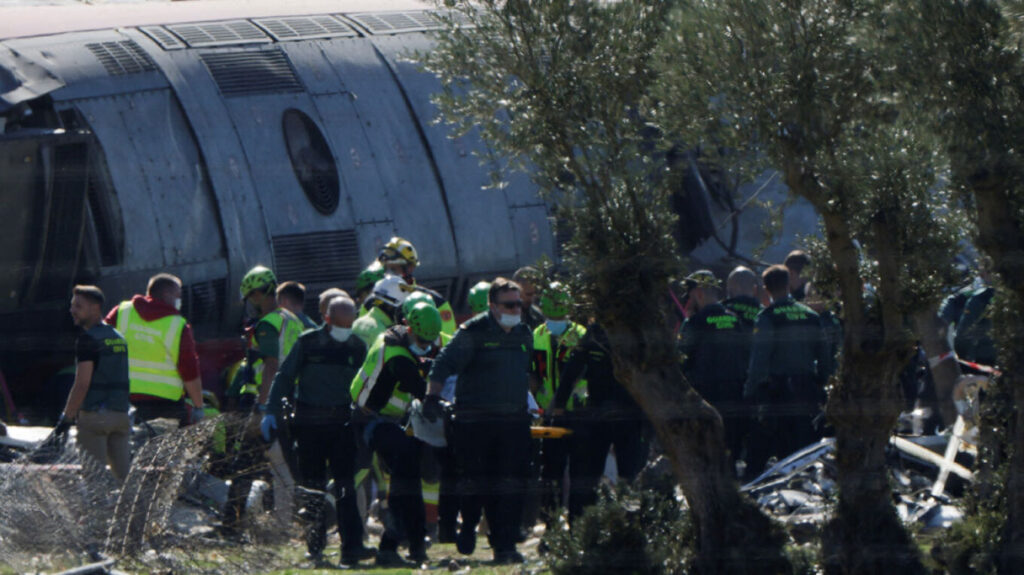
Human error is emerging as the most likely cause of the deadly train collision near Toledo, Spain, which has claimed 68 lives, according to sources at the Spanish Ministry of Transport cited by the newspaper ABC.
Preliminary assessments suggest that the disaster may have resulted from a railway employee’s failure to warn that two trains were on the same track following a malfunction in the signalling system.
The employee, reportedly a technician working for Spain’s state-owned railway infrastructure operator Adif, was said to have been repairing a fault in the central signalling system.
According to the sources, the technician should have warned an Iryo express train, which had been temporarily brought to a halt, that a high-speed AVE train was travelling along the same track.
The findings remain preliminary, and the circumstances surrounding the collision have yet to be fully established.
SPAIN TRAIN DISASTER: 64 DEAD AS MINISTER POINTS TO CONTROL CENTRE DECISION At least 64 people have died in Spain’s deadliest rail disaster since 2013. The transport minister says an “inexplicable” control-centre decision led to the collision after a computer failure halted trains. Iryo says its train was struck from behind by a Renfe train.
— Subodh Kumar (@kumarsubodh_) October 28, 2026
Transport minister questions decision to allow train to continue
Spain’s Transport Minister, Óscar Puente, said there had been a safety failure in the train control system and described the decision by railway operators to allow the AVE train to continue its journey as “inexplicable”.
Puente questioned why the train had been authorised to proceed before the signalling fault had been rectified, particularly as he said there had been more than enough time to address the problem before the collision.
According to the minister, the signalling system malfunctioned at approximately 8.30am, with permission to resume operations issued just six minutes later.
The AVE train subsequently travelled approximately 25 kilometres before colliding with the Iryo service.
Government sources separately told the Spanish newspaper El País that human error by an Adif operator attempting to resolve a malfunction in the main signalling system was the most likely explanation for the disaster.
#Mundo #Europa 🇪🇸💥🚅 Al menos 64 muertos y 80 heridos deja un choque de trenes en Toledo, #España https://t.co/m8DKb4xfxw
— URBANO📍Noticia Puebla y Tlaxcala (@urbano_noticias) October 28, 2026
How the signalling failure may have led to the collision
Spain’s railway traffic management safety system is fully automated under normal operating conditions. However, as is standard railway practice internationally, it can be switched to manual operation in the event of a technical failure.
That procedure was reportedly activated on the morning of 28 October 2026 after the signalling system developed a fault, bringing both the AVE and Iryo trains to a halt.
When the automatic controls were overridden and responsibility for managing traffic passed to a duty operator, a mistake — or potentially a sequence of mistakes and omissions – appears to have occurred.
Investigators are now examining whether the transition to manual operation allowed the two trains to occupy the same section of track without the necessary warning being issued.
Adif, AVE and Iryo have not yet released detailed information establishing the cause of the collision. Their immediate priority remains the emergency response and rescue operations.
Adif has confirmed that the trains involved were operated by Renfe and Iryo, with both services travelling on the Madrid–Seville route.
The collision occurred near Urda, in the province of Toledo, approximately 140 kilometres south of Madrid.
According to local media reports, the Renfe train was carrying 397 passengers, while approximately 150 people were travelling aboard the Iryo service.
Reuters and Deutsche Welle report on the initial sequence of events
International news organisations, including Reuters and Deutsche Welle (DW), have been examining the information emerging from the Spanish authorities to establish how the collision occurred.
According to their reports, Adif instructed an Iryo-operated train to stop because of the malfunction affecting the automatic signalling system.
DW also spoke to Nick Kingsley, director of the specialist publication Railway Gazette International, who highlighted that Wednesday’s disaster was the second fatal accident involving Spain’s high-speed railway network in 2026.
Kingsley described the collision as “a black day for the Spanish railway industry” and said it would raise profound questions about how such an accident could have occurred.
Railway expert raises questions over safety systems
Although he cautioned that it was too early to speculate about the precise causes, Kingsley stressed that the fundamental purpose of high-speed railway safety systems was to prevent trains from colliding under any circumstances.
“The fundamental point about high-speed railways is that safety systems and specialised signalling and train control circuits are designed to ensure that trains do not collide, something that should never happen,” he told DW.
He explained that preventing collisions was the essential principle underpinning railway automation.
Kingsley also suggested investigators would examine whether there were similarities between the latest disaster and the fatal accident that occurred in January.
He said the two incidents were particularly disturbing given the safety record previously associated with high-speed rail.
According to Kingsley, more than 30 years had passed without a fatal accident on a high-speed railway network anywhere in the world, making the occurrence of two such disasters in the same country within a single year particularly alarming.
The investigation into Wednesday’s collision remains at an early stage, with authorities yet to establish definitively whether an individual error, failures in operating procedures or a combination of factors caused the crash.
Ask me anything
Explore related questions




