





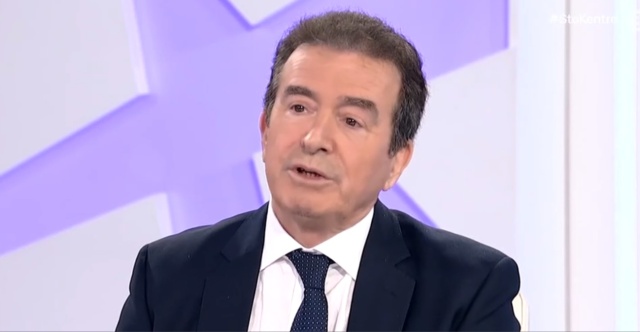
Greek Minister of Citizen Protection Michalis Chrysochoidis has revealed that investigations into alleged tax fraud involving the Pizza Fan restaurant chain and Horiatiko bakery chain have been under way for approximately 18 months, with authorities also examining the possible involvement of state officials.
Speaking on ERTnews programme Sto Kentro, Chrysochoidis clarified that the investigations concern two separate cases and are being conducted under the supervision of the relevant prosecutor.
He said police had spent months investigating the alleged illegal financial activities and that anyone against whom incriminating evidence emerges would be referred to prosecutors.
Asked whether public officials could be implicated, the minister declined to rule out the possibility, stressing that the investigation would extend to anyone linked to the alleged offences by evidence.
He also revealed that several other investigations are ongoing, beyond the cases involving the two well-known chains.
‘A disorganised state cannot dismantle organised crime’
Asked how alleged tax fraud involving businesses such as Pizza Fan and the Horiatiko bakery could have escaped effective scrutiny for years, Chrysochoidis argued that tackling complex criminal networks requires a properly organised state.
“A disorganised state cannot dismantle organised crime,” he said, pointing to the establishment of the Directorate for Combating Organised Crime, commonly known as the “Greek FBI”.
“That is precisely why this service was created,” he added, noting that Greece had previously lacked a comparable mechanism.
The minister explained that establishing the directorate required extensive legal preparation to develop the institutional framework underpinning its operations.
He also highlighted its cooperation with the Independent Authority for Public Revenue (AADE) and the Anti-Money Laundering Authority in investigating financial crime.
‘The Greek FBI was my personal vision’
Chrysochoidis described the creation of the Directorate for Combating Organised Crime as a personal ambition and a strategic political objective.
He said implementation began following his return to the Ministry of Citizen Protection approximately two years ago.
“Establishing the Greek FBI was my vision,” he said, arguing that the new service shares certain characteristics with its American counterpart.
According to the minister, the directorate is staffed by experienced, specially trained officers selected from the Hellenic Police, who undergo annual performance assessments.
Its workforce comprises approximately 1,200 officers, including 1,000 based in Athens and 200 in Thessaloniki.
He also announced the inauguration of a new unit in Crete, staffed by 100 police officers.
More than 3,250 arrests and 259 criminal organisations dismantled
Presenting the directorate’s record over its two years of operation, Chrysochoidis said its results demonstrated the effectiveness of the new service.
According to the figures he provided:
- 5,459 people have faced criminal charges.
- 3,254 people have been arrested.
- 814 people have been remanded in custody.
- 259 criminal organisations have been dismantled.
The minister described the directorate as a highly capable and effective law enforcement body.
‘Security is a constitutional right for every citizen’
Addressing concerns that the government’s emphasis on law and order could result in excessive policing, Chrysochoidis insisted that public safety is both a fundamental social good and a constitutional right.
“Security is a great public good and a constitutional right for all citizens,” he said.
He argued that the true measure of security is whether people can return home late at night without fear.
He referred particularly to young people returning home at one or two in the morning, saying they should feel completely safe as they approach their neighbourhoods and homes.
“If we achieve that, then we will have succeeded in establishing security in everyday life and social peace,” he added.
Protests, tear gas and the November and December anniversaries
Turning to public demonstrations, Chrysochoidis stressed that the police have a duty to protect the right to peaceful assembly rather than disperse protests.
He acknowledged that officers sometimes use tear gas and that incidents occur which the authorities would prefer to avoid.
However, he argued that police must also protect demonstrators, officers and private property, particularly when small groups engage in violence during otherwise peaceful gatherings.
The minister expressed confidence that serious disturbances would not occur during demonstrations marking the November anniversary of the Athens Polytechnic uprising and the December anniversary of the killing of Alexandros Grigoropoulos.
He said his assessment was based on the belief that the overwhelming majority of participants intended to demonstrate peacefully.
He added that the small number of individuals who repeatedly attempt to cause disturbances were “under control and surveillance”.
Kasidiaris gathering: ‘It would have been illegal for police to cancel it’
Chrysochoidis also addressed the gathering organised by Ilias Kasidiaris at a hotel in Thessaloniki on October 28, explaining why the authorities had not prohibited the event.
According to the minister, police initially sought judicial intervention to prevent the gathering, but the president of the Thessaloniki Court of First Instance determined that an event held inside a private venue could not be prohibited on those grounds.
“It would therefore be illegal for the police to cancel it,” Chrysochoidis explained.
He suggested that the relevant legal provisions could be reviewed if changes were considered necessary.
The minister added that police had instead imposed a ban on public gatherings across a designated section of Thessaloniki to prevent potential clashes between opposing groups.
He said the restrictions were intended to ensure that rival demonstrators did not come into confrontation.
Ask me anything
Explore related questions




