






With just 24 hours to go before polling stations open across the United States, attention in Washington has shifted from the White House to Capitol Hill. On Tuesday, 3 November, Americans will not elect a president, but will decide how much power Donald Trump retains during the final two years of his second term. The battle for control of Congress has become a crucial political test for both the Republican president and the Democrats, who are seeking their first major electoral victory since Trump returned to power.
The picture emerging from the latest opinion polls and analyses published by major US media outlets on Sunday points to significant pressure on the Republicans. Democrats are seeking a majority in the House of Representatives, while the Senate race is being fought under different political and electoral conditions. Republicans are attempting to limit their losses by keeping their electoral base united and presenting the contest as a choice between continuing Trump’s policies and returning Democrats to positions of power.
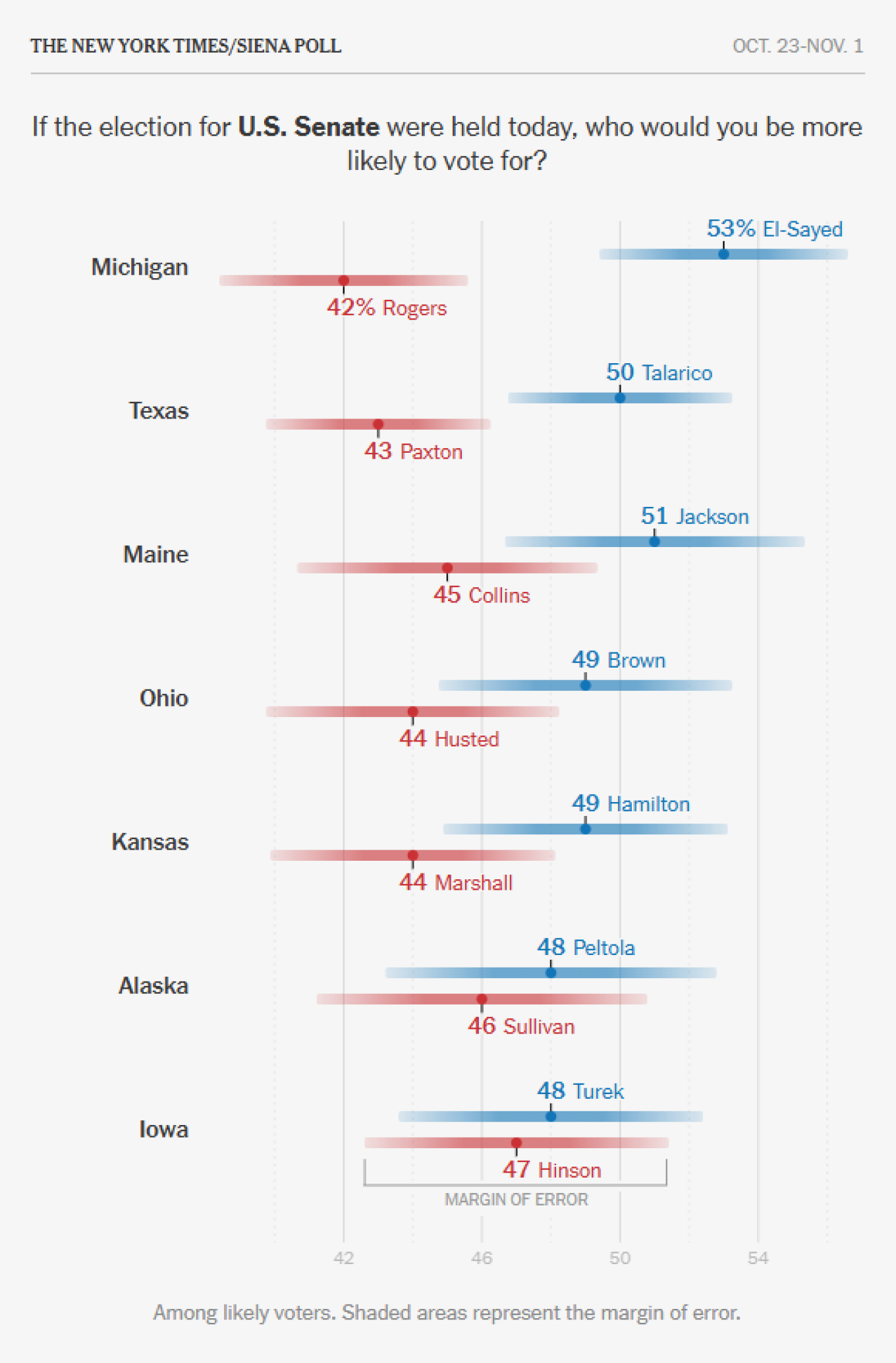
A poll published by The New York Times in the early hours of Monday is particularly noteworthy, showing Democrats leading in all seven key states that could determine the balance of power in Congress. The poll suggests that Democrats hold a significant lead in Texas, where no Democrat has been elected to the Senate since 1988, and Kansas, where the party has not won a Senate election since 1932. To secure a Senate majority, Democrats must retain all the seats they currently hold and win at least four seats currently held by Republicans.
Democratic candidates are ahead in Michigan, Kansas, Maine, Ohio, Texas and Alaska, while holding a narrow lead in Iowa.
An analysis published by the Associated Press on Sunday focused on the political consequences of the government’s policy choices and the burden they place on Republican candidates. Tariffs, the cost of living, the impact of the war in Iran and disputes over the functioning of government are central issues in the election campaign.
Democrats, however, face a challenge of their own. Dissatisfaction with the president does not automatically translate into support for their programme. Their leadership must demonstrate that it can turn opposition to Trump into sustained electoral backing, particularly in districts and states where independent voters will play a decisive role.
The economy returns to centre stage
The economy remains the most important battleground. Donald Trump returned to the White House in 2025 after staking much of his political appeal on promises of economic recovery, protecting American industry and increasing consumers’ purchasing power. His administration must now defend its policies amid concerns about the cost of everyday necessities.
Democrats have chosen to place particular emphasis on the prices of food, energy and housing, as well as healthcare costs. Their aim is to link the financial difficulties facing households to specific government decisions.
In an analysis of campaign advertising published ahead of the election, The Washington Post identified the economy as one of the dominant themes of the campaign. The two parties are trying to persuade voters with competing explanations of the causes of economic problems and the solutions they propose.
House Democratic Leader Hakeem Jeffries links the administration’s economic policies to the need to strengthen social benefits, protect healthcare and impose tighter oversight of the executive branch.
Republican House Speaker Mike Johnson, by contrast, is defending the administration’s tax and economic policies, arguing that the US economy needs continuity and stability rather than a reversal of government decisions.
The crucial point is that voting behaviour is not determined solely by overall economic indicators. Voters’ personal experiences, disposable incomes and sense of financial security influence how they assess the government. This is one of the most important battlegrounds in the final days of the campaign.
The war in Iran and the contradictions of ‘America First’
The war in Iran has added a significant dimension to the electoral equation. The handling of the conflict, its effects on international energy markets and the cost of American military involvement have become part of the domestic political debate.
Donald Trump built a substantial part of his political identity around a promise that the United States would avoid new, prolonged military interventions abroad. The course of the war gives Democrats an argument with which to challenge the consistency between his campaign pledges and the decisions taken by his administration.
Republicans, for their part, point to the need to protect American interests, ensure the security of US allies and maintain the country’s deterrent capabilities.
The debate also touches on divisions within the Make America Great Again (MAGA) movement. The slogan ‘America First’ attracted voters with differing views on the United States’ role in the world. They include both supporters of a strong military presence abroad and those opposed to prolonged American involvement overseas.
The administration must navigate these competing positions as Democrats seek to link foreign policy to its economic consequences for American citizens.
Republican strategy: Immigration, security and ideological conflict
The Republican Party’s response to the Democratic campaign centres on issues that helped fuel Trump’s political comeback: immigration, border security, crime and cultural divisions.
The president is seeking to frame Tuesday’s election as a choice between continuing his policies and a broader shift towards the progressive wing of the Democratic Party.
In this context, Republicans are using New York Mayor Zohran Mamdani’s political profile to associate Democratic candidates with positions held by the American left, even when those candidates themselves represent more moderate political tendencies.
Mike Johnson has chosen to give the contest a strong ideological dimension, warning of the consequences that a Democratic majority in Congress would have, according to Republicans.
This strategy is aimed primarily at conservative voters and sections of the independent electorate who view the progressive wing’s social and cultural positions with scepticism.
The final day of campaigning is therefore particularly important for turnout. Republicans need strong mobilisation among the voters who backed Trump in 2024, while Democrats are seeking to attract people who do not participate as consistently in midterm elections.
The polls and the battle for both chambers
In the national polling average recorded by RealClearPolling on Sunday, Democrats stood at 51.5%, compared with 43.1% for Republicans, giving the Democrats an 8.4-percentage-point lead. This measures general voting intention rather than directly predicting how congressional seats will be distributed.
All 435 seats in the House of Representatives are up for election. The narrow balance of power makes contests in districts where the gap between the two parties is small particularly important.
The Senate follows a different electoral logic. Republicans entered the election cycle with 53 seats, compared with 47 held by the Democratic caucus, including two independent senators who caucus with the Democrats.
Thirty-five Senate seats are being contested this year. To secure control of the chamber, Democrats need a net gain of four seats, since Vice-President JD Vance would cast the deciding vote in the event of a 50–50 tie.
This arithmetic explains why national polls alone cannot capture the real battle. Senate candidates are judged separately in each state, where local political dynamics can differ significantly from the national picture.
The states attracting the most attention
In Texas, the race between Democrat James Talarico and Republican Ken Paxton has taken on particular political significance. Democrats are seeking to broaden their appeal in a state with a strong conservative tradition, while Republicans are trying to keep their base united.
In Maine, Republican Senator Susan Collins faces Democrat Troy Jackson. Collins has cultivated a more moderate profile over the years than many other Republicans, making the contest a telling example of the party’s efforts to maintain its presence in states that do not consistently align with Trump’s politics.
In Michigan, attention is focused on the industrial economy, employment, trade policies and social groups affected by developments in the Middle East.
North Carolina, Ohio and Alaska are also important battlegrounds in the Senate race, while contests in states such as Iowa and Kansas are being watched for indications of the geographical reach of the electoral shift.
In New Hampshire, the candidacy of Greek-American Democrat Chris Pappas, who is running against former Republican Senator John Sununu, adds a distinct Greek dimension to the race.
The results in these states will affect not only the party composition of the Senate but also the internal balance of power within both parties.
Three possible scenarios for the day after
The first scenario would see Democrats regain control of the House of Representatives while Republicans retain the Senate.
In that case, Trump would continue to enjoy significant institutional support, but his legislative agenda would face greater obstacles. The House could launch congressional investigations, summon government officials to hearings and exert pressure through the federal spending approval process.
Hakeem Jeffries could become Speaker of the House, making him the first African American to hold the position.
The second scenario involves Democrats winning control of both chambers of Congress. Such an outcome would significantly limit the White House’s ability to advance legislation without bipartisan agreement.
The Senate would be particularly important because of its powers to confirm executive branch and judicial appointments. Democrats would also have greater scope to strengthen congressional oversight of the administration.
The third scenario would see Republicans retain control of both chambers. In that case, Trump would enjoy more favourable conditions for advancing his legislative agenda and would strengthen his position within his party.
Regardless of the final distribution of seats, Tuesday’s election will also influence the process of selecting presidential candidates for 2028. Democrats will assess the effectiveness of their opposition strategy, while Republicans will consider whether the political coalition assembled by Trump can still be mobilised when he himself is not on the ballot.
The Greek equation: Athens, Congress and Turkey
For Greece, the significance of the midterm elections extends beyond America’s domestic political contest. The composition of the new Congress will affect the balance of power on issues directly connected to Greek foreign policy and security in the Eastern Mediterranean.
Athens has long invested in maintaining bipartisan relationships with members of the House and Senate. This strategy becomes particularly important when US foreign policy is shaped by a president who places considerable emphasis on personal relationships with foreign leaders and bilateral negotiations.
US-Turkish relations are one of Greece’s principal areas of interest. The prospect of Turkey rejoining the F-35 programme, sanctions linked to its purchase of Russian S-400 missile systems, defence procurement agreements and American policy choices in the Eastern Mediterranean are all issues on which Congress has the ability to intervene.
Its influence is not unlimited. The White House continues to play a decisive role in shaping foreign policy. However, Congress can apply pressure, impose conditions on specific decisions and influence the allocation of defence funding.
The presence of politicians of Greek descent is also particularly significant.
Democrat Chris Pappas is seeking election to the Senate from New Hampshire. If elected, he would strengthen the representation of the Greek-American community in the upper chamber of Congress.
Democratic Representative Dina Titus of Nevada remains active on issues concerning Greece and Cyprus. Her membership of the House Foreign Affairs Committee takes on added significance if control of the House changes hands.
On the Republican side, Florida Representative Gus Bilirakis is one of the most consistent supporters of Greek and Cypriot positions. New York Representative Nicole Malliotakis also maintains a significant political presence within the Republican Party.
Greek-American political interest also extends to other politicians of Greek descent, including Mike Haridopolos and Jimmy Patronis in Florida.
The key issue, however, is not simply the number of Greek-American members of Congress. Their participation in the Foreign Affairs, Armed Services and Appropriations committees matters more, as does their ability to maintain channels of communication with the leadership of both parties.
A Democratic majority could lead to greater congressional scrutiny of US policy towards Turkey. It would not, however, automatically mean a tougher stance towards Ankara. Equally, a continued Republican majority would not mean that Greek positions would lack support.
Greek diplomacy has an interest in maintaining strong channels of communication with both sides, particularly at a time when US decisions on the Middle East, Turkey, Ukraine and NATO directly affect the security environment in the Eastern Mediterranean.
Washington’s day after
The outcome of Tuesday’s election will not change who occupies the White House. It will, however, determine the political conditions under which Donald Trump completes his second term.
A change of majority in the House would make negotiations with the opposition necessary again on major legislative issues. A corresponding change in the Senate would also affect appointment procedures and congressional oversight. If the current balance of power remains unchanged, Republicans would be able to pursue their governing agenda with greater institutional cohesion.
Democrats are seeking to turn dissatisfaction with the economy and the administration’s policies into a congressional majority. Republicans are trying to demonstrate that Trump’s electoral base remains strong and that his political programme continues to enjoy broad support.
For Washington, Tuesday will be the first major electoral assessment of Trump’s second presidency. For both parties, it will also mark the beginning of the political journey towards 2028.
For Greece, the result will indicate the congressional balance of power with which Athens will have to work over the next two years, at a time when developments in the Eastern Mediterranean and relations between the United States and Turkey remain crucial to Greek interests.
Ask me anything
Explore related questions




