





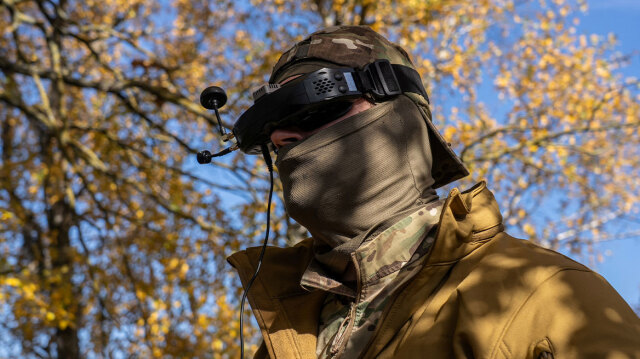
Russia’s Federal Security Service (FSB) says it has foiled a plot to eliminate Russian drone operators using FPV goggles rigged with explosive devices, accusing Ukrainian intelligence services of attempting to turn military equipment into a deadly trap. The operation bears a striking resemblance to Israel’s attack involving booby-trapped Hezbollah pagers and walkie-talkies, which caused dozens of deaths and thousands of injuries in Lebanon and Syria in September 2024.
According to the FSB, the explosive devices had been concealed inside specialized goggles used by unmanned aircraft operators to view, in real time, the footage transmitted by drone cameras. The equipment was intended for military units on the front line of the war in Ukraine.
The FSB claims that Ukrainian agents were behind the operation. They allegedly posed as pro-Russian volunteers and arranged for the booby-trapped devices to be delivered through humanitarian organizations and charities that supply Russian forces with equipment.
“The Federal Security Service has prevented a series of acts of sabotage and terrorist attacks involving improvised explosive devices concealed inside FPV drone goggles, which were intended to be delivered to the Russian army,” the agency said in a statement.
According to the Russian agency, bomb disposal experts who examined the suspicious equipment carried out X-ray inspections and discovered that components of the cooling system had been replaced with improvised explosive devices.
The purpose of this particular “modification” was to trigger an explosion at an extremely short distance from the operators’ faces, putting them at risk of fatal injuries, severe burns or permanent damage to their eyesight, the experts stated in their report.
Russian authorities released accounts from volunteers who said they had received, or were due to distribute, the goggles in question without knowing that they contained explosives.
One man said that a humanitarian organization had contacted him to collect FPV equipment that had been sent by an unidentified individual.
“I agreed to receive this humanitarian aid. But as soon as I opened the package, I immediately contacted the security services,” he said.
A woman claimed that she had agreed to deliver similar equipment to Russian military forces after an unknown woman, who introduced herself as Daria, offered it to her.
“When I went to collect the package, FSB officers approached me. They informed me that the goggles contained an explosive device intended to endanger my life and health, or those of the men to whom we planned to deliver them,” she said.
Some of the booby-trapped goggles reached the front line
Particular interest surrounds the testimony of another female volunteer, who admitted that some of the suspicious equipment had already been forwarded to Russian units on the front line of the war in Ukraine.
“We volunteers do not really know the details of this kind of equipment. We simply received the aid, expressed our thanks and forwarded it to the men at the front,” she said.
Despite this testimony, it remains unknown whether any of the booby-trapped devices exploded or whether any Russian military personnel were injured.
For its part, Kyiv has not commented on the allegations, while the FSB’s claims about the involvement of Ukrainian intelligence services have not been independently verified.
The similarities with Israel’s attack on Hezbollah
The alleged operation directly echoes the attack involving booby-trapped pagers and walkie-talkies used by Hezbollah members in Lebanon and Syria.
On September 17 and 18, 2024, thousands of pagers and hundreds of handheld radios exploded in two successive waves, causing panic and mass casualties.
The operation, which Israel later acknowledged carrying out, targeted Hezbollah’s communications network and relied on the booby-trapping of electronic devices that had been distributed to their intended users.
Dozens of people were killed and thousands injured in the explosions, including civilians. Many suffered serious injuries to their hands, eyes and faces, while some lost their eyesight or underwent amputations.
According to estimates made public after the attack, approximately 1,500 Hezbollah members were put out of operational action because of their injuries.
The fundamental similarity between the two cases lies in the alleged booby-trapping of electronic equipment before it reaches its end users. Rather than carrying out a conventional attack with missiles or drones, the aim is to exploit a device that the adversary considers safe and essential to its operations.
In the case of the Russian FPV goggles, however, there is so far no independently verified evidence proving that any explosions took place or that the alleged operation had results comparable to those of the attack against Hezbollah.
Ask me anything
Explore related questions




