





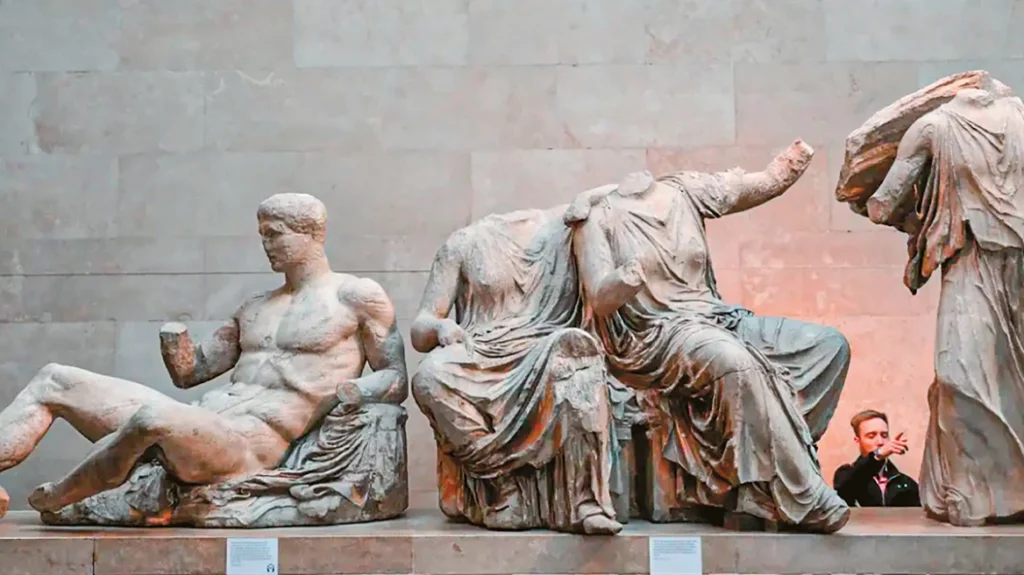
The British government has no intention of amending the legislation that prevents the permanent return of the Parthenon Sculptures to Greece, despite cross-party pressure in the House of Lords. Culture Minister Baroness Twycross made clear that there is no government initiative to that effect, referring instead to negotiations between the British Museum and the Greek side over a possible loan agreement, modelled on the Bayeux Tapestry.
The issue was raised again on Tuesday (3 November) by the independent Earl of Clancarty, who asked whether the government had considered proposals for the permanent reunification of the Sculptures in Athens.
Twycross replied that no such assessment had been carried out and that amending the British Museum Act 1963 was not included in the government’s legislative programme.
“The government has no plans to change the law or introduce legislation that would allow the permanent return of the Parthenon Sculptures,” she said.
The legal obstacle and the loan solution
The 1963 Act prohibits the British Museum from permanently removing objects from its collections, providing only limited exceptions for duplicate items or those deemed unsuitable for preservation. Specific legislative provisions also allow for the return of certain objects looted during the Nazi era and human remains less than 1,000 years old.
The minister stressed that the Museum operates independently of the government but is bound by the existing legal framework.
Meanwhile, British Museum chairman George Osborne is continuing discussions on a long-term loan agreement for the Sculptures, in exchange for the periodic exhibition of important Greek antiquities in Britain.
The main obstacle remains ownership. The British Museum has made recognition of its ownership and a commitment to return the Sculptures conditions of any loan—something the Greek side does not accept.
The Bayeux Tapestry as a model and categorical assurances that it will be returned
Particular interest was sparked by the reference to the Bayeux Tapestry, the historic French work that has been loaned temporarily to Britain and is being presented as a possible model for an agreement on the Sculptures.
Liberal Democrat Lord Addington asked whether the government would allocate parliamentary time for a change in the law if an agreement with Greece were reached.
Twycross replied that no such agreement had yet been reached and that the British Museum was “working very intensively to find an arrangement within the existing legal framework”.
She added that the Museum’s director had cited the loan of the Tapestry as a possible model, while the government would support an agreement acceptable “to Greek ministers and the Greek people”.
However, when independent Lord Ricketts asked for assurances that the Tapestry would be returned to France once its loan period ended, the minister’s answer was unequivocal:
“There is absolutely no intention, and they would have to go over my dead body, of trying to keep the Bayeux Tapestry in this country.”
Her remarks highlighted the difference between the two cases: the return of the French work is taken for granted, whereas, in the case of the Parthenon Sculptures, the British side continues to discuss only a temporary loan.
“If Guernica were cut into pieces”
During the debate, the Earl of Clancarty raised the issue of the artistic unity of the Parthenon, arguing that the return of the Sculptures was not merely a legal or national question, but also an aesthetic one.
“If Picasso’s Guernica were cut into pieces and displayed in different museums, there would be a huge outcry calling for its reunification. Shouldn’t we treat the masterpiece of Phidias in the same way?”
He proposed a limited amendment to the law that would allow the British Museum to decide for itself whether to return the Sculptures permanently.
Labour Baroness Chakrabarti made an equally pointed intervention, questioning the logic of a loan:
“If someone had stolen some of the Crown Jewels, I don’t think we would be so happy with a loan agreement.”
A contrary view was expressed by Conservative Viscount Hailsham, who warned that a return would create “an extremely unfortunate precedent”, given that British museums hold numerous objects acquired abroad, “often under rather questionable circumstances”.
Labour Lord Dubs asked for clarification on whether a new law would be required to enable the return, with the minister referring to the existing restrictions.
Interventions in support of the Acropolis Museum
Baroness Jones of Moulsecoomb, a Green Party member and former archaeologist, also supported the Greek position, pointing out that the Sculptures had been acquired from the Ottoman authorities, not from the Greek state.
“I have visited the Parthenon, and there are some very visibly bare spaces where the Sculptures should be,” she said.
Liberal Democrat Baroness Hussein-Ece reminded the House that Greece had been seeking their return for decades and had built the Acropolis Museum specifically to house them close to their original location.
She also noted that the British Museum had numerous objects in storage that could be displayed in place of the Sculptures.
Athens’ claim is linked to their removal in the early 19th century by Thomas Bruce, the 7th Earl of Elgin, who maintained that he had obtained permission from the Ottoman authorities. Greece disputes the legality of the process and is seeking the reunification of the Sculptures in their natural and historical setting.
Prime Minister Kyriakos Mitsotakis has previously compared their separation to cutting the Mona Lisa in half.
The government’s position and the deadlock with Athens
The government’s refusal carries political significance also because of the previous position of the current prime minister, Andy Burnham, who had supported the unconditional return of the Sculptures and taken part in an initiative to amend the 1963 Act.
After becoming prime minister, however, he referred responsibility for decisions to the British Museum, without committing to legislative intervention.
Twycross sought to keep the door open to cooperation, stressing that Greece and Britain maintain “a truly strong relationship, founded on shared values and history”.
Despite the cross-party support emerging in the House of Lords, London is not moving to remove the legislative obstacle, while Athens rejects any agreement that requires it to recognise British ownership.
As a result, negotiations remain deadlocked, with a loan arrangement continuing to be the British side’s main proposal, but one that has failed to secure Greece’s acceptance.
Ask me anything
Explore related questions




