





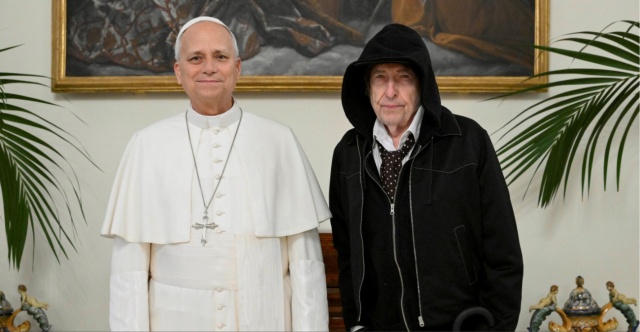
An unusual meeting between two iconic figures took place at the Vatican on Wednesday (4 November), where Pope Leo XIV received Bob Dylan. The 85-year-old American singer-songwriter, who is in Italy for a series of concerts, visited the first American-born head of the Roman Catholic Church, with the two men exchanging symbolic gifts and highlighting an unexpected connection between music, religion and the anti-war message.
The audience took place at the Apostolic Palace, shortly before Dylan’s scheduled concert in Rome. According to Vatican News, the 71-year-old pontiff gave the musician a rosary, while Dylan presented him with a copy of his autobiography, Chronicles: Volume One, published in 2004.
The meeting was brief, consisting of greetings and a short conversation, and the exact content of their discussions was not made public.
Pope Leo XIV met with American singer-songwriter Bob Dylan in a private audience on Wednesday, November 4. https://t.co/7OAJcluj0n
— Vatican News (@VaticanNews) November 4, 2026
The legendary singer-songwriter nevertheless attracted attention with his appearance, keeping the hood of his black sweatshirt up even in front of the pope, opting for a look that departed from the Vatican’s customary dress conventions.
Dylan, who became the first singer-songwriter to receive the Nobel Prize in Literature in 2016, continues to perform live at the age of 85. On Thursday (5 November), he is scheduled to give a concert at Rome’s Palazzo dello Sport as part of his Rough and Rowdy Ways tour, which also includes stops in Milan and Bologna.
Dylan’s anti-war song cited by the pope
The meeting was not entirely unexpected, as Leo XIV has publicly expressed his appreciation for Dylan’s work, even drawing on his lyrics to deliver a powerful message against wars and nuclear weapons.
In July 2026, in the foreword to Disarmed and Disarming: Peace Is a Gift, published by the Vatican publishing house, the pontiff quoted a passage from Dylan’s anti-nuclear song Go Away You Bomb.
It is a lesser-known composition by Dylan, dating from 1963, during the Cold War, in which the songwriter symbolically addresses the atomic bomb, condemning its development and use by humanity.
The song was never recorded or officially released on an album, while its original handwritten manuscript remained unknown until it was discovered in 2013.
Leo XIV chose these lyrics to warn of the dangers of global rearmament and the threat of a new nuclear conflict.
The pope’s dispute with Trump over the war
The reference to Dylan’s anti-war work takes on particular significance in light of Leo XIV’s position on military conflicts in the Middle East.
The first American pope has repeatedly advocated diplomacy and the peaceful resolution of disputes, criticising the war with Iran and the use of military force.
His interventions have prompted a strong reaction from US President Donald Trump, who described the pontiff as “weak” on crime and “terrible for foreign policy”, accusing him of failing to understand the dangers posed by Iran’s nuclear programme.
Leo XIV responded that he was not afraid of the US administration and would continue to defend the message of peace, dialogue and reconciliation.
His meeting with Dylan, an artist closely associated with protest songs and social movements, therefore took place at a time when the pontiff is seeking to highlight the Church’s role in promoting peace.
Bob Dylan’s religious journey and the silver cross
Beyond their shared anti-war concerns, the pope and Dylan have another area of common interest: religious faith.
The American musician, whose real name is Robert Allen Zimmerman, was born into a Jewish family. However, in the late 1970s, he went through a period of intense engagement with evangelical Christianity.
This religious turn was linked to an incident at one of his concerts in San Diego in November 1978, when a member of the audience threw a small silver cross on to the stage.
Dylan, who was experiencing personal difficulties at the time and felt exhausted, later recalled noticing the object and, contrary to his usual practice, deciding to pick it up and put it in his pocket.
He subsequently travelled to Arizona for the next stop on his tour. There, in a hotel room in Tucson, he experienced what he later described as a profound religious encounter.
In a 1979 interview, recalling what had happened at the San Diego concert, he explained that someone in the audience had realised he was not feeling well and had thrown the cross to him.
“I don’t usually pick things up from the front of the stage. But I looked at that cross and told myself I had to pick it up,” he recalled.
Describing what happened next, the singer-songwriter said that in Tucson he was feeling even worse and was looking for something that might help him.
“I said I needed something that night, something I hadn’t had before. And then I looked in my pocket and there was that cross,” he said.
In a later interview, cited by the British newspaper The Independent, Dylan described the experience in even more explicitly religious terms.
“Jesus put his hand on me. It was a physical thing. I felt it. I felt it all over my body. I felt my body trembling. The glory of the Lord knocked me down and picked me up again,” he said.
This period was also reflected in his discography, with three albums featuring strong Christian themes: Slow Train Coming in 1979, Saved in 1980 and Shot of Love in 1981.
In the years that followed, his public expression of Christian faith became more limited, while he adopted a more private approach to religion. He has occasionally referred to his Jewish identity, without clearly defining his later religious beliefs.
The historic meeting with John Paul II in 1997
Leo XIV is not the first pontiff Bob Dylan has met.
In 1997, the American artist performed at the 23rd National Eucharistic Congress in Bologna, Italy, in the presence of Pope John Paul II and around 300,000 young people.
During the event, he performed four of his songs: Knockin’ on Heaven’s Door, A Hard Rain’s A-Gonna Fall, Blowin’ in the Wind and Forever Young.
After his performance, Dylan approached John Paul II, took off his cowboy hat and exchanged a handshake and a few words with him.
The meeting took on particular symbolic significance when the Polish pontiff referred to Blowin’ in the Wind, one of Dylan’s best-known songs, using its question about how many roads a person must travel as the starting point for a religious reflection.
John Paul II responded that there was one road for humanity: that of Jesus Christ.
The image of Dylan standing alongside the pope at the time became one of the most memorable moments in the encounter between contemporary music and the Roman Catholic Church.
From Dylan to Jewel and the Vatican concerts
The presence of American music artists at Vatican events continued in the years that followed.
In 1998, American singer-songwriter Jewel took part in the Vatican’s Christmas concert, accompanied by a choir and orchestra.
Jewel had previously worked with Dylan. In 1996, she had opened five of his concerts on the east coast of the United States. At his invitation, she had also joined him on stage at two performances to sing I Shall Be Released together.
Almost three decades after his meeting with John Paul II, Bob Dylan has returned to the Vatican, this time not to perform, but to meet a pope who has already used his lyrics to deliver an anti-war message.
Ask me anything
Explore related questions




