





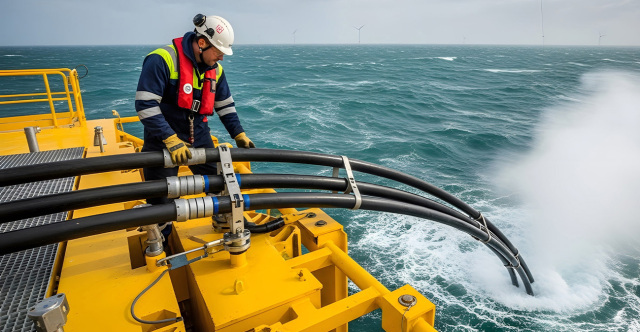
The Greek government has completed the licensing process and issued a NAVTEX maritime notice for survey and cable-laying operations linked to the Greece-Cyprus electricity interconnector, government spokesman Pavlos Marinakis announced during his opening remarks at a briefing for political correspondents.
Marinakis said the competent Greek authorities had completed the required authorisation procedures following a request from French company NEXANS.
He explained that, following a favourable opinion from the competent interministerial committee responsible for authorising marine surveys, Foreign Minister Giorgos Gerapetritis issued the decision approving the survey and cable-laying operations last Friday.
The survey vessel subsequently requested the necessary Notice to Mariners (NAVTEX), which was duly issued.
The government spokesman described the Great Sea Interconnector (GSI) as a project of strategic importance for strengthening energy self-sufficiency, regional cooperation and stability, adding that it would contribute to peace and security across the wider region.
Addressing Turkey’s objections, Marinakis made clear that no authorisation had been requested from Ankara.
“Permission was sought exclusively from the Greek and Cypriot authorities. Our position is clear: permission was sought exclusively from the Greek and Cypriot authorities. It has not been, and will not be, sought from Turkey,” he said.
He added: “There is no agreement or coordination between Athens and Ankara.”
Price reductions of up to 34% on 1,109 products
Turning to the cost of living, Marinakis announced that 1,109 product lines have now been included in the second phase of the National Price Reduction Initiative, which runs until the end of 2026.
Price reductions range from 5% to 34%, with the average reduction in the standard shelf price standing at 7.1%.
More than 600 of the products are branded goods, while the initiative also includes supermarket own-label products and dozens of fresh meat items.
The list covers everyday essentials, including dairy products, cold cuts, bread, flour, pasta, cleaning products, personal care items, baby products, soft drinks and fresh meat.
Consumers can check participating products and prices through the posokanei.gov.gr platform, while special labels identify the discounted products in supermarkets.
Marinakis said the list remains open and is expected to expand, with the Independent Authority for Market Supervision and Consumer Protection continuing discussions with suppliers and supermarket chains.
He also cited Eurostat figures showing that inflation in Greece for food, alcohol and tobacco stood at 1.4% in October, compared with 1.6% across the eurozone.
New rules governing artificial intelligence in the workplace
A public consultation on draft legislation from the Ministry of Labour and Social Security, introducing rules governing the use of artificial intelligence in the labour market for the first time, will conclude on 19 November.
According to Marinakis, the proposed provisions will strengthen transparency in algorithmic management of employment and require human oversight when significant decisions affecting workers’ employment status are made.
The measures aim to ensure that employees are informed about the processes and criteria used to make decisions affecting them, while also protecting their personal data.
The legislation also provides for improvements to working conditions for people employed through digital platforms and stronger protections for users of their services.
Further provisions seek to improve insurance coverage for children approaching adulthood, facilitate access to parental and carers’ leave, and introduce supplementary maternity benefits during pregnancy and after childbirth, paid by Greece’s Public Employment Service (DYPA) to insured mothers covered by EDOEAP, the insurance organisation for media workers.
Out-of-court debt settlement mechanism covers €21.77 billion
Marinakis also presented the latest figures for Greece’s out-of-court debt settlement mechanism, reporting 4,144 finalised application submissions in October, the highest monthly total recorded in six months.
More than 7,000 new applications were initiated for the second consecutive month, while 1,965 new debt settlements were successfully concluded. Of these, 552 were completed under provisions requiring creditors to participate in the process.
The original value of debts settled during October amounted to €524 million.
By the end of October, the mechanism had facilitated a total of 72,232 successful settlements, covering original debts worth €21.77 billion.
The spokesman also reported that 675 borrowers had begun submitting applications under a new arrangement designed to protect their primary residences, less than six weeks after the measure came into effect.
University funding and expansion of student accommodation
The government spokesman outlined further measures to upgrade Greece’s public universities, announcing more than €2 million in funding for maintenance, repairs and improvements to the buildings and technical infrastructure of the National and Kapodistrian University of Athens.
An additional €5.5 million has been earmarked to improve security and upgrade infrastructure at the Hellenic Mediterranean University.
Marinakis also referred to the inauguration of a new student residence at the University of the Peloponnese in Tripoli, built with approximately €2.5 million in public funding.
The new facility increases the university’s student accommodation capacity from 330 to 426 places.
He highlighted the increase in the student housing allowance, which stood at €1,000 annually in 2019 and has since risen to €2,000 for eligible students attending regional universities, or €2,500 where students share accommodation.
According to Marinakis, the increase amounts to as much as 150% compared with 2019.
He also announced plans for a permanent increase in annual state funding for student meals to €80 million from 2027, aimed at improving the quality of services provided.
€5 million maintenance project for Athens Metro Line 1
Finally, Marinakis announced the signing of a contract for maintenance and restoration work on the railway infrastructure of Athens Metro Line 1, formerly known as ISAP, in the presence of Deputy Minister of Infrastructure and Transport Giorgos Kotsiras.
The project, with a budget of approximately €5 million, covers maintenance and restoration work along 16 kilometres of railway track and at 60 sets of points.
According to Marinakis, the interventions are intended to address wear and tear caused by regular use, maintain high safety and reliability standards, and improve journey times.
The project forms part of a wider modernisation programme for Line 1, which includes train refurbishment, infrastructure maintenance and station renovations, with the overall aim of upgrading Athens’ urban transport network.
Ask me anything
Explore related questions




