





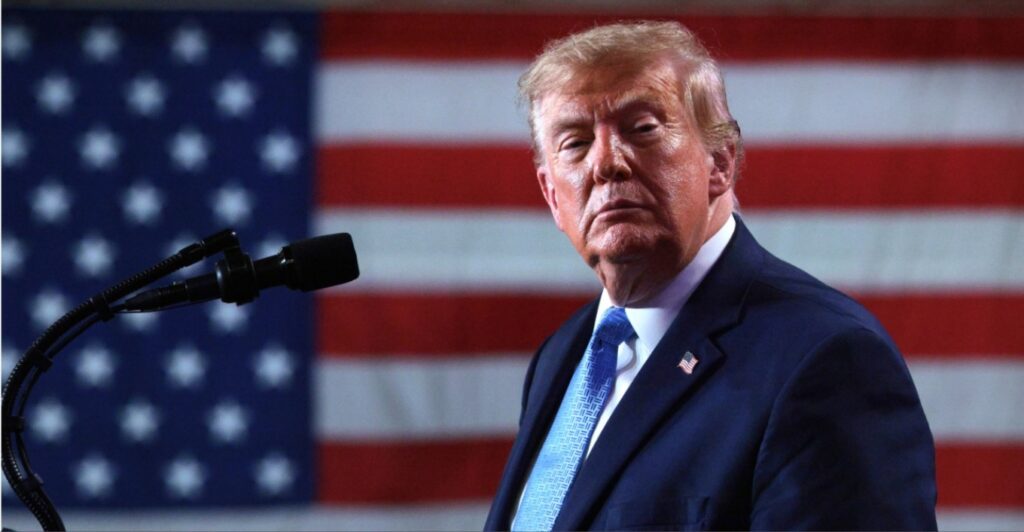
In a wide-ranging interview with CBS’s 60 Minutes, US President Donald Trump conceded that the war in Iran, rising petrol prices and public dissatisfaction with Israel had contributed to the Republican defeat. He also acknowledged that his administration’s aggressive deportation policies had come at a political cost.
Trump suggested that Ukraine might have to surrender territory to secure peace with Russia, discussed potential successors within the Republican Party and made a strikingly personal admission that he could not forgive some of his political enemies, even if doing so were a condition for entering Heaven.
60 MINUTES REPORT: Ross Douthat interviews President Trump in his first sit-down interview since the 2026 midterm elections. The wide-ranging conversation covered immigration and corruption, Iran and artificial intelligence, his potential successors and his own mortality. The interview begins with the election results.
— 60 Minutes (@60Minutes) November 9, 2026
‘MAGA can continue without me’
Following the Republicans’ disappointing election results, Trump was asked by interviewer Ross Douthat about the future of the Make America Great Again movement as his second presidential term enters its final two years.
The president expressed confidence that the political movement he created could outlast his time in office.
“I think so, because MAGA is essentially common sense,” he said when asked whether the movement could continue without him.
“MAGA means strong borders, a strong military. We’ve created wealth at a level our country has never seen before,” he claimed.
President Trump believes the MAGA coalition will continue on long after him because it’s “basically common sense” ideas and policies. 60 Minutes’ Ross Douthat: “Do you think you can have MAGA without you as the leader?” President Trump: “I think so, because MAGA is basically common sense. You know, MAGA strong borders, good military. We have created wealth at a level that our country has never seen before.”
— RedWave Press (@RedWavePress) November 9, 2026
‘We lost because we couldn’t get our message across’
Discussing the November 3 midterm elections, in which Republicans lost control of both the House of Representatives and the Senate, Trump acknowledged that shortcomings in his party’s communications strategy had played a role.
The electoral setbacks extended to traditionally Republican strongholds, including Texas, Kansas and South Carolina.
Trump initially argued that the outcome would have been different had he personally been on the ballot. Despite holding numerous campaign rallies, he said he had been unable to transfer his own popularity to Republican candidates.
Some voters had stayed at home, he suggested, while others had been unimpressed by the candidates selected to represent the party.
Douthat challenged Trump over his endorsements of several unsuccessful candidates, including Ken Paxton in Texas and Darlene Graham in South Carolina.
Trump defended his choices, arguing that alternative Republican candidates would also have lost. He pointed instead to victories by candidates he had endorsed in Florida.
Beyond candidate selection, the president acknowledged that the war in Iran, higher fuel prices and negative attitudes towards Israel among significant sections of the electorate had contributed to the defeat.
Nevertheless, he maintained that public dissatisfaction with his economic management did not reflect what he regarded as the administration’s actual economic achievements.
“I think it was bad messaging, maybe by me, but I talked about it all the time,” he said.
“So I don’t know how much more I could have talked about it,” he added.
Asked to clarify his remarks, Trump replied: “We couldn’t get the message across.”
His admission came despite his earlier insistence that he had held dozens of campaign rallies in the run-up to the elections.
Trump also blamed the media, arguing that positive developments involving Republicans received insufficient coverage.
He cited the performance of the US stock market as evidence of economic success and continued to describe the results of the war in Iran as “amazing”, despite opinion polls indicating a considerably less favourable public assessment.
Disagreement with Vance over Iran: ‘I would do it again’
Trump also addressed comments by Vice President JD Vance, who had publicly linked the Republicans’ electoral defeat to the war in Iran.
The president revealed that Vance had sought his opinion before publishing his analysis and that he had encouraged the vice president to express what he genuinely believed.
Although Trump agreed with much of Vance’s assessment, he said he would have preferred a more explicit defence of the military intervention.
“If we had to do it again, would we do it again? The answer is yes,” he declared, arguing that preventing Iran from acquiring nuclear weapons remained essential.
Trump acknowledged that such a decision might carry short-term political costs but maintained that history would ultimately judge the intervention favourably.
He also insisted that the differences in emphasis between himself and Vance had not damaged their relationship.
Trump admits mass deportations cost him politically
During the interview, recorded on Friday, November 6, and broadcast on Sunday, November 8, Trump also addressed his immigration policies, acknowledging that the severity of the deportation programme had produced negative political consequences.
“It was too harsh. I think maybe it was too harsh, yes,” he said of the mass deportation approach he had pursued during his first administration.
“Ultimately, that hurt me,” he added, linking the policy to the midterm election results.
Trump acknowledged that many Americans believe migrants who may have entered the country illegally but have spent years working in the United States should be allowed to remain.
He illustrated his argument by referring to workers in the hotel industry and the impact of removing people who had established professional and personal lives in the country.
If President Trump softens on immigration enforcement, it will be a disaster: 60 Minutes: "So you think your deportation policy went too far? President Trump: "I think it was too tough." 60 Minutes: "It was too tough?" President Trump "I think it might be too tough, yeah." https://t.co/L44SDmrS1T
— Steve Cortes (@SteveCortes) November 8, 2026
“When you go into a hotel and there’s a woman working there as a maid, as a cleaner, in different jobs, as a waitress, in many good jobs, great jobs, and suddenly she’s taken out of the country, it’s tough. It’s a tough thing,” he said.
The president acknowledged that competing views on immigration exist within the American right.
“But there’s a group of people, I would say pretty close to the far right, who would like everybody removed,” he said.
Asked whether members of his administration shared that position, he replied: “There are many such people.”
Trump also described a more moderate approach, leaving open the possibility of reaching an agreement with Democrats.
“There are also people who are more moderate. In other words, get the murderers out, get all the dangerous people out, get the drug dealers out, but for the people who are here, and in some cases have been here for 10 or 15 years, work out a deal for them,” he said.
A change in White House leadership
The interview took place just hours before a significant change in the White House leadership was announced.
Stephen Miller, a longstanding Trump adviser and one of the most prominent advocates of restrictive immigration policies, was named as Susie Wiles’s replacement as White House chief of staff.
During the interview, Trump had indicated that changes to his administration would follow the election defeat, although he emphasised that he continued to hold a favourable opinion of his Cabinet members.
Miller’s appointment is particularly significant in the context of the president’s remarks about reconsidering aspects of his immigration policy.
Trump on Ukraine: ‘It will end up with a slightly different shape’
Turning to the war in Ukraine, Trump suggested that Kyiv might have to accept territorial concessions as part of a peace agreement with Russia.
“Ukraine will end up with a slightly different shape,” he said, indicating that the country’s internationally recognised borders could change as part of a diplomatic settlement.
His comments came days before another round of talks in Abu Dhabi, where American negotiators are expected to continue efforts to end the years-long conflict.
Trump’s son-in-law Jared Kushner and US special envoy Steve Witkoff are due to travel to the capital of the United Arab Emirates this week for US-initiated trilateral talks involving the United States, Ukraine and Russia.
According to CBS, the delegations are expected to meet for the first time since February.
President Trump says he believes the war in Ukraine will end soon, adding that ultimately there could be changes to the country’s borders: “They’re going to end up with a little bit different shape Ukraine.” https://t.co/KL9y0GUqWo https://t.co/UgeoxsRnQy
— 60 Minutes (@60Minutes) November 9, 2026
Asked what he considered the greatest obstacle to peace, Trump pointed to the intense personal hostility between Ukrainian President Volodymyr Zelensky and Russian President Vladimir Putin.
He repeated his assertion that the war would never have begun had he been in the White House when Russia launched its invasion, while expressing optimism that an agreement was approaching.
When asked which of the two leaders he trusted more, Trump declined to choose, saying he maintained relationships with both.
Douthat pointed out that Zelensky’s hostility towards Putin was understandable given Russia’s invasion of Ukraine.
Trump acknowledged the argument but claimed that considerable disrespect had been shown towards Russia during the initial meeting between the two sides.
He also rejected suggestions that Putin was deliberately prolonging negotiations without any genuine intention of reaching an agreement, pointing to sanctions imposed on Moscow by his administration.
Asked about the easing of restrictions on Russian diesel exports, Trump maintained that he had not granted Russia any particular favour but had instead allowed significant quantities of fuel to reach international markets.
Zelensky has repeatedly stressed that Ukraine’s territorial integrity is protected by its constitution and that formally surrendering Ukrainian territory would be unconstitutional.
‘I can’t forgive my enemies because I hate them’
One of the interview’s most personal exchanges came when Douthat asked Trump what he believed would happen to him after his death.
“I’m a religious person, so theoretically I’ll go to Heaven. I don’t want to go to Hell,” the president replied.
The discussion then turned to forgiveness, with Douthat posing a hypothetical question about whether Trump could overcome his hatred of political opponents if doing so were necessary to enter Heaven.
“Suppose you die and pass into the next life. And all that’s required for you to enter Heaven is to feel love and forgiveness for James Comey, Nancy Pelosi or anyone else you’ve expressed hatred for over the years. Do you think you could do that?” he asked.
Douthat also recalled Trump’s remarks at Charlie Kirk’s memorial service, when the president had declared: “I hate my opponent and I don’t want the best for him.”
What does President Trump think will happen to him after he dies? “I’m a religious person, so in theory I go to heaven…I don’t want to go to hell,” he answers. https://t.co/EvX8pM7G9g https://t.co/AMdFaexjET
— 60 Minutes (@60Minutes) November 9, 2026
Trump initially rejected the idea of offering an affirmative answer simply because it would be easier.
“Then I wouldn’t be truthful, would I? I mean, if I told you, of course, the easy answer would be, ‘Oh, yes, I could forgive,'” he said.
When Douthat pressed him on whether his answer was therefore no, Trump replied unequivocally.
“The answer is no. I want to be honest, no.”
The interviewer returned to the question for a third time, asking whether Trump could find it within himself to forgive his opponents.
“I probably can’t do it, no, because I hate some of my enemies and I will always hate them,” the president said.
“I do hate some of my enemies, and I always will,” says President Trump. https://t.co/hcYuiYy6Gc https://t.co/D5LwPZCiQl
— 60 Minutes (@60Minutes) November 9, 2026
Artificial intelligence: ‘I don’t want the US to come second’
Trump also discussed the global race to develop artificial intelligence, describing it primarily as a contest between the United States and China.
He stressed that maintaining American leadership in the sector was a strategic priority, although he did not rule out regulations designed to ensure the technology developed safely.
“The level of power that comes with winning this race is very significant,” he said.
Asked whether he would work with Democrats on AI safety, Trump gave an emphatically positive response.
“If we don’t have it, China’s going to have it. That would put us at an unbelievable disadvantage,” President Trump says about the race to develop artificial intelligence. Trump tells 60 Minutes he doesn’t mind AI safety guardrails, but warns: “I don’t want to put us in a deep second position. We’re leading number one. And China has no guardrails, by the way.” https://t.co/CruaMEdM0i
— 60 Minutes (@60Minutes) November 9, 2026
“I have no objection to safeguards, but I don’t want them to put us so far behind that we’re in second place,” he said.
According to Trump, China does not face the same regulatory restrictions, potentially giving it a competitive advantage.
Commenting on President Xi Jinping’s exercise of power, Trump observed that decisions made by China’s leader are implemented, whereas the United States has different institutional constraints despite the considerable powers of its presidency.
The race to succeed Trump in 2028: Vance, Rubio and the possibility of no endorsement
Asked who might succeed him as the Republican presidential nominee in 2028, Trump declined to provide a definitive answer.
He acknowledged that the party would need to select a new candidate in two years as his second presidential term approaches its conclusion.
Asked whether he intended to endorse a particular successor, he said he probably would, although he did not consider that certain.
Trump argued that Republicans had several highly capable figures with whom he enjoyed strong personal relationships.
Vice President JD Vance was mentioned during the discussion, while Trump also singled out Secretary of State Marco Rubio for praise, expressing particular satisfaction with his performance.
Asked whether Rubio would remain at the State Department, Trump said he believed that was likely, arguing that Rubio was happy in his role and doing an excellent job.
He also referred favourably to several senators without naming other potential contenders for the Republican presidential nomination.
Trump did not rule out withholding his endorsement altogether, leaving open the possibility that he might choose not to intervene in the succession contest.
Questions over Trump’s wealth and cryptocurrency business
Trump faced persistent questions about his personal fortune and his family’s business activities.
Douthat cited a Forbes report suggesting that the president’s net worth had increased by approximately $3 billion since his return to the White House.
Trump maintained that he spent virtually no time monitoring his wealth and had already accumulated more money than he had ever imagined.
He explained that one of his sons managed his financial affairs, while much of his capital was invested through major Wall Street firms.
The interviewer then raised the cryptocurrency company World Liberty Financial, which Trump acknowledged he co-owned and in which members of his family are involved.
According to Douthat, investors linked to the United Arab Emirates government also have interests in the company.
The journalist suggested that a comparable business relationship between the Biden family and foreign investors would probably have prompted Trump to make accusations of corruption.
The president responded that he did not know the details of the company’s operations and that his sons were continuing their business activities as they had before he returned to office.
He argued that it would be unreasonable to expect his children to stop working for four years simply because he occupied the White House.
Asked why he did not personally withdraw from the company to avoid potential conflicts of interest, Trump repeated that he was not involved in the day-to-day management of his investments.
Douthat then directly raised the possibility that foreign investors might believe they were acquiring political influence through their financial relationships with the president’s businesses.
Trump replied that he did not know whether investors thought in those terms, maintaining that conflicts of interest could arise under any presidential administration.
‘I can work with Democrats even if they investigate me’
The Republicans’ loss of control of Congress presents a new political challenge for the Trump administration, with Democrats gaining the ability to initiate congressional investigations, hold hearings and demand documents.
Trump said he would be willing to work with the new Democratic majority, particularly on immigration.
He claimed that Democratic figures had already made contact to explore the possibility of an agreement.
The discussion also touched on James Talarico, the newly elected Democratic senator from Texas, who has expressed an interest in immigration cooperation.
Douthat reminded Trump that he had used insulting language about Talarico during the election campaign and asked whether he could refrain from personal attacks to help secure a deal.
Trump replied that he could do so for as long as six months if that was what achieving an agreement required.
Asked whether he would cooperate with Democrats even if they launched investigations into his administration, Trump recalled facing two impeachment proceedings during his first term.
Although he considered another impeachment attempt unlikely to succeed, he did not rule out cooperation with the opposition.
Trump backs Hegseth despite calls for his resignation
Trump also expressed confidence in Defence Secretary Pete Hegseth despite public demands for his departure.
Douthat said he had seen Hegseth at the White House shortly before the interview and asked whether the president still trusted him.
Trump answered in the affirmative, citing his administration’s military operations.
He referred specifically to Venezuela, claiming that the United States had secured a military victory in less than an hour without any loss of life and had already gained substantial economic benefits from the country.
The president stopped short of attributing the operation’s success personally to Hegseth, noting instead that the defence secretary had been involved.
His remarks followed the release of an extensive video message in which Hegseth defended his leadership at the Pentagon and his handling of the war in Iran.
Iran: No further escalation, but allies should pay for the war
Trump also said he was not seeking further military escalation with Iran following the midterm elections.
He maintained that Iran’s nuclear programme had suffered decisive damage and that its facilities remained buried beneath enormous quantities of rock.
Douthat asked how an agreement could be reached to guarantee freedom of navigation through the Strait of Hormuz without requiring a permanent deployment of substantial American military forces.
Trump replied that the strait was open and ships continued to pass through it, downplaying the costs of the US military presence.
NEW | Trump says countries protected by the US during the war with Iran will have to reimburse Washington for all the costs of the conflict. “Without us, Israel would not exist,” he told CBS’s 60 Minutes. The war had already cost the US an estimated $47.1 billion by October 16. https://t.co/pptMU3W0oh
— GeoInsider (@InsiderGeo) November 9, 2026
He went further, arguing that countries protected by the United States should compensate Washington for the cost of the war.
Referring to Israel, Trump claimed the country would not exist without his decisions and the earlier American B-2 bomber strikes against Iranian nuclear facilities.
Asked whether he regretted US participation in operations targeting Iran’s leadership that contributed to the escalation of the conflict, Trump declined to express remorse.
Instead, he defended his military decisions, insisting they had decisively weakened Iran’s ability to acquire nuclear weapons.
Trump on UFOs: Fighter pilots describe mysterious objects travelling at extraordinary speeds
The interview also ventured into the subject of unidentified flying objects, or UFOs.
Trump revealed that UFOs were among the topics he was most frequently asked about in private conversations, including by people he would not have expected to take an interest in them.
Although he said he was not particularly convinced of the existence of extraterrestrial life or other unexplained phenomena, Trump disclosed that he had heard unusual accounts from experienced US Air Force pilots.
He said he had met pilots in the Oval Office during both his first and second presidential terms.
President Trump says he’s “not too much of a believer” in UFOs, but he has spoken with military pilots who say “there’s something going on out there.” https://t.co/rPo9LqBtFa https://t.co/09vOH0nuGU
— 60 Minutes (@60Minutes) November 9, 2026
Describing them as reliable professionals rather than conspiracy theorists, Trump said they had reported seeing unidentified objects travelling at speeds several times greater than those of their fighter aircraft.
He specifically referred to accounts of round objects with no conventional aerodynamic shape that, according to the pilots, travelled at three times the speed of F-22 fighter jets.
Trump presented these incidents as accounts relayed to him by pilots, rather than independently verified events.
Douthat also asked whether the president was aware of a secret government programme investigating such phenomena that, according to some claims, operates without even informing successive presidents.
Trump replied that he had neither seen evidence of nor been briefed on the existence of such a programme, adding that he intended to investigate if one existed.
Ask me anything
Explore related questions




