





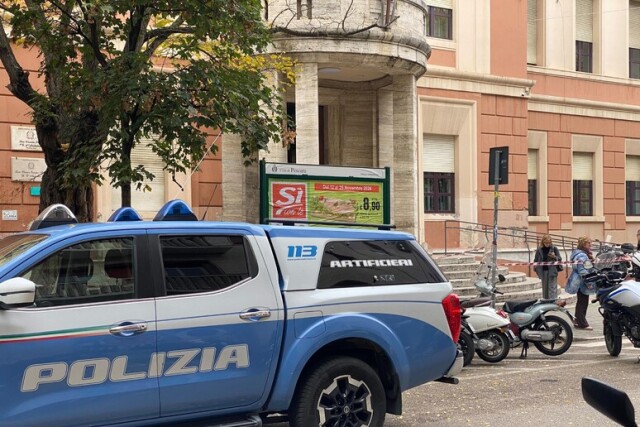
Bomb threats sent to hundreds of schools in Italy, Scotland, Ireland and Northern Ireland have triggered security alerts and widespread evacuations, with thousands of pupils forced to leave their classrooms.
According to the Financial Times, the threats were made in emails sent to schools across the four countries, with authorities investigating whether they were part of a coordinated campaign intended to cause disruption across Europe.
More than 300 schools targeted in Italy
In Italy, at least 312 schools received emails claiming that explosive devices had been planted on their premises, prompting dozens of evacuations.
The threats were sent to schools in numerous cities, including Rome, Milan, Naples, Venice, Trieste, Padua, Bergamo and Modena, as well as locations across Tuscany.
More than 50 schools were evacuated in the Lazio region alone, according to the student organisation Rete degli Studenti Medi.
“We have come to exterminate you. We will carry out a genocide against Italians,” the threatening email reportedly stated. According to available information, the message originated from abroad and was signed by someone identifying himself as “Mikhail Andropov, leader of Wilayat Misogynistan”.
The same message also referred to a bomb allegedly planted in Italian Prime Minister Giorgia Meloni’s car. Bomb disposal teams have been conducting searches of school buildings, while dozens of school complexes have been evacuated, according to the Italian news agency ANSA.
Meloni called an emergency meeting for 4pm Italian time at Palazzo Chigi, the government headquarters, to assess the situation and coordinate the necessary response. The meeting will be attended by Deputy Prime Ministers Matteo Salvini and Antonio Tajani, Interior Minister Matteo Piantedosi, Defence Minister Guido Crosetto, and senior intelligence and cybersecurity officials.
Crosetto described the incidents as part of a “strategy to spread terror”, while clarifying that some of the threats could have been made by pranksters rather than foreign governments or hostile organisations.
Meloni urges calm as authorities find no evidence of immediate danger
In a social media post, the Italian prime minister said the government was closely monitoring the numerous reports of bomb threats at schools, while police and other relevant authorities had been mobilised to investigate the incidents.
“The government is monitoring with great attention the numerous reports of bomb alerts in schools. The police and the relevant institutions, at every level, have been mobilised to monitor the situation and reassure citizens, families and school staff,” Meloni said.
She added that “at present, the checks carried out have revealed no evidence suggesting the existence of a specific threat”. The prime minister also suggested that the reports could be linked to a strategy intended to generate anxiety and disruption, stressing that all necessary investigations were under way.
Speaking from Brussels, Italian Education Minister Giuseppe Valditara announced that 312 schools had so far been affected by the bomb threats. “I want to send a reassuring message, because at this moment there is no danger whatsoever. There is no reason for panic or any other concern, as that would be entirely unjustified,” he said.
Meanwhile, Italian authorities are continuing their investigations to establish the origin of the emails and identify those responsible for the threats. According to Reuters, similar threatening messages bearing the same signature had also been sent to media organisations in Ireland and Bulgaria in recent days.
Threatening emails sent to more than 770 schools in Scotland and Northern Ireland
More than 770 schools across Scotland and Northern Ireland have reported receiving the threatening emails, with police authorities so far assessing them as hoaxes. According to Sky News, similar messages were sent to 470 schools in Scotland, while more than 300 schools in Northern Ireland reported receiving the same threatening email.
The Police Service of Northern Ireland (PSNI) said it was treating the message, which originated from outside the United Kingdom, as a hoax, although investigations remain ongoing. Assistant Chief Constable Anthony McNally said authorities take such incidents extremely seriously and recognise the concern they cause within school communities, among pupils and parents. “Our enquiries are ongoing, however, at this stage we consider risk to the public as low,” he said.
Police Scotland has reached a similar assessment, announcing that the messages had been evaluated and were being treated as hoaxes. A police spokesperson acknowledged that such incidents can cause considerable disruption and anxiety among pupils, parents and teachers, but clarified that schools did not need to suspend operations solely because of the emails.
“Our advice is that there is no requirement to evacuate schools or keep children away from education based solely on the content of the messages,” the spokesperson said. Meanwhile, Police Scotland’s cybercrime and fraud unit is carrying out extensive investigations to trace the origin of the emails, working alongside police forces across the United Kingdom and overseas.
Similar threats reported in October
The latest wave of threatening emails comes just weeks after similar incidents in Northern Ireland and Scotland, when schools temporarily suspended operations following bomb threats that were subsequently found to be false. Northern Ireland’s Education Authority said the latest messages bore similarities to those received last month, adding that there was currently no evidence of a credible threat.
The authority also urged schools to remain vigilant and immediately report any suspicious activity to the police. Investigations are continuing to identify the senders and establish whether the incidents are connected, as the threatening messages have been distributed widely through email mailing lists across the United Kingdom, including Northern Ireland.
The threats are the latest example of what appears to be a growing wave of coordinated activities apparently designed to spread chaos across Europe.
Last week, bomb threats were sent to airlines across the continent, forcing some aircraft to make emergency landings and others to divert from their planned routes. European security services are attempting to establish whether the threats could have originated in Russia.
Ask me anything
Explore related questions




