





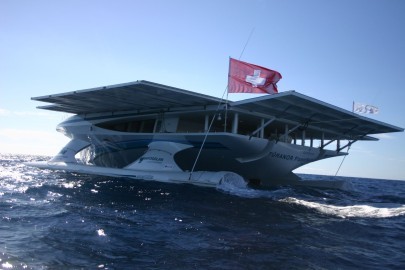
The world’s largest solar-powered boat, MS Turanor PlanetSolar, is to arrive in Greece on August 1 as part of a joint archaeological project on the underwater exploration of one of Europe’s oldest human villages at the Franchthi cave in the Argolid, southeast Peloponnese. The boat will be the lab base from which archaeologists will work from August 18 through to September 12.
The project – TerraSubmersa – brings together Greek and Swiss archaeologists who will explore the underwater area to identify a prehistoric village near Franchthi, a cave occupied continuously for about 35,000 years, from Paleolithic to Neolithic times.
The archaeologists will carry geophysical measurements to reconstruct the original above-water, topography of the area before it sank. They will be assisted by the Hellenic Centre for Marine Research (ELKEThE) – a collaborator on this project. Other partners on this project include the University of Geneva, the Swiss School of Archaeology in Greece and the Greek Ministry of Culture’s Ephorate of Underwater Antiquities.
The area of Argolid is famed as one of Greece’s richest archaelogical areas with its major palatial complexes of the Bronze Age that include Mycenae and Tiryns and later, classical-era city-states and sites like Argos as well as the impressive ancient theater of Epidaurus.
The boat will set off on August 1, Swiss National Day, with successive stopovers at Eretria (southwest Evia island), Athens and Nafplio (Argolid). During these stopovers there will be events open to the public.
Following a meeting with Swiss Ambassador to Greece Lorenzo Amberg, Environment, Energy and Climate Change Minister Yiannis Maniatis said the that the “TerraSubmersa” project “constitutes a dive into the history of this country” and called the Argolid “the greatest open archaeological park of the world, which is now going to reveal the first prehistoric steps of Homo Sapiens in the Mediterranean.”
Ask me anything
Explore related questions




