





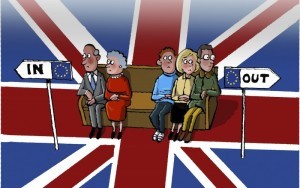
The decision by the British citizens to part ways with the EU on Thursday’s referendum has sent global markets into a tailspin, while pundits and analysts are trying to weigh the medium and long term impact of the Brexit. Site Politico.eu presents 6 ways the decision of the referendum could be reversed.
Here are six possible scenarios to stave off Brexit (and probably give right-wing UKIP leader Nigel Farage an aneurism):
Wrong answer, try again
The ultimate Euroskeptic fear: They wouldn’t, would they?
They could.
A petition to re-run the referendum has taken off, with over three million signatures already. More than a few Bremorsers voice regret over their vote for Leave, in the wake of the financial and political chaos unleashed on the U.K.
A referendum is not legally binding. In pure constitutional terms it is merely advisory. You can repeat the exercise as wanted, as long as the irrevocable Article 50 formalizing the U.K.’s divorce from Brussels hasn’t been invoked. Cameron said it would be up to the next prime minister, whoever that may be, to apply for the decree nisi.
There are recent European precedents for ignoring the will of the voters. The Irish voted down the EU’s Lisbon Treaty in 2008 before sheepishly adopting it less than a year later. The Greeks defied their “Troika” masters by saying oxi to their bailout terms last summer. A few days later they were forced to swallow them.
On Sunday, former Labour Prime Minister Tony Blair was holding on to the slim hope that the same could happen in the U.K., but accepted it was very unlikely. “As I’m looking at it here, I can’t see how we can do that. But, you know, the point is, why rule anything out right now?”
Chances: 1/15
Renegotiation, mark two
“There is only one way to get the change we need — and that is to vote to go; because all EU history shows that they only really listen to a population when it says No.”
So said Boris Johnson in the Daily Telegraph, the day after the then mayor of London formally announced his decision to campaign for Brexit in February.
In other words, vote out to gain leverage to negotiate on better terms with Brussels — and then vote to stay in. Don’t rule it out.
Would Brussels stomach it? Jean-Claude Juncker, president of European Commission and no great fan of the U.K., was quick to slap down any talk of any new negotiations with London the day the result was announced. But Angela Merkel, the dominant force in Europe, may be more open to the idea.
The Conservative Euro-MP Daniel Hannan, one of the brains behind Brexit, is happy to grant EU citizens the right to work in the U.K. but not to move looking for work. Theresa May, the home secretary and prime ministerial hopeful who supported Remain, has previously backed such a compromise.
If there was a change to the principle of free movement of people across the EU, then it may be acceptable to many Brexit supporters. This option would likely require a fresh referendum on continued U.K. membership.
The more immediate hurdle would probably be to get the other 27 remaining members of the bloc to even consider talks with London, much less agree to such a big change to the rules of the club.
Chances: 1/9
Parliament flexes sovereignty
Brexit wasn’t about stopping immigration, it was about restoring British sovereignty. So say Conservative constitutionalists.
The foundation of the British constitution — that semi-mythical beast, unwritten and guided above all by convention — is that no one parliament can bind another. And more to the point today, no referendum can tell parliament what to do. It is sovereign.
The current parliament’s members are overwhelmingly pro-Remain. A majority is unlikely to risk the wrath of ignoring the public will, but they have the right to do so.
Parliament can stop Britain’s exit from the EU by not endorsing any prime minister’s decision to invoke Article 50.
Tim Farron, the Liberal Democrats’ leader, this weekend pledged to ignore the referendum. His party has only eight seats out of 650 at Westminster. Labour and the Tories are divided, but between them could in theory come up with enough pro-EU votes to buck a prime minister who wants to take the U.K. out of the bloc.
By that same logic, future parliaments can do whatever they want.
Chances: 3/20
New elections bring in pro-EU PM
Ministers now wonder “what Out means,” and speculate that snap general elections might be needed this fall to find out.
As parliament is sovereign (see above), whoever comes in claims a new mandate to govern.It’s unlikely yet conceivable that a pro-EU Tory prime minister, alone or in coalition with a another pro-EU party, gets brought back in new elections and doesn’t carry through on Brexit.
Less likely on current polling evidence, a Labour Party that pledges to keep Britain in the EU wins power in Westminster. A fantasy perhaps, but some Labour MPs believe that a new general election is inevitable sooner than later. That is why many in the party are now moving against Jeremy Corbyn. A string of his shadow ministers, 14 by the end of Sunday, had resigned in a coordinated move to oust him.
While the odds of new elections aren’t bad, it’s still a long-shot that they would stop the Brexit train.
Chances: 1/10
Scottish backdoor
Could the U.K. negotiate “associate status,” outside the EU but with devolved powers for Scotland to maintain free movement and other EU benefits?
Scotland’s First Minister Nicola Sturgeon — who has emerged, for the moment, as the British leader in office with the most political legitimacy — suggested there might be ways to carve out a separate deal for Scotland, which voted to stay in by 24 percentage points. She has also said the Scottish parliament could also move to stop Britain’s exit from Europe.
When asked about it Sunday, she said her priority was to protect Scotland’s interests, not necessarily push for independence. Most people in Westminster are unconvinced that she would drop the push for a second referendum in two years to leave the U.K. and if successful, look to join the EU as an independent state.
The “associate” option, which would be decried as a sell out by hardline Brexiters, would see the future prime minister try to keep Britain in the EU single market, accepting large tracts of EU law, but with autonomy over agriculture, fishing and trade deals.
In that deal, England and Wales, which want to get Out, are likely to accept free movement of labor, but only for those with a job offer. Scotland, which needs more inward migration, would probably accept free movement entirely. In that case, Westminster would have to devolve immigration control to Holyrood, seat of the Scottish parliament. Northern Ireland, which vote for Remain by 10 percentage points, may also be interested in this kind of separate arrangement with the EU.
Sturgeon is key to making this happen. If she can go back to Edinburgh claiming victory — protecting Scotland’s access to the single market and getting back fishing rights — the U.K. could be saved.
But the U.K. as a whole would lose its seat at the EU table and be firmly more Out than In. It would be powerless, but sovereign. It is a hard sell in the long term.
Chances: 1/7
Dream on
The fervent pro-Remain MP Hilary Benn, who was sacked overnight Sunday from Labour shadow cabinet for disloyalty after telling Corbyn to go, said: “We have to accept the result of the referendum. We have to accept the democratic opinion and the democratic will.”
By that political logic, Britain will invoke Article 50 this autumn and exit the EU sometime around New Year’s Day 2019.
Chances: 9/10
Ask me anything
Explore related questions




