





In early 1941, Adolf Hitler could look at a map of Eastern Europe and think that his plans were progressing nicely. The invasion of the Soviet Union, Operation Barbarossa, was coming in a few short months, Hungary, Romania and Bulgaria had joined the Tripartite Pact, and Yugoslavia’s government signed on to the same on March 25th, 1941.
Perhaps the only problem was the Italians’ stalled invasion of Greece from Albania, which began in October 1940. In fact, the Greek Army had counter-attacked and were pushing the Italians well back into Albania. But plans were already in place for the German military to sweep in from Bulgaria and take care of what the Italians couldn’t. Hitler knew he needed to control Mediterranean ports if the North Africa Campaign was to be won.
But two days after Yugoslavia signed the Tripartite Pact, there was a coup d’état by the mostly Serbian military who favored solidarity with Greece and closer ties to the rest of the Allied nations. Now, Hitler felt personally wronged and began a new plan for a simultaneous invasion of both Yugoslavia and Greece, which began on April 6th, 1941.
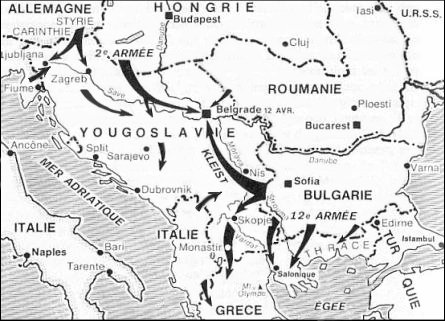
(German lines of attack into Yugoslavia and Greece, April 6th, 1941)
Known as the Balkan Campaign, the German invasion of these two countries happened relatively swiftly and with great success. However, Hitler came to blame the necessity for these actions, because the Italians couldn’t conquer Greece alone, for the failure of Operation Barbarossa and the loss to Russia.
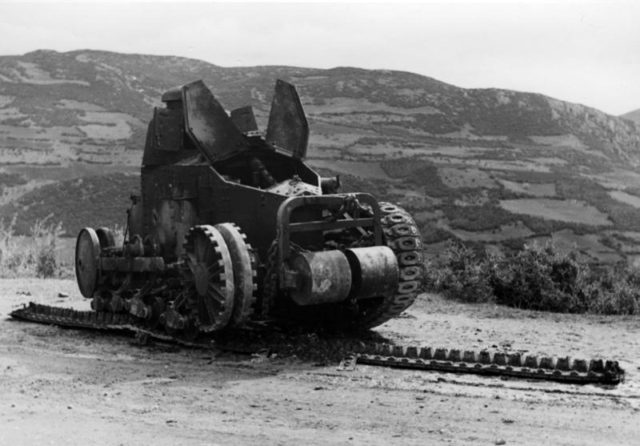
(Destroyed Yugoslavian Renault NC tank)
Yugoslavia, though dominated government and military by the people of Serbia was also comprised of the Slovenian and Croatian people. All these people now have their own nations as well as the other small nations of former Yugoslavia. Even before the German invasion, Croats and Slovenes began rebelling against Serbian rule. Croatia formed its own government and aligned with the Nazis. Huge portions of Yugoslavia’s army mutinied when the invasion commenced.
The invasion began with a massive aerial bombing of Belgrade in which tens of thousands of civilians were killed.
Very little organized resistance met the Germans outside of ethnic Serbs fighting in Serbia. So despite having 700,000 troops, though many poorly trained and equipped, before the invasion, Yugoslavian resistance crumbled very quickly and ended in just 12 days.
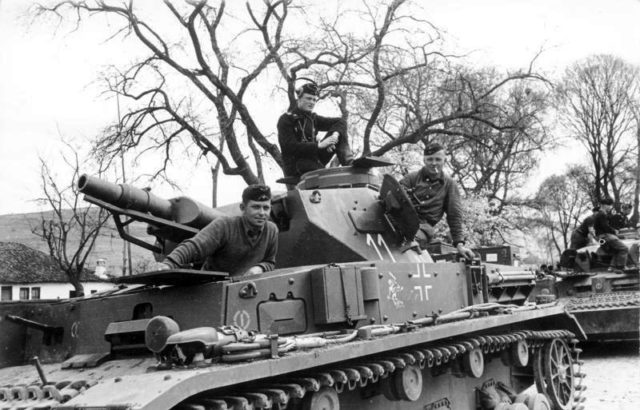
(German Panzer IV of the 11th Panzer Division advancing into Yugoslavia from Bulgaria as part of the Twelfth Army)
Yugoslavia did have a compelling strategy if faced with an overwhelming German invasion: retreat from all fronts except the Southern, advancing on the Italian positions in Albania, meet up with the Greek army and build a substantial Southern front. But due to the rapid fall of the country and inadequate gains against the Italian Army, this move failed and Yugoslavia surrendered to Germany.
The Greeks fared somewhat better due in large part to a kingdom far less divided, and to substantial support from British Imperial forces, including from Australian, New Zealand, Palestine, and Cyprus.
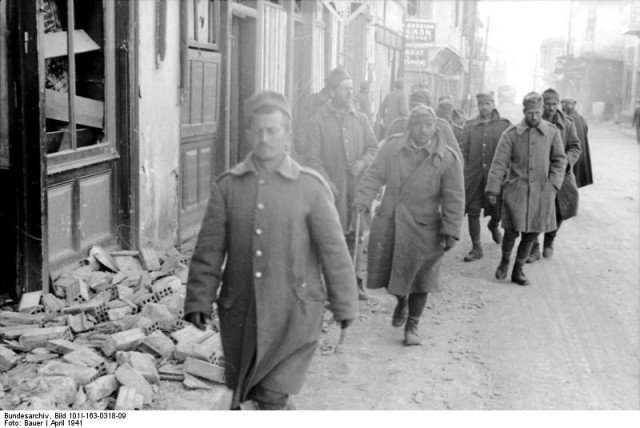
(Greek soldiers retreating in April 1941)
The British, however, were not able to commit nearly enough troops to the defense of Greece and the deployment of over 60,000 men was heavily criticized and seen as a largely symbolic gesture of support to fight a “gentleman’s war” of honor that was sure to be lost.
The Greeks had a formidable front line defense along their Northeastern border with Bulgaria called the Metaxas Line. Similar to the Maginot Line in France, it featured pillboxes and other fortifications. But the Greeks, who had the bulk of their army fighting the Italians in Albania to the West, were not nearly prepared to defend it well. They did so anyway, despite British requests to form a shorter, more concentrated line further into the Greek mainland.
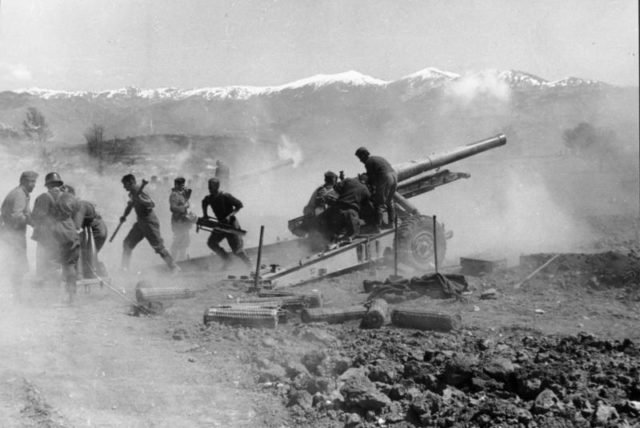
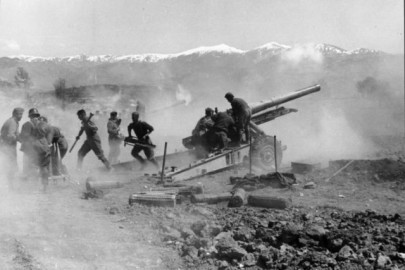
(German artillery firing during the advance through Greece)
Germany’s blitzkrieg warfare pushed, front by front, down the East side of Greece, gradually defeating the underequipped Greeks and Numerically inferior British over several weeks. They reached Athens on April 27th.
The Reich’s road to victory on the Greek mainland (Crete didn’t fall until June 1st, 1941) would have been much slower had things fared better for the Allies to the North and West. The swift collapse of Yugoslavia was not anticipated and German forces sweeping in across that border were in a position to flank the Greeks and British fighting to the East and the Greek army fighting the Italians to the West.
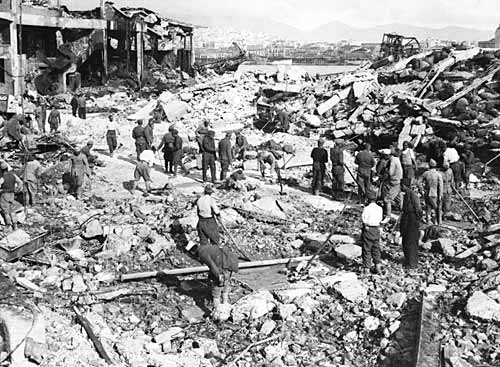
(Devastation after the German bombing of Piraeus)
The Greeks, reluctant to concede to the Italian army they had been fairing so well against, wouldn’t pull back their front until it was too late and the Germans advancing from Yugoslavia flanked them and forced their surrender.
There is an unconfirmed legend that when the Germans entered Athens and marched to the Acropolis to raise the Nazi flag, an Evzone soldier (elite Greek infantry) named Konstantinos Koukidis lowered the Greek flag and refused to surrender it to the German officer. He wrapped himself in the flag and jumped off the Acropolis to his death.
With stories like this, a long recent history of enduring occupation by outside nations like Venice and the Ottoman Empire, and actions from Germany like allowing the Greek army to surrender to them and not Italy and to disband and go home instead of being taken as prisoners, allowed Greece to save pride.
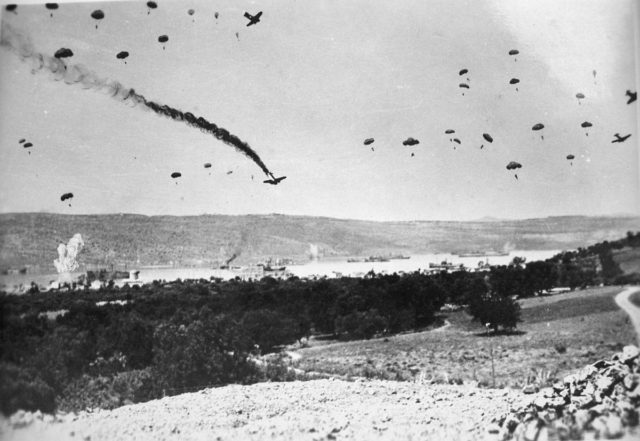
(German paratroopers land in Crete)
According to the 1995 book Greece 1940-41: Eyewitness, by Maria Fafalios and Costas Hadjipateras, on the eve of the Germans entering the capital, Athens Radio aired this message:
“You are listening to the voice of Greece. Greeks, stand firm, proud and dignified. You must prove yourselves worthy of your history. The valor and victory of our army have already been recognized. The righteousness of our cause will also be recognized. We did our duty honestly. Friends! Have Greece in your hearts, live inspired with the fire of her latest triumph and the glory of our army.
Greece will live again and will be great because she fought honestly for a just cause and for freedom. Brothers! Have courage and patience. Be stout-hearted. We will overcome these hardships. Greeks! With Greece in your minds, you must be proud and dignified. We have been an honest nation and brave soldiers“.
Ask me anything
Explore related questions




