





If President Donald Trump is to fulfil his inauguration pledge to eradicate “radical Islamic terrorism” he will soon have to decide who he is going to do this with.
The battle to retake Mosul, the northern Iraqi city that Isis seized in a lightning strike in 2014, is well under way. US special forces are operating alongside Iraqi elite units and aligned with Kurdish peshmerga and Iraqi Shia militia backed by Iran. The decision now is about how to recapture Raqqa, the Isis stronghold in north-east Syria. That means deciding between two antagonistic US allies: Nato partner Turkey; and Syrian Kurdish militia known as the People’s Defence Units (YPG).
Not just the territorial defeat of Isis in its cross-border jihadi caliphate hangs on Mr Trump’s choice. The future of the Kurds, a stateless people spread over Syria and Iraq, Turkey and Iran, hangs in the balance too.
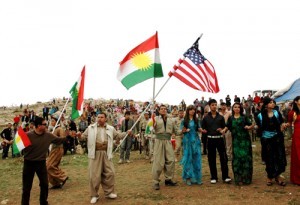
On the campaign trail last year, Mr Trump praised Kurdish forces, saying they had “proven to be the best fighters” and “the most loyal to us”. This has raised Kurdish hopes. Iraqi Kurds, already self-governing and endowed with oil riches inside their Kurdistan Regional Government (KRG), want America eventually to bless their separation from a Shia-dominated Iraq they believe will never share power. The Syrian YPG, to which the US provides air cover, is seeking better weapons and political support for home rule inside Syria.
The Syrian Kurdish fighters became a legend, after defeating an Isis that then seemed unstoppable, at the ferocious siege of Kobani on the Turkish border in 2014-15. A narrative of their pluck and courage, and the fierce exploits of their women combatants — an aesthetic gift to the media — combined with an unmatched battle record against Isis to make them almost indispensable allies to the US.
Turkey’s fears grew in tandem with this Kurdish success, in particular that territorial advances by the Syrian Kurds across its southern border would embolden Turkish Kurds to push for self-rule on their side of the frontier. Ankara’s hostility is sharpened by the YPG’s affiliation to the Kurdistan Workers’ party (PKK), with which Turkey has been at war almost continuously since 1984.
Yet even though Turkey is a Nato ally, its neo-Islamist government, dominated by President Recep Tayyip Erdogan, is not in the strongest position.
Dedicated to toppling Bashar al-Assad’s regime in Syria and playing a lead role in the formerly Ottoman Arab lands swept by turmoil after 2011, Turkey for five years permissively allowed jihadis as well as mainstream Syrian rebels to transit and base in their territory. Despite a string of Isis bombings from Istanbul airport to an Ankara railway station, Turkey only last summer took the fight to the jihadis. Yet the circumstances of this will not necessarily encourage President Trump to ditch the YPG and team up with Turkey against Isis to take Raqqa.
Turkey sent troops into north-west Syria last August, alongside some 3,000 so-called Free Syrian Army rebels, clearing Isis from 98km of border. Its primary objective was to prevent YPG fighters crossing the Euphrates river to link up their two eastern cantons with Afrin, the territory they control in the west. To do this, Mr Erdogan needed a green light from President Vladimir Putin, whose Russian air force was helping Mr Assad to recapture eastern Aleppo. For some rebels, Turkey in effect siphoned off defenders of the opposition’s last great urban stronghold, changing the course of the war by switching sides to Russia.
Turkey’s reliability in Syria, for anything except its determination to halt Kurdish advances, is therefore in question. Throughout most of this savage and shape-changing conflict, Syria’s Kurds have held more of their country’s border with Turkey than the Turks — and the stretches they control have been better policed against jihadi marauders. Along with some 5,000 Syrian Arab tribal militia, they can field 30,000 fighters, already pressing down towards Raqqa.
Unless Turkey were to commit divisions of its army — severely weakened by the purges that followed last July’s abortive coup against Mr Erdogan — it will not match the Syrian Kurds. Its Free Syrian Army force and Islamist proxies probably amount to 3,000 to 5,000 fighters. It has taken them three months to more or less capture the north-west town of al-Bab from Isis. Ankara’s proposal for the much bigger fight for Raqqa is, once again, more about blocking the YPG. “Ankara doesn’t just want to prevent the two Kurdish cantons east of the Euphrates river uniting with the one on the west,” writes Cengiz Candar, a veteran Turkish analyst of Kurdish affairs, “it wants to also separate the two cantons in the east.”
When Syrian Kurdish momentum spilled over into Turkey’s Kurdish heartland in 2015 the PKK, in its militarist overconfidence, played into the hands of Mr Erdogan, who needed a nationalist drum to beat to consolidate his increasingly autocratic power. But that was before President Trump arrived with his heat-seeking anti-Isis policy. He must now choose between what would appear to be a limited, less than convincing Turkish operation — called Euphrates Shield — and the Kurdish-spearheaded push already under way — dubbed Euphrates Wrath.
Ask me anything
Explore related questions




