





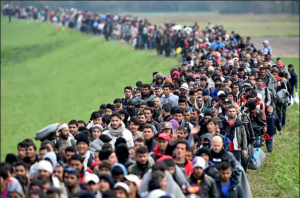
The European Commission launched a legal case on Tuesday against Poland, Hungary and the Czech Republic for refusing to take in asylum seekers, ratcheting up a bitter feud within the 28-nation bloc about how to deal with migration.
The eurosceptic, nationalist-minded governments in Poland and Hungary have refused to take in anyone under a plan agreed by a majority of EU leaders in 2015 to relocate migrants from frontline states Italy and Greece to help ease their burden.
The Czech Republic, another ex-communist central European state, initially accepted 12 people but has since said it would not welcome more.
“I regret to see that, despite our repeated calls to pledge to relocate, the Czech Republic, Hungary, and Poland have not yet taken the necessary action,” the EU’s migration commissioner, Dimitris Avramopoulos, told a news conference.
He said the Commission was therefore launching so-called infringement procedures against the three, a way for the executive arm to take to task countries that fail to meet their obligations. It opens the way for months, even years, of legal wrangling before a top EU court could potentially impose fines.
“From the political point of view, this action … unnecessarily heats up political tensions, of which there are already too many in the European Union,” Polish Deputy Foreign Minister Konrad Szymanski told state TV on Tuesday.
“If necessary, Poland is ready to defend its legal arguments in court.”
At stake in the dispute is the bloc’s unity, already tested by Britain’s unprecedented decision to leave, weak economies and higher support for eurosceptic parties across the EU.
Beyond its borders, the EU is also facing a resurgent Russia and a tricky new relationship with U.S. President Donald Trump.
But two years of arm-wrestling have so far produced no results and EU leaders are unlikely to be able to break the impasse when they discuss the matter next week in Brussels.
“The Czech Republic does not agree with the system of relocation,” Prime Minister Bohuslav Sobotka said in response.
“With regard to the worsened security situation in Europe and dysfunctionality of the quota system, it will not participate in it.”
In a separate legal battle on the matter, Hungary and Slovakia have challenged the relocation agreement in a top EU court, with an initial indication of the ruling due next month.
TARNISHED UNITY
The easterners justify their stance on asylum seekers by citing security concerns, noting a series of militant Islamist attacks in western Europe since late 2015. The bulk of refugees come from the mainly Muslim Middle East and North Africa.
Their resistance to what they present as pressure from Brussels also earns them credit with eurosceptic voters at home.
Many other EU states have also dragged their feet over taking in refugees, with fewer than 21,000 people relocated from Italy and Greece so far under a plan that had been due to cover 160,000 people.
Wealthier EU states including Italy – now the main gateway to Europe for African migrants and refugees – have threatened to reduce generous development funds earmarked to help the easterners close the gap in living standards.
The Commission is backed in the feud by Germany and Sweden, countries that took in most of the people who arrived in the EU. They have been mounting pressure on the vehement easterners over recent weeks and months but to no result so far.
Brussels’ confidence has been boosted by ardently pro-EU French President Emmanuel Macron’s victory over eurosceptics and nationalists, which gave the EU a renewed confidence a year after Brexit thrust it into an existential crisis.
But Avramopoulos said the timing of the decision came after the executive had been warning governments for months to change tack and had simply “exhausted all options” with the holdouts. An EU official said that despite its legal challenge, Slovakia had heeded the call to take in refugees and so escaped sanction.
After more than a million migrants and refugees reached the EU in 2015, mostly via Greece, Brussels sealed an accord with non EU-member Turkey that sharply cut the overall number of arrivals, though the deal was criticized by rights groups.
Italy remains under pressure, but the EU treats the vast majority of the 64,000 people who made it to Italian shores this year as migrants – rather than refugees requiring legal protection – and does not plan to let them stay.
The internal EU dispute over relocating asylum-seekers is a political one about values, as Avramopoulos stressed in his renewed appeal to the easterners.
“Europe is not only about requesting funds or ensuring security. Europe is also about sharing difficult moments and challenges,” he said.
Ask me anything
Explore related questions




