





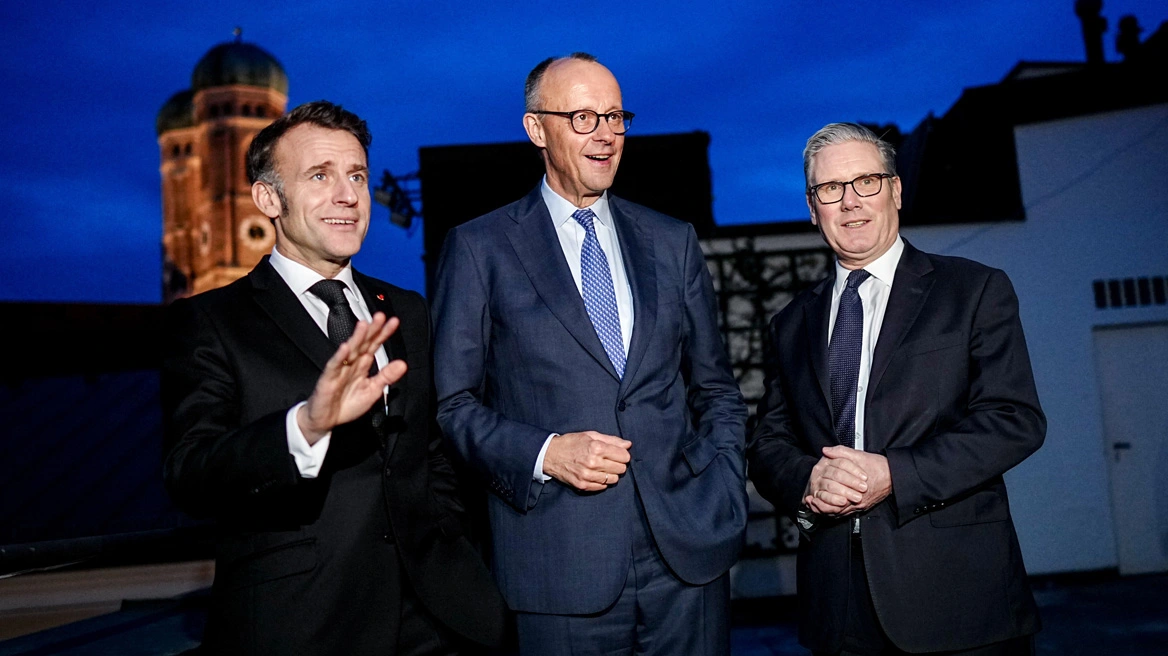
Last year, the “steamroller” J.D. Vance shocked Europe with a speech signaling that the United States intended to chart a different course. This year, at the Munich Security Conference, the tone from the outset has been one of alliance-building and strategic reorientation, as Europe realizes that a gradual “weaning” from the U.S. must move from theory into practice.
Underscoring the sense that the U.S. is, in effect, pushing Europe toward new partnerships, U.S. Secretary of State Marco Rubio (who is expected to speak at the conference on Saturday) signaled his intentions by canceling, at the last minute, a meeting with European leaders and officials focused on peace efforts for the war in Ukraine.
European capitals interpret the move as evidence of Washington’s waning interest in including Europeans in U.S. planning for resolving the conflict in Ukraine.
Rubio had been scheduled to attend a meeting in Munich on Friday afternoon with the leaders of Germany, Poland, and Finland, as well as representatives of the European Commission. He canceled at the eleventh hour, citing “scheduling difficulties.”
“The Secretary will not attend the Berlin meeting on Ukraine due to the large number of meetings he has at the same time,” a U.S. official said, while assuring that the head of U.S. diplomacy is “addressing the Russia-Ukraine issue in many of his meetings here in Munich.” A European official, speaking on condition of anonymity, described the cancellation as “outrageous.”
The development comes as the Trump administration continues to distance itself from its European allies and seeks to pressure Ukraine toward a settlement with Russia, the Financial Times commented, having first reported the cancellation. “The meeting no longer made sense without U.S. participation,” a second European official told the British newspaper.
The message appears to have been received by German Chancellor Friedrich Merz, who opened the conference—he has called it a “seismograph for global developments.” This was also evident in other interventions on the first day. Traditionally, the German chancellor’s speech takes place on the second day, but Merz moved it to the opening to set the tone from the outset.
Merz: Leaving behind dependence on the U.S.
“We are living through a period of profound change,” the German chancellor noted, referring to Moscow’s revisionist plans and China’s growing military role.
“Great-power politics are harsh and unpredictable,” he said, defining Europeans’ first task as “recognizing these realities without fatalism. We must believe in our strengths and respond to these challenges by defining our goals and capabilities. Above all stands freedom, guaranteed by security.”
He continued: “We must flip the switch in our minds. Excessive power threatens freedom, but insufficient power does so as well, in a different way. It is not enough merely to react to the maneuvers and moods of the great powers. We must define our own agenda. Leadership together with partners—not fantasies of hegemony—is Germany’s approach.”
As for the pillars of the new approach, Merz outlined strengthening Germany’s military to reduce dependencies; reinforcing the idea of Europe by focusing on essentials and tackling bureaucracy and over-regulation; and forging a new transatlantic relationship that would heal the rift with the United States.
“Democracies need partners and allies. No one imposed dependence on the U.S. on us—it was our own decision, and we are now leaving it behind,” he stressed, adding that “we want a new network of partners with whom we may not share everything, but with whom we share a great deal.” He named Canada, India, Turkey, South Africa, and Brazil.
Ahead of Merz’s speech, Deutsche Welle noted that, after the Greenland affair (another shock for the EU), “Europe is fully awake and clearly shows it is now looking in all directions, not only toward the United States.”
“The EU’s trade agreements with Mercosur and with India are living proof of Europe’s newly acquired self-confidence,” the German network added.
Berlin, the Greek-language service commented, “is now openly declaring that it is seeking new, stable, long-term alliances precisely because the old ones are being shaken.” The question, of course, is how quickly the EU’s heavy ship can turn.
German media observed that Merz was responding, in his own way, to Vance’s speech last year—while also pre-empting Rubio’s upcoming address. The question, some German commentators note, is not only whether Americans heard him, but whether “Europeans will hear him as well.”
Macron: Free ourselves from dependencies
After 8:00 p.m. (Greek time), French President Emmanuel Macron delivered a highly anticipated speech.
He began by sending a “message of hope and determination. Europe can become stronger. We need a positive approach.” Europeans should be proud and highlight their achievements, he said, adding—after addressing Ukraine—that “there can be no peace without Europeans.”
“All matters that concern Europeans must also be decided by Europeans,” he emphasized. “We will continue to live next to Russia, and it is up to us to define that neighborhood.”
“In this new framework we must become stronger and more independent. I do not mean France. I do not mean Germany. I mean Europe as a whole. We must view power collectively as Europeans, free ourselves from dependencies in a range of areas, and set clear goals,” he continued.
Voices for strategic autonomy
EU High Representative for Foreign Affairs Kaja Kallas set the tone of EU policy during a panel that turned into an informal Euro-American debate, according to Deutsche Welle.
“What is the difference when Russia wages war? It does so alone, because it has no allies. When the U.S. wages war, we go with you and lose our own people. The difference between you and other powers is that you have allies,” she said.
Of particular interest was Kallas’s call for the EU to pursue joint borrowing for defense spending, as was done during the pandemic. She recalled that Europeans had taken on common debt for the first time to confront a threat shared across Europe—arguing that the same logic applies today, making joint borrowing “meaningful,” while acknowledging sensitivities in German public opinion.
Finnish President Alexander Stubb echoed the point elsewhere, saying Europeans can secure their own defense—and adding that “we can also help the Americans, if they need us.”
The message is coming even from German industrialists: “Europe’s defense must be planned and prepared—if necessary, even against Washington.”
Ask me anything
Explore related questions




