





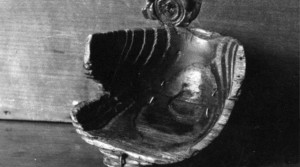
British police raided a provincial pub in England seeking a stolen wooden relic which some believe to be … the Holy Grail, the cup from which Jesus drank wine at the Last Supper before the crucifixion.
The Holy Grail has captured the imagination of thousands of people over the centuries and around the myth have been countless theories from the Middle Ages until today.
The subject of the police investigation-that proved unsuccessful, as most searches of the Holy Grail was a fragile wooden bowl, known by the name Nanteos. Since the 19th century this heirloom attributed miraculous and many began to believe that Nanteos identified with the Holy Grail.
Based on information, eight policemen and a specially trained police dog arrived on Sunday morning at the Crown Inn, a pub in Cherforntsir England. According to the pub owner Dai Franklin the police “searched the place thoroughly and made a big mess . They had optical fiber cameras and looked at all angles, the pits, crannies, under the flooring boards. . . certainly they had taken it very seriously ” .
According to the police the Nanteos, a cup of dark wood was kept in a blue velvet bag, which was stolen from a home in the area about a month ago. The photographs circulating at the Internet illustrated a cup-shaped container, which half side missing.
“The pub visit all sort of people, cheats and charlatans, but none of them is able to steal a priceless ancient relic,” added the pub owner.
The cup is named from villa Nanteos, a cottage in Wales where it was kept until 1952. Monks had taken it there in the 16th century, after the dissolution of the monasteries in England by King Henry I.
It is said that the cup was transferred to Britain by Joseph of Arimathea, a secret disciple of Jesus who asked permission to disestablishment his body from the cross and bury it. The legend also wants Joseph to have transfer the Holy Grail in Europe.
Scientists who have examined the Nanteos they have declare that the cup is many centuries after the crucifixion. Also, it is made of olive wood, as one would expect for an ancient cup from the Middle East.
Ask me anything
Explore related questions




