





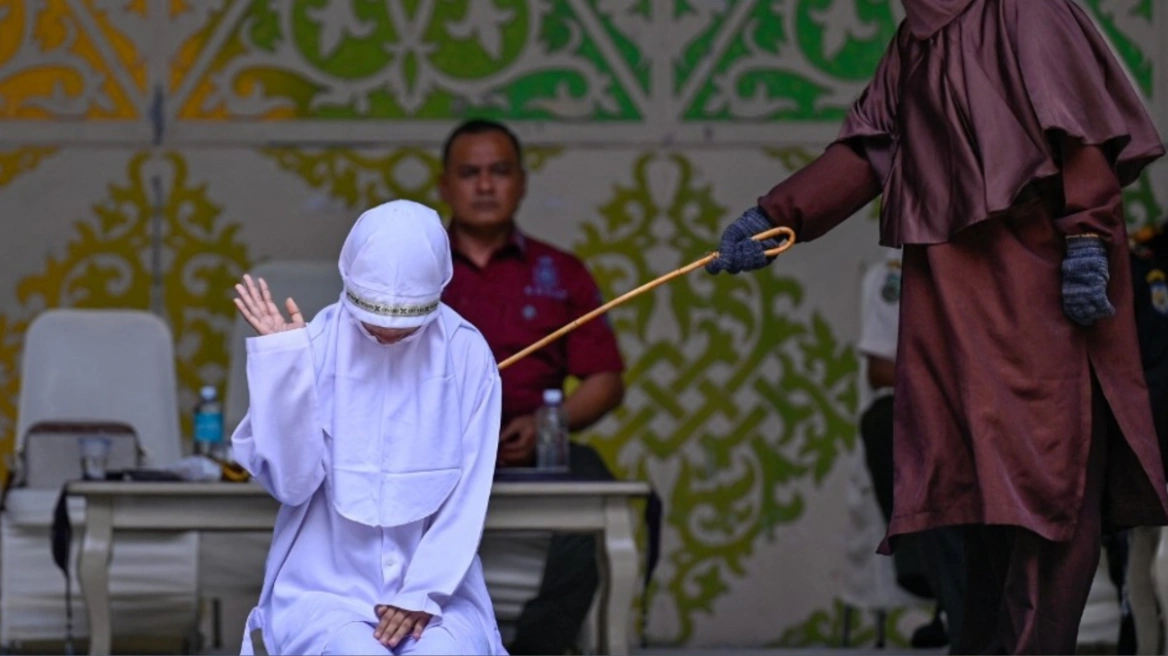
A woman collapsed after being publicly caned for having sexual relations outside marriage in Indonesia, where the enforcement of Islamic law in the province of Aceh continues to provoke strong reactions from human rights organisations.
Footage from Banda Aceh, the capital of the country’s only province that actively enforces Sharia law, shows medical personnel and religious police officials gathering around the woman after her punishment was carried out. Meanwhile, a man dropped to his knees in pain as he was caned for adultery.
The woman and the man were among eight people sentenced by an Islamic court in Banda Aceh for violating various provisions of Sharia law. Their sentences included up to 100 strokes of the cane.
The punishments were carried out on a public platform in the city, in the presence of Islamic court officials and members of the public who had gathered to watch.
The canings are administered by specialist executioners known as “algojos”, who use rattan canes to strike those convicted.
The executioners wear dark uniforms that cover their entire bodies, while their faces remain concealed to protect their identities.
These corporal punishments are imposed for a range of offences, including alcohol consumption, gambling, homosexual acts and sexual relations outside marriage.
Convicts faint from pain as public humiliation takes centre stage
Public caning in Aceh is intended not only as physical punishment but also to publicly shame those found guilty of violating Islamic law.
The sentences are often carried out outside mosques or in central squares, in front of members of the public, many of whom record the proceedings on their mobile phones.
It is not uncommon for those being punished to faint from the pain. Photographs and videos have repeatedly captured men and women being carried away on stretchers after being caned.
Human rights organisations have condemned the combination of physical violence and public humiliation, warning that it can cause serious psychological harm that may last for years.
International condemnation: “Cruel and inhuman punishment that may amount to torture”
Amnesty International and Human Rights Watch have repeatedly condemned the practice, arguing that it violates both Indonesia’s Constitution and the country’s international obligations.
In a previous statement, Amnesty International said:
“Caning is contrary to the Indonesian Constitution and constitutes a clear violation of international law and international human rights standards.”
The organisation added that it was a “cruel, inhuman and degrading punishment that may amount to torture”, in breach of the United Nations Convention against Torture and other international agreements to which Indonesia is a party.
Usman Hamid, Amnesty International’s executive director in Indonesia, has also previously criticised the disproportionate severity of punishments for certain behaviour on social media.
“Such behaviour may be considered inappropriate because social media is used by people of different ages, including children,” he said.
“But is it a crime that warrants imprisonment or even caning? That would be excessive,” he added.
Local authorities, for their part, defend the practice, arguing that it acts as a deterrent and forms part of the province’s religious and cultural identity.
Critics, however, warn that the practice has damaged Indonesia’s international reputation on human rights and inflicts lasting trauma on those subjected to the punishments.
Despite the backlash, public caning continues to enjoy widespread support among Aceh’s predominantly Muslim population.
How Aceh became Indonesia’s only province to enforce Sharia law
Indonesia is the world’s most populous Muslim-majority country, with more than nine in ten of its residents identifying as Muslim. The original report cites a population of 255 million, a figure that reflects older demographic data.
Although most of the population follows a moderate form of Islam, the Indonesian state officially recognises six religions, as well as indigenous religious beliefs.
Aceh is an exception when it comes to the enforcement of religious law.
In 2001, the central government granted the province special autonomy in an attempt to end a long-running separatist insurgency.
Under the agreement, Aceh gained the right to apply Sharia as part of its legal system, making it the only province in Indonesia with this status.
The implementation of Islamic law began in 2002, while additional provisions introduced in 2003 expanded restrictions on private and social life.
These included a ban on being alone with a person of the opposite sex unless they were a spouse or relative.
Penalties were also introduced for sexual offences, extramarital relationships, displays of affection between unmarried people and sexual relations involving minors.
Religious police target even women who do not wear headscarves
Religious police checks in Aceh extend to many aspects of everyday life.
There have been reported cases of Muslim women being targeted for not wearing headscarves or for choosing tight-fitting clothing.
Similar checks are carried out against people who consume alcohol or participate in gambling.
The strict rules can lead to penalties even for behaviour such as standing too close to one’s partner in a public place or being alone with someone to whom one is not married.
Men and women have collapsed in pain after their sentences were carried out, with the severity of their injuries intensifying concerns about their physical and mental health.
The beheading proposal that sparked outrage
Over the past decade, Indonesia’s central government has delegated additional powers to regional authorities in an effort to strengthen autonomy and accelerate development.
In Aceh, however, the enforcement of religious law has repeatedly sparked controversy.
In 2018, local authorities launched a public consultation on the possibility of introducing beheading as a form of punishment.
The proposal prompted a reaction from Indonesia’s central government, which warned that such a measure would not be permitted under national law.
Despite international condemnation, public canings remain part of the province’s criminal justice system, with human rights organisations continuing to call for the practice to be abolished.
Ask me anything
Explore related questions




