





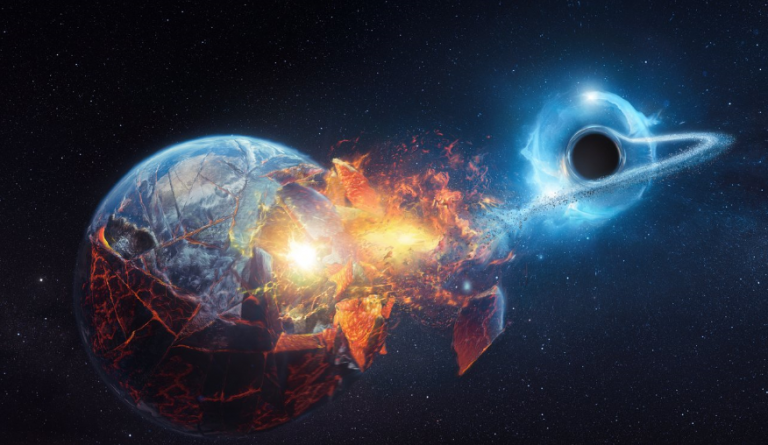
Ever wondered how the world might end? According to physicists, one unnerving possibility could involve Earth being swallowed up by a black hole created by freak gravitational waves.
Gravitational waves are invisible ripples in space that travel at the speed of light. The most powerful of these waves occur when objects move very quickly, for instance when two big stars orbit each other or two black holes orbit one another and merge. Such waves are often compared to the circular ripples that emerge when a stone is dropped in water.
However, if a particle or object travels at the speed of light, flat gravitational waves can result.
So, what would happen if these waves ran into each other? Scientists at Princeton University and the Perimeter Institute for Theoretical Physics in Waterloo, Ontario, set out to answer this question using numerical solutions of the Einstein equations. These 10 equations detail Albert Einstein’s general theory of relativity.
The findings published in the journal General Relativity and Quantum Cosmology indicate that if the waves were big enough, such as collision could create a black hole: an area of space with such a strong gravitational field that even light can’t escape from it.
The physicists believe such a freak gravitational wave could be powerful enough to tangle space-time. That in turn could create a black hole. The resulting black hole could swallow up 85 percent of the wave’s energy, while some of the lingering ripples would orbit the hole forever.
Frans Pretorius, study co-author and a professor of physics at Princeton University, told New Scientist: “These particles have a lot of energy and produce curvature in space-time, and when the waves collide, that curvature wraps in on itself. Space-time is sort of sucking itself into a black hole.”
Reassuringly, however, if small waves collided they would likely cross each other and dissipate.
Dr. David Garfinkle, a professor in the department of physics at Oakland University in Michigan, told New Scientist nothing in the known universe exists that could cause plane-fronted waves to form a black hole.
The researchers believe the methods used in their study could help to solve other problems relating to strong field gravity and cosmology that involve particle distributions of matter.
Earlier this year, astronomers found the fastest-growing black hole ever. It ate up a mass equaling that of the sun’s every two days. The black hole grew at 1 percent every million years, 12 billion years ago.
“We don’t know how this one grew so large, so quickly in the early days of the Universe,” Christian Wolf, an astronomer at the Australian National University (ANU), said in a statement. “The hunt is on to find even faster growing black holes.”
Wolf continued: “This black hole is growing so rapidly that it’s shining thousands of times more brightly than an entire galaxy, due to all of the gases it sucks in daily that cause lots of friction and heat.”
Source: newsweek
Ask me anything
Explore related questions




