

×
GreekEnglish

×
  • Politics
  • Diaspora
  • World
  • Lifestyle
  • Travel
  • Culture
  • Sports
  • Cooking
Wednesday
24
Dec 2025
weather symbol
Athens 11°C
  • Home
  • Politics
  • Economy
  • World
  • Diaspora
  • Lifestyle
  • Travel
  • Culture
  • Sports
  • Mediterranean Cooking
  • Weather
Contact follow Protothema:
Powered by Cloudevo
> technology

RIP Kepler: NASA’s revolutionary planet-hunting telescope runs-out of fuel

"This marks the end of spacecraft operations for Kepler, and the end of the collection of science data"

Newsroom October 31 09:53

The most prolific planet-hunting machine in history has signed off.

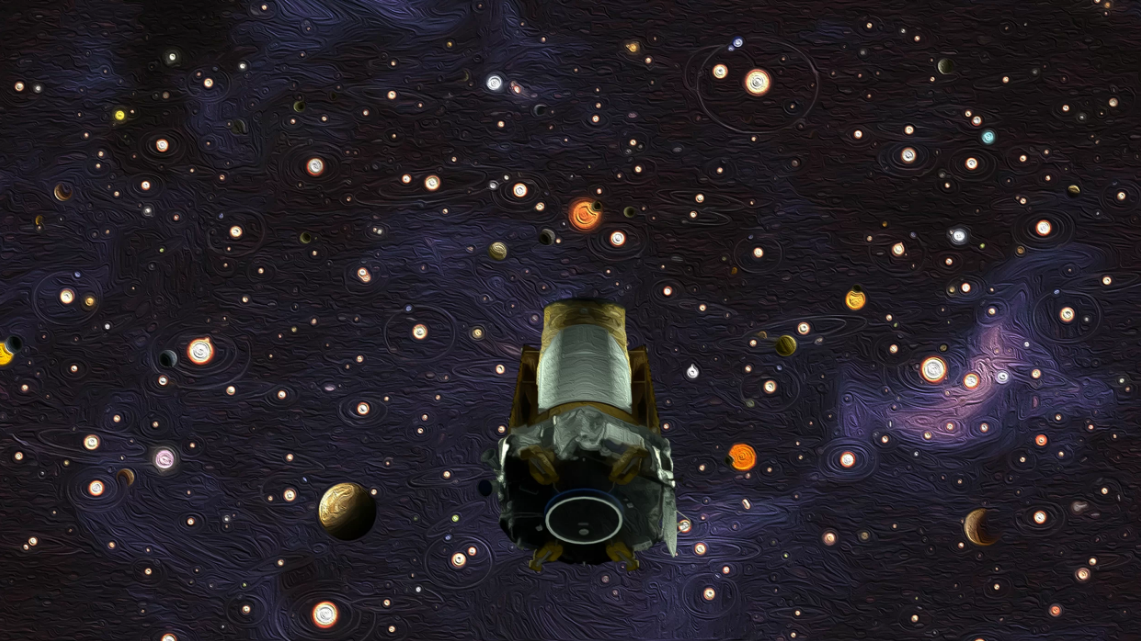
NASA’s Kepler space telescope, which has discovered 70 percent of the 3,800 confirmed alien worlds to date, has run out of fuel, agency officials announced today (Oct. 30). Kepler can no longer reorient itself to study cosmic objects or beam its data home to Earth, so the legendary instrument’s in-space work is done after nearly a decade.

And that work has been transformative.

“Kepler has taught us that planets are ubiquitous and incredibly diverse,” Kepler project scientist Jessie Dotson, who’s based at NASA’s Ames Research Center in Moffett Field, California, told Space.com. “It’s changed how we look at the night sky.”

Today’s announcement was not unexpected. Kepler has been running low on fuel for months, and mission managers put the spacecraft to sleep several times recently to extend its operational life as much as possible. But the end couldn’t be forestalled forever; Kepler’s tank finally went dry two weeks ago, mission team members said during a telecon with reporters today.

“This marks the end of spacecraft operations for Kepler, and the end of the collection of science data,” Paul Hertz, head of NASA’s Astrophysics Division, said during the telecon.

Leading the exoplanet revolution

Kepler hunted for alien worlds using the “transit method,” finding the brightness dips caused when a planet crosses its star’s face from the spacecraft’s perspective.

Those dips are tiny — so tiny, in fact, that NASA officials were originally dubious that a spacecraft could make such measurements. The driving force behind Kepler, Ames’ Bill Borucki, had four mission proposals rejected in the 1990s before finally breaking through in 2000, after he and his team demonstrated the instrument’s sensitivity at a test-bed facility on Earth. (Borucki retired in 2015.)

>Related articles

Research: The BBC’s “first Black Briton” from the Roman era was ultimately…white and originated from southern England

The Greeks of Silicon Valley

Voyager 1 ready to make history again: in 2026 it will reach a distance of “one light-day” from Earth

It still took a while for Kepler to get aloft. The spacecraft launched in March 2009, on a $600 million mission to gauge how common Earth-like planets are throughout the Milky Way galaxy.

Initially, Kepler stared continuously at a single small patch of sky, studying about 150,000 stars simultaneously. That work was incredibly productive, yielding 2,327 confirmed exoplanet discoveries to date.

Read more HERE

Ask me anything

Explore related questions

#Alien#Kepler#nasa#revolution#RIP#science#technology
> More technology

Follow en.protothema.gr on Google News and be the first to know all the news

See all the latest News from Greece and the World, the moment they happen, at en.protothema.gr

> Latest Stories

The sarcophagus over Chernobyl will not withstand a direct hit by a missile or drone, says the director of the

December 23, 2025

US announces tariffs on microchips imported from China from 2027

December 23, 2025

Russia and the US have not yet found solutions to “troublesome” issues in their relations, Moscow says

December 23, 2025

Video of the French Navy raid on the ship of the Greek “Escobar”

December 23, 2025

Learjet crashes in Ankara: Libya’s Chief of the General Staff, Mohammed Al-Haddad, dead

December 23, 2025

Ryanair fined €256 million by Italy for abusing dominant market position

December 23, 2025

6th Meeting of Catechumens and distribution of catechetical material in Stockholm

December 23, 2025

The cost of blockades to the market reaches €200 million per week, with Thessaly suffering the greatest damage

December 23, 2025
All News

> World

The sarcophagus over Chernobyl will not withstand a direct hit by a missile or drone, says the director of the

The New Security Enclosure was severely damaged in a Russian drone attack last February

December 23, 2025

Russia and the US have not yet found solutions to “troublesome” issues in their relations, Moscow says

December 23, 2025

Learjet crashes in Ankara: Libya’s Chief of the General Staff, Mohammed Al-Haddad, dead

December 23, 2025

Where Christianity is still Persecuted: Beheadings in Mozambique, underage sex slaves in the Occupied Cyprus, churches burned in Nigeria, rapes in Pakistan

December 23, 2025

Our army will remain in Gaza, says Israeli Defence Minister

December 23, 2025
Homepage
PERSONAL DATA PROTECTION POLICY COOKIES POLICY TERM OF USE
Powered by Cloudevo
Copyright © 2025 Πρώτο Θέμα



