





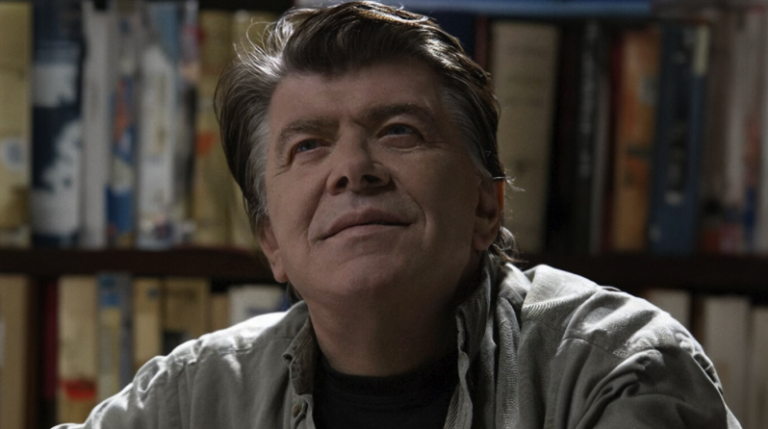
“A classical composer and someone who plays rebetiko can have the same artistic value”, the great poet Nikos Gatsos assured the young, restless composer one evening in 1967, who approached him timidly asking him to provide him with lyrics for his music.
And it was this small but so essential phrase that unlocked the many different paths of the musical genius of Dimos Moutsis, which freed him and allowed him to capture in notes the rushing musical river of his inspiration, which was decisive for the development of Greek song.
Because Dimos Moutsis, who passed away yesterday at the age of 86, was one of the greatest and most influential chapters in the history of Greek songs.
He was the one who signed some of the most beloved and timeless songs of Greek discography, the one who sang by great voices such as Bithikotsis and Moscholiou, and introduced remarkable young performers such as Mitsias, Mitropanos, Galani and Protopsaltis, and did not hesitate to fuse the influences of Hatzidakis and Vamvakaris with the electronic sound.
Pioneering and timelessly unconventional, with innate musical talent, popular but at the same time classical and contemporary, melodic but hard, true, straightforward but explosive and quirky and lonely, he combined music with poetry and opened new paths in Greek singing, radically changing the domestic musical landscape.

Moutsis with Dimitra Galani and Grigoris Bithikotsis
Stubbornness, after all, was an element that characterized him from his childhood, when at just seven years old he demanded that his poor family, who were raising him in Piraeus, teach him music, without even being exposed to any musical influence.
And yet his mother, a determined yet tough woman, unexpectedly responded to his pressing request and enrolled him in the “Piraeus Association” in order to take violin lessons.
Growing up, his footsteps led him to the National Conservatory where he completed his musical studies, as an honours student, in fact, to begin his formal musical journey which was to last for over half a century.
From early great songs to the revolutionary “Saint February” (Άγιο Φεβρουάριο).
It was the precise poetic speech of his artistic mentor Nikos Gatsos’ father that inspired him to write his first songs, proving, from his very first steps, that he had the stuff of a great composer.
From “It’s raining God” (Βρέχει ο Θεός), “Don’t knock on my door at midnight” (Μη μού χτυπάς τα μεσάνυχτα την πόρτα) and “Piraeotissa”(Πειραιώτισσα) with the singer Stamatis Kokkotas and “I saw you in my eyes” (Σ’ έβλεπα στα μάτια) with the inimitable Vicky Moscholiou to “Tomorrow Again” (Αύριο πάλι) with the great Grigoris Bithikotsis and “With a Complaint” (Μ’ ένα παράπονο) with the then newcomer Manolis Mitsias, Moutsis supplied the Greek repertoire of the last three years of the 1960s with popular hymns that spoke to the hearts of the people and won the difficult battle with time.
The advent of the 1970s would bring him another important meeting, this time with the great teacher Manos Hadjidakis, who, recognizing his talent, would entrust him with the orchestration and musical direction of his album “Return” (Επιστροφή), with lyrics by Nikos Gatsos, performed by the young, then Dimitra Galani and Grigoris Bithikotsis.
At the same time, he would continue to write his own songs, with the top songs of that period being “These Hands” (Αυτά τα χέρια) and “In Elefsina once” (Στην Ελευσίνα μια φορά), with lyrics by Lefteris Papadopoulos, which were performed brilliantly by Manolis Mitsias.
However, the year 1972 would prove to be a milestone in his career, but also in the history of Greek singing, with the release of his sensational album “Saint February” (Άγιος Φεβρουάριος), an inconceivable and ingeniously innovative album for the given time, a musical work, based on lyrics by Manos Eleftheriou, with the voices of Dimitris Mitropanos and Petri Salpeas, which shook the waters of Greek discography by masterfully mixing folk with art and electronic sound.
His introduction alone is enough for someone to realize that this work brought a great revolution in Greek music.
The saturation and the feeling of dissatisfaction
He, of course, failed to enjoy that era of universal success: “I don’t want to remember that state of being a ‘slave’, being handed a piece of paper and told: “Bring five songs tomorrow”.
I’d rather that era never came back.
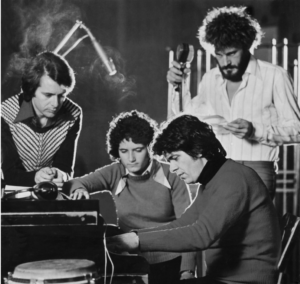
Moutsis with Alkisti Protopsaltis and Manolis Mitsia
Better my silence today than that horror that I couldn’t choose in that factory-company where I worked,” he declared a few years ago, admitting that in the late ’70s, he felt so trapped and fed up that he was thinking very seriously about retiring.
And yet, in the early 80’s, he would find his way back to renewal and the desire to create, setting the lyrics of Kostas Tripolitis to music on his album “Fragma” (Φράγμα), an excellent mishmash of folk and electric sound, from which came the sensational “Don’t say a word” (Δεν λες κουβέντα) with the “rebetiko voice” of Sotiria Bellou, which gives you goose bumps with every listen.
Somewhere there the era of his collaboration with performers came to an end and a new cycle began, now purely personal, with him writing and performing his songs.
And in this dual role he responds deservedly, proving that an accomplished creator can stand as a unit on a stage and transform himself into an ideal defender of his musical creations.
He appears in various music scenes in Athens and sings old and new very interesting pieces of his, such as the innovative “Walkman” (Γουώκμαν) and the surreal “A Weeping Harmonica” (Μια φυσαρμόνικα που κλαίει), almost always with his eyes closed, so that he can travel in his own ideal world.
Throughout his life, moreover, he was closed, solitary, even peculiar, strict with others but above all with himself, burdened with that constant feeling of unsatisfactoriness he inherited from his mother, a woman who was extremely sparing in her enthusiasm and rewards, which on the one hand deprived him of the pleasure of success and on the other hand pushed him to create new, different, innovative works in an effort not to fall into the trap of repetition:
Copernicus: The winter of 2023-2024 was the warmest ever in Greece – meteo maps
“Now that the years have passed and I reflect on what I did, I’m not very happy. The fact that I may have written five songs better perhaps than someone else is nothing to me and my character… Where others stand up to me and say ‘well done’, in my heart I always say: That’s not it, something else was needed,” he admitted in one of his last interviews, adding: “I don’t know if I go unsatisfied often. What I do know for sure is that I’m a psychopathic person who gets bored easily. Friendships don’t last long for me. I leave. We can’t go on being the same people for a lifetime in each other’s arms. We will go on, but not hugging!”
Cynical words from a man who has created so many deeply emotional songs that confirm, for the umpteenth time, his contradictory nature, his tendency towards extremes, the impulse of his passions, elements he has never tried to hide.
Moreover, as he once meaningfully stated, ‘the truly great artists are often too bad. But that’s why they are great’.
Ask me anything
Explore related questions




