





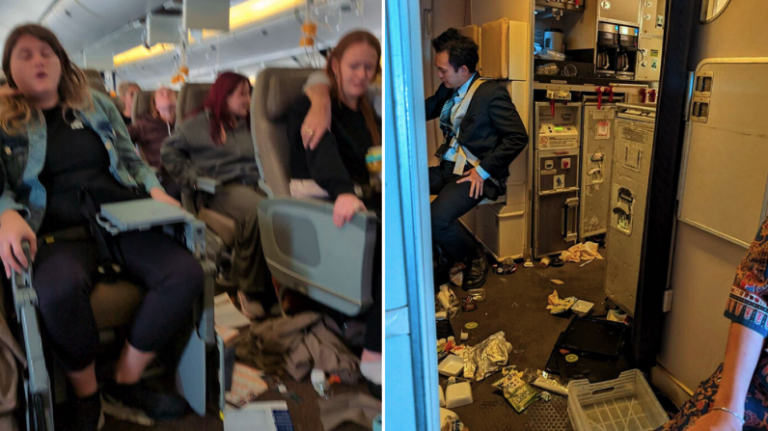
The death of a man and the injury of dozens of other passengers due to the violent turbulence that occurred during a Singapore Airlines flight yesterday morning has caused international concern and worry, especially for people who travel frequently by airplane.
The images of the shattered interior of the aircraft, as well as the fact that a traveller died of a heart attack during the terrifying incident, are a reminder of the danger of turbulence, and several international media outlets are turning to experts and statistics to find answers about the causes of the phenomenon, its frequency or even the connection it may have with the climate crisis.
Crazy footage shows the aftermath of a Singapore Airlines plane that suffered extreme turbulence during a flight from London. Tragically, one person, a 73-year-old British man, died, “likely” from a heart attack.
53 passengers and one crew member were also Injured during the… pic.twitter.com/ccNbLJtIc2
— Morbid Knowledge (@Morbidful) May 21, 2024
What happened to the Singapore Airlines aircraft
The nightmare for the passengers of flight SQ321, which was operating the London-Singapore route, began about 10 hours after it left Heathrow airport.
The plane, a Boeing 777-300R, fell into a vacuum while within Thai airspace and then encountered severe turbulence while flying at 37,000 feet over Myanmar, according to a statement issued by the airline.
The pilot declared a medical emergency and took the necessary actions to divert the flight to Bangkok, where the plane landed a few hours later.
During the terror flight, 73-year-old British man Geoff Kitchen, 73, died of a heart attack, while dozens of other people were injured.
Of those, six people were seriously injured, while 39 others received medical attention for minor injuries.
According to the latest information from the BBC, of the 211 passengers and 18 crew members on board the Singapore Airlines Boeing, 143 travelled to Singapore this morning. Seventy-nine passengers and six crew members are still in Bangkok, with some of them remaining in hospital.
Aftermath of Singapore Airlines flight 321 from London to Singapore which had to divert to Bangkok due to severe turbulence. One death passenger and several injured. Blood everywhere, destroyed cabin. #singaporeairlines #sq321 pic.twitter.com/C2FgrVt9yv
— Josh Cahill (@gotravelyourway) May 21, 2024
How frequent are injuries or deaths during severe turbulence?
On scheduled international flights, deaths caused as a direct result of turbulence are extremely rare. Pilots are usually able to warn the crew of most types of turbulence in time for them to ensure that all passengers wear their seat belts and observe the required safety measures.
According to the Guardian, on smaller private planes or business jets, serious injuries or deaths are more common, with the US National Transportation Safety Board recording more than 100 injuries and dozens of deaths in just a decade on domestic flights – although the fatalities mostly involve flights where turbulence ultimately caused the aircraft to crash.
On larger planes, turbulence poses risks of head or other injuries to people who may be ejected from their seat in the cabin if they are not wearing a seat belt, or hit by an ejected object. Naturally, the chances of injury are much higher for the crew, whose members spend much of the flight without wearing a seat belt, serving passengers and providing assistance.
Interestingly, data from the US Federal Aviation Administration, which tracks reports of injuries due to turbulence, but does not record all incidents of turbulence.
In 2022, the last year for which data was available, the FAA reported that four passengers and 13 crew members, a total of 17 people, suffered serious injuries as a result of turbulence. From 2009 through 2022, a total of 34 passengers and 129 crew members, or 163 people in total, were seriously injured in turbulence incidents.
What is turbulence and how can planes avoid it?
Broadly speaking, turbulence is caused by air masses of different temperature, pressure or speed meeting in areas where different wind patterns collide – such as when a boat crashes in a sea turbulence, the British newspaper said.
While there are weather and geographical conditions, such as thunderstorms, mountain ranges and the appearance of certain clouds, that act as harbingers of potential turbulence in flights, there are also so-called CAT (clear-air turbulence) turbulence that can catch airplane pilots by surprise, as they appear completely unannounced.
Tributes have been paid to 73-year-old British grandfather Geoff Kitchen who died from a suspected heart attack after severe turbulence hit a Singapore Airlines flight from London.
Dozens of others were hurt – including seven people who were seriously injured. @NickDixonITV… pic.twitter.com/BeHiLyRbtJ
— Good Morning Britain (@GMB) May 22, 2024
According to Stuart Fox, director of flight and technical operations at the International Air Transport Association Iata, weather forecasts that include impending weather fronts or wind direction over mountains can indicate a greater chance of “clear-air turbulence” occurring.
The problem, according to him, is that the intensity and direction of airflow is something that changes rapidly, so these forecasts are of limited use. Such wind gusts can knock planes off course, cause a sudden loss of altitude or cause them to shake violently.
Pilots can now take guidance from reports of aircraft ahead. Iata hosts a platform used by several carriers to share data, says Fox: “It’s a direct way of informing pilots who may be going through the same turbulence.”
Although areas such as the Bay of Bengal (which the Singapore Airlines aircraft had just passed through before the incident) are known to experience turbulence, pilots’ options may be limited, says Marco Chan, a former commercial pilot and professor at Buckinghamshire New University.
According to him, the Singapore Airlines incident took place “within the intermodal convergence zone, where extremely strong storms occur. These storms are prominently displayed on the pilots’ navigation screen – but it may not be possible to completely bypass the storm cluster, as its extent can be well in excess of 50 nautical miles.”
Could the climate crisis cause the more frequent occurrence of turbulence?
According to a study by scientists at the University of Reading, the answer is ‘yes’. The experts found through their research that higher temperatures, as a result of the climate crisis, are leading to a significant increase in turbulence on transatlantic flights.
“They found that incidents of severe turbulence increased by 55% between 1979 and 2020, due to changes in wind speed at high altitudes,” the Guardian report said.
Professor Paul Williams, one of the study’s authors, said the data showed that the effects were already a reality and encouraged the aviation industry to invest in better systems to predict and detect turbulence.
Ask me anything
Explore related questions




