





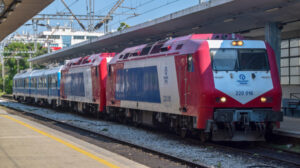
Distances from the safety issues of the Greek railway today, following the Tempi tragedy, the National Organization for the Investigation of Air and Rail Accidents and Transport Safety took the floor during the hour-long presentation of its findings and the detailed press conference that followed.
Although there were a flurry of questions about whether the Greek railway meets the requirements for safe travel, HODASAM president Christos Papadimitrioux limited himself to saying that he uses the trains as he did before the incident, but stressed that although it is not the role of the agency to judge safety, the 17 recommendations the agency makes to OSE are revealing about the safety levels of the vehicle.
The people who work on the railroad are dedicated and work hard. But for the railway to be adequately safe, the recommendations we are making today must be implemented.
The Agency’s (EODASAM) conclusion focuses on the temporary pathologies in the Railways, its understaffing and underfunding. These conditions are attempted to be “cured” through the 17 new sector-wide safety recommendations under the Rail Regulatory Authority (RRA), which, it was stressed, should be implemented immediately and reported on a six-monthly basis. It was reported that during the investigation of the accident, a safety recommendation was issued concerning poor communications methodology on trains. Many of the new recommendations, as said, go beyond the remit and powers of individual organisations. As such, the Department for Infrastructure and Transport should improve the implementation of the existing action plan to develop a safe railway.
As noted, the inquiry was concerned with Contract 717, but it was not the main focus of the investigation. That the delay in implementation contributed to the accident is a fact, the commission members said, adding that if the contract had been completed, the accident would have been avoided.
The 17 recommendations for safe trains made by the report point to the gaps and shortcomings that transport operators are required to address from now on in collaboration with the Ministry of Infrastructure and Transport.
What it provides
1 The Ministry is to improve the implementation of the existing Rail Safety Action Plan.
2. The action plan will enable the relevant railway operators to acquire all the human, financial, and organizational resources necessary to develop and maintain a sustainable and safe railway system.
3. The OSE needs to better understand the risks associated with the reality of the operation of the current railway system in Greece and improve the way it controls these risks.
4. OSE needs to optimize the performance and reliability of infrastructure assets and manage the safety risks associated with them throughout their life cycle.
5. The RU is required to regularly assess the competence of staff performing safety-related tasks and ensure that they are maintained. This includes all competencies related to nontechnical skills, but also related to physical and psychological fitness, not only when recruiting new staff but also throughout their career.
6. Develop a performance monitoring system so that the OSE is aware of any deterioration in the performance of safety-related tasks by stationmasters or other personnel performing safety-critical tasks on the railroad.
7. The tragedy at Tempe should be a driver for the PSO. Thus, structural improvement measures will be implemented that can create an environment that supports the work of operational staff.
8. The OSE should maximize the availability of recorded data (i.e., video, cameras) that can assist in the analysis of accidents and incidents. It is, therefore, invited to consider the possibility of using these technologies to continuously monitor safety performance.
9. Hellenic Train is recommended to strengthen its competence management system to ensure that drivers (and other staff, where appropriate) who perform safety-related tasks are appropriately prepared, that their competence is regularly assessed and maintained, and that their duties are performed accordingly.
10. Hellenic Train should develop a system for the evaluation of drivers so that any deterioration in the performance of their safety-related tasks on the Railway is immediately noticed.
Ask me anything
Explore related questions




