





Resumption of U.S. Intelligence Support
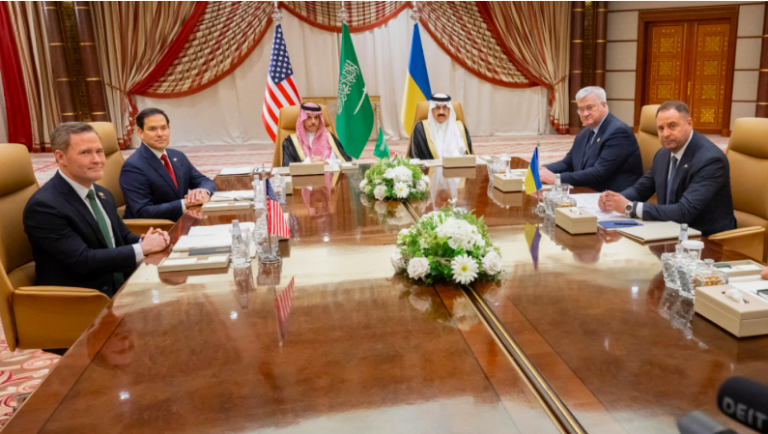
As part of the agreement, Washington will immediately lift its suspension on intelligence-sharing with Kyiv and resume security assistance, according to officials who met with the Ukrainian delegation in Saudi Arabia. The decision restores a crucial flow of battlefield intelligence that Ukraine had relied on for tracking Russian military movements and strategic assets.
According to reports from Agence France-Presse (AFP), Ukraine has conditionally agreed to the temporary ceasefire, provided that the U.S. unfreezes weapons shipments to Kyiv. The deal represents a diplomatic breakthrough, but its success now hinges on Moscow’s willingness to participate.
Rubio: “The Ball Is in Russia’s Court”
U.S. Secretary of State Marco Rubio emphasized the importance of Russian cooperation, stating, “We hope Russia agrees. The ball is now in their court. Ukraine has accepted the foundation of our plan.”
On the issue of Ukraine’s critical mineral resources, Rubio clarified that while discussions are ongoing at the ministerial level, no formal agreements were reached in today’s negotiations.
When asked whether relations between former U.S. President Donald Trump and Ukrainian President Volodymyr Zelensky had improved, Rubio avoided a direct answer, stressing instead that, “This is not a television drama—this is serious business.”
Regarding potential goodwill gestures from Russia, Rubio reiterated that Ukraine is prepared to end the war and enter negotiations, expressing hope that Moscow would agree. However, he warned that if Russia rejects the proposal, “We will know who is the real obstacle to peace.”
Key Agreements Reached
Following nine hours of talks, the U.S. and Ukraine released a joint statement confirming:
- The immediate resumption of U.S. intelligence-sharing to support Ukraine’s security efforts.
- Ukraine’s willingness to accept a 30-day ceasefire, contingent on mutual implementation by Russia.
- A commitment to negotiations for a long-term peace deal, including security guarantees for Ukraine.
The agreement is seen as a major gain for Ukraine, which had struggled without U.S. intelligence on Russian troop movements and critical installations. Additionally, it had faced disruptions in accessing advanced American defense systems, such as electronic warfare jammers used in combat aviation.
The “Jeddah Declaration” – A Path Toward Peace?
The meeting, hosted in Jeddah, Saudi Arabia, under the patronage of Crown Prince Mohammed bin Salman, was framed as a step toward lasting peace. Both delegations praised Ukraine’s resilience and agreed that now is the time to initiate a long-term peace process.
Ukraine expressed deep gratitude to former President Trump, the U.S. Congress, and the American people for their continued support, which has been instrumental in achieving progress toward peace.
The ceasefire proposal, which could be extended by mutual agreement, requires Russia’s acceptance and implementation. The U.S. has conveyed to Moscow that reciprocity is essential for peace to be realized.
Humanitarian Considerations
The agreement also includes provisions for humanitarian efforts during the ceasefire, such as:
- Prisoner exchanges and the release of political detainees
- The repatriation of Ukrainian children forcibly taken to Russia
Both sides have committed to establishing negotiating teams immediately to work toward a permanent peace agreement ensuring Ukraine’s long-term security. The U.S. has also pledged to discuss these proposals with Russian representatives.
Ukraine reiterated that European partners would play a key role in the peace process.
A Strategic Economic Deal in the Works
In addition to security discussions, Washington and Kyiv have agreed in principle to a comprehensive deal for the development of Ukraine’s critical mineral resources. The agreement—long a point of contention between Trump and Zelensky—aims to strengthen Ukraine’s economy and provide long-term stability and prosperity.
As the world awaits Russia’s response, the proposed ceasefire represents a pivotal moment that could shape the future of the war—and the geopolitical landscape of Eastern Europe.
Ask me anything
Explore related questions




