





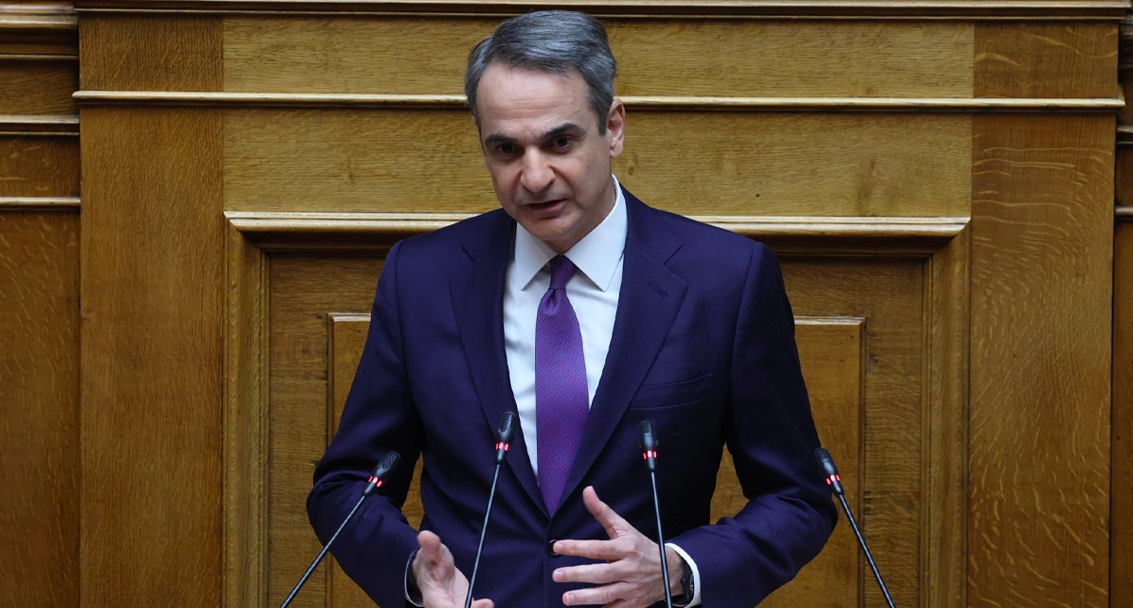
The philosophy of the new €25 billion armament program was presented today in Parliament by Prime Minister Kyriakos Mitsotakis, who is currently at the podium for his second speech.
Regardless of Greece’s fiscal leeway via the escape clause, this will not be a pretext for excesses – Today, the image of the Armed Forces has no resemblance to what we inherited in 2019.
Prime Minister Kyriakos Mitsotakis is currently addressing Parliament on defense procurement.
Minute-by-minute coverage of the Prime Minister’s address:
- The first [Belharra-class] frigate “Kimon” will be delivered in 2025.
- In 2019, we inherited Armed Forces in poor condition. Today, the situation is vastly improved.
Mitsotakis emphasized that Europe must move forward with the creation of a fund for projects of shared defense benefit, such as an anti-missile shield. “We’re not there yet, but we’ve taken an important step with the ReArmEU plan,” he said, noting that it was supported by MEPs from New Democracy and PASOK, and voted down by SYRIZA and the Communist Party, while nationalist parties “Victory” and “Voice of Logic” abstained. “Let everyone draw their own conclusions on who are patriots in practice and who are only in words,” he added.
He also stressed that the country’s fiscal flexibility, through the escape clause, will not lead to irresponsible spending. “Not only because the markets are watching, but because strong economic performance is itself a factor of security.”
He noted that many thought such developments were unachievable, but Greece succeeded in securing European decisions that benefit the country, especially the escape clause that allows additional investments without being counted against fiscal ceilings, thus creating space for implementing the armament program.
Mitsotakis reiterated that the EU must reassess its strategic stance. “Greece – and I personally – have long argued for European strategic autonomy. At first, only a few of us supported this. Now our partners are beginning to adopt this view.”
At the same time, defense investments also strengthen diplomacy.
“Investments in defense capabilities are investments in sovereignty.”
In this context, the Prime Minister highlighted the strategic importance of Greece’s choices, noting that the U.S. is pursuing a path diverging from NATO, and global economic trends suggest a move away from established international trade frameworks.
Mitsotakis warned of growing instability in the Middle East, where fragile ceasefires are being replaced by bombardments. “We are not talking about isolated incidents, but pieces of a complex puzzle.”
He pointed to a global environment where tariffs could threaten international relations and technology could be used to disrupt social stability.
“The dilemma of ‘guns or butter’—mainly posed by the left—is both hollow and dangerous,” he said.
He underlined that fiscal stability is a crucial lever for effective defense readiness. “Without protection from external threats, there can be no investment and economic development. Who would invest in a country that doesn’t defend its own borders? Conversely, how can security be ensured without a strong economy?”
The strength of the Armed Forces is crucial. Thanks to them, Greece has handled crises like migration and recurring tensions in the Aegean.
“When we talk about resources for national defense, we’re not only referring to equipment, but to the country’s unwavering commitment to remain strong and independent in a changing world.”
The Prime Minister concluded by describing a comprehensive plan that represents the most transformative overhaul of Greece’s Armed Forces in modern history.
“The price of freedom is eternal vigilance,” Mitsotakis said, quoting Thomas Jefferson. “It’s a price the homeland willingly pays, recognizing that there can be no prosperity without security.”
Ask me anything
Explore related questions




