





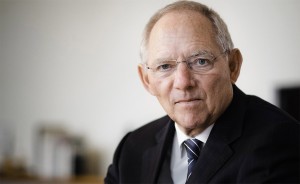
Wolfgang Schauble sent a clear message saying that Greece’s exit from the fiscal adjustment program does not automatically mean that austerity and sacrifices will end, nor that European partners will stop demanding reforms.
“The countries that are in adjustment programs have higher performance in terms of implementing reforms of the OECD,” Minister of Finance of Germany noted, but he warned the countries that completing the program does not mean that they should rest but they should keep on the reforms.
“It would be disastrous to say that we have overcome the danger, despite the progress we have made. The countries that are in the program should be aware that completing the program does not mean the end of reforms” said Mr Schauble speaking at a conference on Europe organized by the “Hertie School of Governance” in Berlin in which many other political personalties participated such as former Greek Prime Minister Giorgos Papandreou, President of the Eurogroup Jeroen Dijsselbloem and former Italian Prime Minister Mario Monti.
The German minister described the assumptions for “a German Europe” as “nonsense” and highlighted the need for greater coherence and development of the EU.
Referring to the crisis in Ukraine, he underlined that it was now clear that the issue was not just the economy. “Common Foreign and Security Policy in Europe must become more powerful and, the most important is the policy of Europe to become more distinguishable,”.
Talking about the necessary institutional changes, he pointed out that a more effective European Commission and European Parliament with greater involvement in decision making are needed.
“Compliance of member states with the conditions agreed to regarding the competition should be monitored. We need better democratic legitimacy for the European institutions. I have repeatedly proposed the direct election of the President of the European Commission, which would change the communication among Europe in a very effective way,” he added, but he appeared sceptical regarding the political union.
“The term ‘political union’ is very blurred. Like the “United States of Europe”. This is something that we could say that we already have, but again the term is too vague to accurately describe the specific nature of the European Union and can lead to misunderstandings. If we want to be more precise, we are talking about a multi-level democracy,”.
Answering to a question posed by Mario Monti regarding the way Europe can achieve a better function of the common market, both in the Eurozone and in the European Union, Mr Schauble said that he would like UK not just to stay in the EU, but to join the Eurozone. He added that Eurozone needs more consistency, so that the common currency to remain stable.
Referring to the European election results he said that “In Italy we had a positive result which was a surprise, in Germany things are relatively good, in France . . . ouch! All of us in Europe, not only in France, we should think what mistakes we have made and a quarter of voters voted not for a rightist, but a fascist, extreme party,”.
Jeroen Dijsselbloem: The primary surplus does not mean anything to Greeks who are struggling to survive
“Try to tell a Greek who is struggling to survive that Greece now has a primary surplus, which for us in the Eurogroup is an important indicator. But what does this mean for a citizen in Greece?” the President of the Eurogroup Jeroen Dijsselbloem asked himself and noted that after the last European elections “Europe is no longer something that is not questioned,”.
Ask me anything
Explore related questions




