





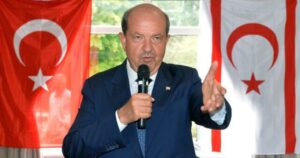
Turkish Cypriot leader Ersin Tatar continues to put obstacles in the way of the UN process to resume talks on a Cyprus settlement. He responded negatively to the proposal made by Cypriot President Nikos Christodoulides for a joint meeting with UN Secretary General envoy Maria Angela Olgin, saying that the Cypriot President is an unreliable interlocutor. The proposal was conveyed to Ersin Tatar by Mrs. Olgin herself.
The Turkish Cypriot leader has been outraged by arrests made in the free areas for usurping Greek Cypriot property in the occupied territories. Foreign nationals operating in the real estate sector in the pseudo-state are under investigation and those identified are being arrested. These arrests have frozen construction activity in the occupied territories, as foreigners considering buying property know that they may face the law.
Speaking to reporters after the meeting, which lasted just over an hour, and reading from a written text, the Turkish Cypriot leader said the decision was not taken as an emotional reaction, but with an approach that prioritizes “the security and rights of our people. As long as the Greek Cypriot leader continues to attack us, he will receive a similar response. I will never give in to threats and blackmail.”
Tatar said he had clearly expressed his warnings on this issue, not only today, but also at the expanded informal meeting in Geneva last March, to the President of the Republic of Cyprus Nikos Christodoulides in Nicosia on 2 April and 5 May, and to the UN Secretary-General’s Special Representative Colin Stewart on the same day. He reiterated it, he added, last Monday and in his meeting with Mrs. Olegin.
He has, he continued, great respect for UN Secretary General Antonio Guterres. “I appreciate his interest in the Cyprus problem and his constructive approach to cooperation between the two sides. I would also like to thank his personal envoy, Maria Angela Olgin, for the approach she demonstrated during her contacts. However, it is clear that Mr Christodoulides, who is targeting our people by using the property issue as a tool of pressure through the judiciary, cannot be considered a credible interlocutor unless he changes his approach. This policy of the Greek Cypriot leader, which increases tension, does not serve dialogue but a deadlock.”
According to Ersin Tatar, “this attitude (of the Greek side) towards the legitimate rights of the Turkish Cypriot people has nothing to do with law. People who invest or carry out real estate transactions within the borders of the tdvk (pseudo-state) are presented as committing crimes for political reasons and in this way an atmosphere of fear is sought to be created.”
This is a “dangerous approach” that targets not only the rights of individuals, but also trust between the “two peoples” and the possibility of future reconciliation, he argued. As long as this attitude continues, it is not possible to talk about a healthy environment for dialogue, he added. “Therefore, showing respect to such a mindset means both normalizing these activities and aggravating the new atmosphere expressed by the UN Secretary General,”
he said.
“The period of tolerance of this hostile policy,” Tatar said, “which targets the freedom, prosperity and peace of Turkish Cypriots is over.”
The Turkish Cypriot leader said that while what has been happening lately on the property issue is happening, it is not possible for him to be in a photo of a trilateral meeting with Nikos Christodoulides.
In the meeting with Ms. Olegin, he said, he saw her sincerity and that satisfies him. He shared with her, he added, his concerns and worries, which he again asked her to convey to the UN Secretary General.
On the sale of Greek Cypriot properties in the occupied territories , he argued that the property titles of the pseudo-state are valid and referred to the “real estate commission” created on the basis of an ECHR decision, which has so far awarded more than 600 million pounds.
The biggest prospect, the Turkish Cypriot leader said, is “property exchange”, indicating that in the free areas there are 200,000 acres owned by Turkish Cypriot owners, many of them by the sea.” The properties, he said, those were left and in exchange for those were given to Turkish Cypriots, properties of equal value in the occupied territories. According to Ersin Tatar, the Greek Cypriot side is now targeting these properties of equal value.”
Ask me anything
Explore related questions




