





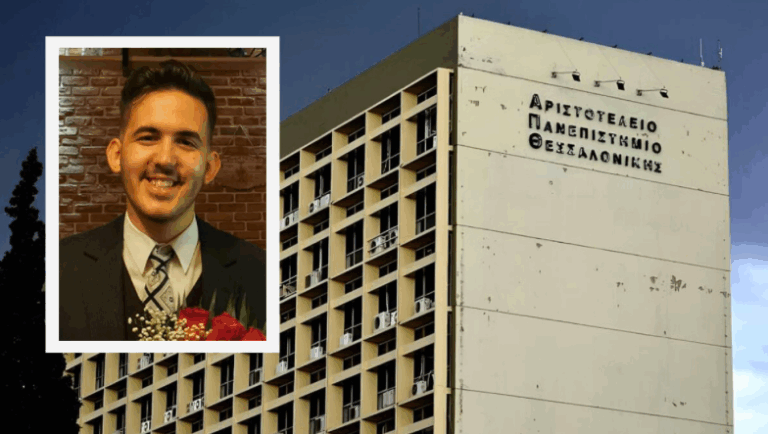
Giorgos Triantafyllou, a fourth-year student at the School of Theatre of the Aristotle University of Thessaloniki, is on the autism spectrum.
A few days ago he sent an open letter to the Rector of the Aristotle University of Thessaloniki, Professor Kyriakos Anastasiadis and to the Deputy Minister of Education, responsible for higher education, Professor Nikos Papaioannou, in which he describes the difficulties he faces as a student with a severe disability, as well as the reaction of a professor, who in essence told him that he cannot be a student because of his condition.
His letter was immediately responded to by Papaioannou, with whom the young man met on Saturday, 21/6, to discuss George’s proposals for an inclusive university.
“Mr Papaioannou listened to me very carefully. He was supportive and willing to take action. He even pledged to bring my issue to the next Rectors’ Meeting,” the young student tells protothema.gr., who expects, soon, to take substantial support measures for those students on the autism spectrum.
Due to autism, every stimulus – sound or light – reaches George in magnification, resulting in repeated ‘shocks’. Taming his thinking requires a tremendous effort. Interaction within groups, when not occurring in a context of safety, seems impossible.
He was severely bullied as a teenager, and the difficulties led him to try drugs in his teens, even attempting to end his life later.
However, he doesn’t give up. He finds a way to get back on his feet and keep trying – not just for himself but for everyone on the autism spectrum – at 23, he has already written three novels and produced a play.
Today, the young student is fighting for equal access to university, which he was admitted to after national exams, and wants more than anything to get a degree.
Displaying quick reflexes, as soon as he read his letter, the Deputy Minister of Education called him to meet. The appointment took place on Saturday 21/6, in the back of a café – “it was very noisy in the front…” – near the White Tower.
George’s route
A student in the 8th semester of the Theatre Department at the Aristotle University of Thessaloniki, George grew up in – much smaller – Kozani.
Being on the autism spectrum, what does his difference consist of? How does he perceive everyday life?
Until the age of six, he didn’t speak – his parents thought he was deaf, took him to an ENT clinic. Harry and Anastasia, his two older siblings, were always calm and cooperative. He, quite the opposite. Very aggressive at school, he beat up the other kids. He didn’t fit into molds. “When I touched an object, I felt it go through my whole body like an electric shock. I might be made to eat beans, and I couldn’t stand the texture of them, tasting them… Or at the sound of a sound, I would start to roar. These stimuli would give me psychosomatic complications, because in essence, I was taking them in … magnified,” he explains.
The problems he faced as a student, many: “I was particularly affected by my inability to perceive non-verbal communication. That is, I could not tell from a person’s expression when the other person was joking, when he was saying something metaphorically. For this reason, I could not understand the other children’s boundaries. When a person is on the spectrum, they can’t separate the ‘signals’ of others.”
He was diagnosed with autism in 2011. Years later, his mother enrolled in occupational therapy school so she could understand exactly what was happening to her child.
His family and therapists alike describe him as a person who is both ‘functional and charismatic’. Of himself, he says he is always ‘between triumph and disaster’ and has experienced ‘many moments of helplessness’.
The school years
“Except my first teacher, who kept taking me out of the classroom, in primary school, they were all over me – the teachers, the principal… they did everything for me, constantly defending me against parents who complained. Especially Mrs. Noula Iakovidou, an excellent teacher, took over my class exclusively for me, for my condition, even asked the children to vote for me to become president, so that I could integrate better,” she recalls.
From Wednesday, elementary school through the end of high school, George had Parallel Support.
However, the worst period was high school: “Those years were torturous for me. A lot of bullying,” he states.
It was a lot of bullying for me.
The situation improved in high school. “I was a good student, and I could answer anything they asked me. But because it was very annoying to be in class with all the other classmates, I had class exclusively outside with Parallel. Because of my autism, I am obsessed. For example, back then, I might have been ‘obsessed’ with car brands, mobile phones, vacuum cleaners or … prime ministers. I had lists in my mind with all kinds of information about them, and I kept repeating them like a tape recorder – ‘this model came out then, in that factory’… Or, ‘Roosevelt was prime minister from then until then and then it was…’ etc. Stereotypical thoughts, from which I found it impossible to detach myself.
The Parallel teacher, an excellent woman, patiently took in what I was saying and related the material to it. Was I talking about cars? She was putting in physics material, talking about torque…. In preparation for the Panhellenic exams, again, I was not in the classroom. We had made a deal with the teacher: ‘I’ll listen to you as much as you want, but you listen to what I say,’ she suggested. We took turns talking – I for 5 minutes, then she for another 5 minutes… She would put on music. In other words, she personalised the training, tailoring it to my needs. And that worked for me. I started studying in March, took the Panhellenic exams, and scored 13,000 points. Autistic people are not stupid. If you find a way to work your brain, you can do great things.”
The difficulties of autism and the way out
“The most serious thing that plagued me was the obsessive-compulsive symptoms I was experiencing at school. Due to excessive anxiety and inability to manage situations, I developed an obsessive-compulsive disorder. The condition came to a head in high school because of a tragic event – a classmate of mine lost both of his parents. I was unable to process it and developed obsessive behaviors, which is typical of autistics. I thought I would get the same thing… Imagine something overwhelming your thoughts, hitting you in the head like a hammer. I felt pain on the top of my head. And whatever happens to you, you can’t express it – also a feature of autism. The autistic person takes it and lives it through his head. What I was experiencing inside me eventually led me to write my first book at 19. The novel ‘Three Worlds’ was the only way I could find an outlet for what was overwhelming me,” he points out.
The transition to university
Aristotle, the School of Theatre, was his first choice. The change, however, was difficult. After the ‘small’ Kozani, the ‘huge’ Thessaloniki, without any support.
“I stay in the dormitory, I don’t like it. It’s all impersonal. I felt like I came to chaos,” his thoughts from the transition to the new reality.
Having lost everything that supported him in his hometown, he found himself alone, having to manage a daily routine tough enough for a person on the autism spectrum like him. “I had to keep asking my fellow students to explain everything to me. The slightest stimulus could freak me ou,t and I would want to go outside, and then everyone would look at me in wonder. Moreover, because there was no more parallel support, I had to attend completely on my own and had to take notes within the 3 hours of what the teachers were delivering, which was impossible for me,” he explains, although he had informed the school secretariat of his problem and there were supportive teachers.
It was only in one professor’s class that George felt comfortable attending: “I had one Professor who made me go to class and feel like I was in a magical place. She was the only one who was empathetic and understanding. I felt safe when she was there. It was the current department chair, Anna Stavrakopoulou.”
By his third year, however, George was gripped by a stalking mania: “I was in the auditorium, sitting on the floor. And every time I heard a voice, I felt like someone was sticking a knife in my stomach – no joke. I thought they were trying to hurt me, and I wanted to keep going outside. Needless to say, I was on medication to alleviate the symptoms… Because of this pressure, the inability to communicate with other people intensified, and because of this, I didn’t want to go to school. But I had compulsory attendance. And that’s how the problem started,” he says. The situation worsened in the fourth year, in classes with compulsory attendance.
“I had some teachers particularly pushy – ‘you have to work in groups, do this assignment immediately, come to class,’ they would say, even though I had informed them that I had a condition. I begged them to reduce the compulsory attendance. And of course, it’s not a solution, having to turn to the department chairman every time to help me. I shouldn’t feel like I’m ‘the autistic one’ and that I should have the chairperson to protect me. These things should be solved for every George, not just for me.”
Why George wrote the letter
Four days ago, the young student wrote an open letter to the Rector and the Ministry of Education, disgruntled. His reaction was sparked by a professor at the university, who, no more, no less, told him, according to him: ‘If you are disabled, what are you doing here?’
“When I explained to a professor what was happening to me, she replied, ‘There is no infrastructure in our university. We cannot manage this issue. Can the blind man operate?” In front was the fencing professor, who added: “Can a child who is in a wheelchair go and do fencing?”, implying that “he can’t”. At that moment, I felt like I was being trashed. I didn’t want to go back to school; that’s how bad I felt. That’s why I wrote the letter,” he will say and continues: “Having now grown tired of the situation and because it is not possible to send 500 mails a month to the department chairman whenever such an issue arises, I felt it was obvious that I should turn to the Rector and the Deputy Minister in charge. In my letter, I explain that a comprehensive solution must be found, pointing out that as an autistic person, I cannot assimilate the lessons like my fellow students, simply because I am in a situation where I cannot manage my mind. I’m on medication. My mind is having a hard time untangling itself from the phobias and psychoses that plague me… Psychiatric illness is, duh…the
Do you know how much guilt the mentally ill feel?”
What does ‘inclusive university’ mean?
How does he envision the ‘ideal’ university that ‘accommodates’ all students?
“I think there should be a body responsible for the university’s disability policy. A committee consisting of occupational therapy professors and special education psychologists, that is, experts who are knowledgeable about sensory issues and who act as ‘advocates’ for students with disabilities, as I do. And this committee should work with the professors per department to jointly regulate the framework in which the student will study,” George notes, adding that for cases of people with autism, such as his, there should be a different approach to the issue of mandatory course attendance. He also suggests the permanent presence of a specialist who would provide counselling services to students on the spectrum: “To give them a direction but also to adapt the curriculum to their specific needs,” he says. He also considers the continuation of Parallel Support at the university to be indispensable: “Just as Parallel helped me at school, why shouldn’t there be something similar at university? In cooperation with the teaching professors, help students with autism receive knowledge in a way they can understand. There are techniques. So instead of telling the child, ‘you can’t get a degree because you’re autistic’ – because that’s actually what’s happening today – tell them ‘do the things you can do’. That’s what needs to change at university,” George stresses.
Being in his eighth semester, he has passed 33 of his 58 classes. By September, he estimates he will have passed 40 – “after that, I’ll have another year and a half left,” he estimates. Where does he see himself five years from now? “Ideally, I’d like to be able to work somewhere with kids, teaching in a classroom or writing plays, books.”
“For me, writing was my ‘outlet’, a way of dealing with my problems. And everyone on the spectrum has a unique way of working within their context.”
How ‘disabled’ does he feel? “Even though I have a diagnosis of 80% disability, there are times when I think that this is all a lie, it’s not true. And what I finally understand is that a ‘label’ does not define a person. What I care about most of all is to be able to prove that any person, with any difficulty – autistic or not – should have a way to manage it. I don’t dispute that it is a problem when one is faced with a severe inability to concentrate thoughts. However, feeling bad about it is not a solution. My only concern is that there are others out there like me, and that’s what I want to solve – and get my degree, of course. Because I’ve spent a lifetime fighting not only for myself but for other autistic people, I want to ‘pave the way’ for all of us. I am a proud autistic person! That’s why when I hear something that offends the group I belong to, I get outraged. And of course, I can’t accept that another autistic child will go to university and hear such ‘potatoes’ from female professors. I can’t allow it….”.
The open letter
George Triantafyllou – 8th semester student in the Theatre Department of the Aristotle University of Thessaloniki-
Recipients: Kyriakos Anatastasiadis – Rector of AUTH, Nikos Papaioannou – Deputy Minister of Education and ESAMEA.
I am writing this letter to express how disgusted I am by the fact that, belonging to any vulnerable social group, whether it is that of the lower economic strata or that of the disabled, and being a student, is extremely painful. Especially when you belong to both.
I have considered dropping out of school, more than a few times, and this is because I am a person who, being on the autism spectrum, my mental health is fragile – dangerously so – and the infrastructure in the department I am studying is non-existent, to the point where I feel I have failed miserably, not because I am doing anything wrong, but because the university is not able to support me as much as it should – no matter how much superhuman efforts the professors and chair of my department make.
Now imagine what it’s like to be diagnosed with asperger’s, and to experience issues of hypersensitivity in your sensory center, which means that the slightest stimulus can cause physical pain and mood swings. E.g., sound, light, and facial expressions of other people.
And what is it like to be forced, in a department that is not like that of medicine, to be forced to be in a room of 50 people for theoretical classes – the so-called seminars – because you are supposed to learn to work in a group. But come on, as an autistic, you have this issue – that you are struggling with it – and you feel that your studying for the national exams, years of effort, with teachers like those in parallel support at school, has gone to waste.
It went to waste because I had to explain to five professors a semester what’s going on with me, trying to understand me, but wondering why I have to report when the university should have given me the solution.
I need individual inclusion, understanding, and support in having a framework in place that gives guidance to all professors on how to behave with autistic people. Verbal exams are not enough, and unfortunately, there is a greater need for people like me to be able to and have a different way of communicating and educating.
And why not have a system like parallel support in universities? My financial situation does not allow me to pay an extra person to help me in the school, so I ask you, Mr. Deputy Minister and Mr. Recto,r to help me so that my condition and my financial background are not reasons for me to leave the school. Please make me feel in such an important matter that I am not alone.
So I ask:
1. The establishment of a department to support people with disabilities, both in the AUTH and in all universities.
2 . The abolition of compulsory attendance for people with disabilities, especially in theoretical courses such as that of Drama, at the AUTH Theatre, where I am.
3. The formulation of a framework for the examination, as people with autism usually suffer from other psychiatric conditions, such as anxiety disorder or depressive symptoms, and this anxiety is dangerous for their health.
4. The establishment of parallel support or a parallel department that is close to people with developmental disabilities, autism, etc, like mine.
5. A detailed discussion with the Rector or the Deputy Minister, so that I can explain the situation and find a solution.
Ask me anything
Explore related questions




