





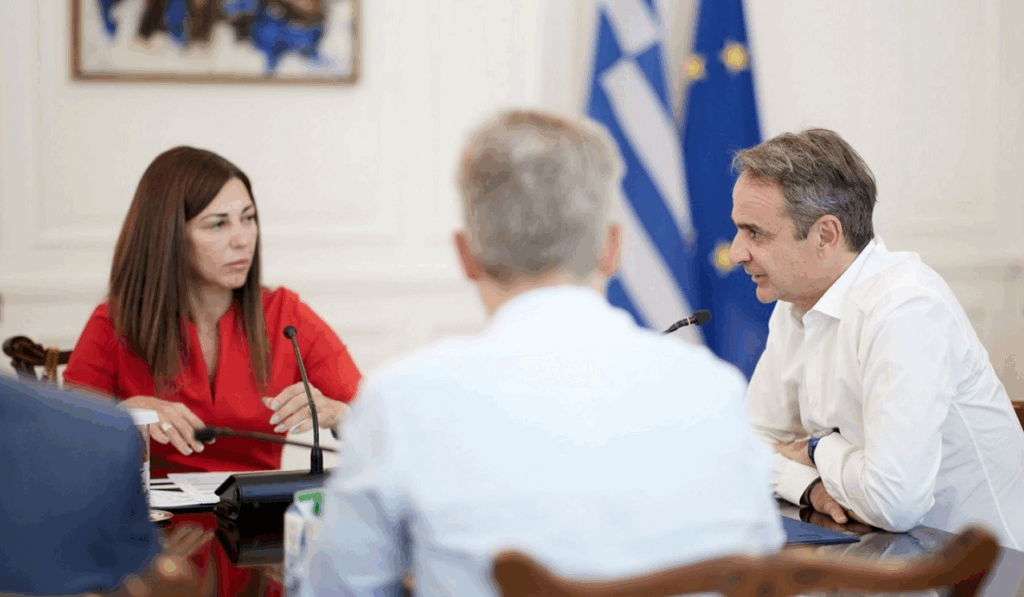
On Monday morning, Prime Minister Kyriakos Mitsotakis chaired a meeting focused on public universities with the political leadership of the Ministry of Education, Religious Affairs and Sports.
During the meeting, a new legislative provision was presented which will give former students, who have demonstrably attempted to complete their studies, one last opportunity to obtain their degree. Specifically, the proposed regulation provides that former students who have completed at least 75% of the credits of their academic program and have successfully participated in at least two examination periods during the past two academic years, will be allowed to extend their studies for up to two additional semesters.
In cases where a practical internship, thesis, or diploma project is required, the extension may be up to three semesters. It is estimated that the regulation will apply to more than 35,000 former but still active students.
Beyond this category, it was reaffirmed that this coming September, inactive students enrolled in four-year programs who had already exceeded their study period during the 2021–22 academic year will be removed from the registries, as the four-year grace period granted at that time is now expiring.
It was noted that, as of now, public university lists still include students who enrolled as far back as the 1930s, while tens of thousands of students enrolled in the 1960s, 1970s, and 1980s also remain on the books.
In this way, among other benefits, the performance of Greek universities on many quality indicators will improve, as individuals who appear unable to graduate for many years will be removed, while at the same time, administrative staff time will be freed up.
During the meeting, final provisions that will be submitted for public consultation were also reviewed. These relate to further safeguarding security at public institutions, focusing on the establishment of a mechanism for imposing criminal and disciplinary penalties within clear timeframes, enhancing accountability, and utilizing technology for preventive protection of university premises.
During the meeting, the Prime Minister stated:
“With the provisions we discussed today, a very important reform will soon be completed — one that we had prioritized in our program for the new public Greek university, as we envision it. Essentially, we are talking about a significant cleansing of the lists of inactive students, many of whom have been enrolled in public university registries since the 1950s and 1960s. This cleansing of the university registries will bring substantial benefits in terms of the quality indicators of the institutions, as for the first time, we will have a clear picture of who the actual students are. But I also want to emphasize the very important provision for a final chance for those students who have demonstrably shown an interest in completing their studies — including those who, due to health reasons, may have had specific and distinct difficulties in doing so. This regulation is absolutely balanced but also fulfills our central commitment to proceed with a necessary cleansing of student registries, making a distinction between inactive and active students, so that universities can know exactly who they are serving and plan accordingly. Finally, on the occasion of the start of the new academic year, let me say this: often, young people come to me asking for advice on which university school to choose. I tell them to pick the one that suits them best, but whatever they choose, they should make sure to graduate within the scheduled time of their program. And they should do this because life is ahead of them. If your program is supposed to take four years, why lose time and finish in the fifth or sixth year? Eventually, you won’t be allowed to finish later anyway. But this is primarily a responsibility that young people have toward themselves. It is not a punishment imposed by the state, but rather a push in a highly competitive environment. And since the state offers free public education to our youth, our university students should also be responsible in meeting their obligations — but above all, they should do it because it’s good for them, not for us, not for their parents, or anyone else.”
Minister of Education, Religious Affairs and Sports, Sofia Zacharaki, added:
“Mr. Prime Minister and dear colleagues, today is an important day as we will soon put the final provisions into public consultation, which serve a deeply political dual objective and principle — the necessary clearing of the registries from long-term inactive students, and of course, the institutionalized provision of a final chance to those who deserve it and are entitled to it. With the initial reform that the New Democracy government passed in 2021 — and is now improving — the Greek university can truly have an accurate picture of who is studying. And with increased funding, new housing provisions for students, internationalization efforts, and all the other actions we need to take for the public university, this can now become a reality. A necessary step, therefore, and thank you for giving us the opportunity to present this improved regulation as both a final chance and a distinction between active and inactive students.”
Ask me anything
Explore related questions




