





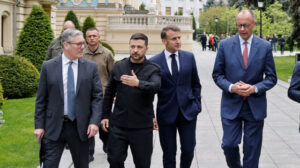
With the backdrop of concern over the recent Trump-Putin meeting in Alaska, Volodymyr Zelensky heads to the White House today, accompanied by European leaders, in a critical effort to prevent Kiev from imposing a solution that would require territorial concessions.
Unlike his first visit to Washington in February, when he faced Donald Trump and Vice President J.D. Vance alone, this time the Ukrainian president arrives in Washington with European support. He will be flanked by the NATO Secretary General, the Finnish President, the British Prime Minister, the German Chancellor, the French President and the Italian Prime Minister, a group of leaders who combine military and economic power with a history of good relations with Trump.
Their goal, according to Guardian, is to use their collective and personal influence to persuade the US president to back away from pro-Russian positions he adopted after hours of talks with Putin. To do so, they must be more determined and united than ever. As former Barack Obama adviser Ben Rhodes notes, “Trump is used to seeing people he considers weaker than him bend to his will… Zelensky cannot be expected to confront him alone. That’s what caused the previous humiliation in the Oval Office. Zelenski needs Europe. And Europeans need to show strength against Trump, more than they have shown so far.”
The composition of the European team
The Ukrainian president will be flanked by Macron and Merz, who represent Europe’s Franco-German axis, while the president of the European Commission Ursula von der Leyen will recall the importance of the EU as an economic powerhouse. Trump recently signed a trade deal with the EU, which he called “the largest trade cooperation in the world.”
Italian Prime Minister Georgia Meloni is expected to play a “bridge” role as a leader of the European right whom Trump considers a friend, but who also supports Ukrainian sovereignty.
Finnish President Alexander Stump, though a representative of a small European state, has cultivated a fairly friendly relationship with Trump. He even recently played golf with the US president in Florida, using the opportunity to warn him that Russia is not a reliable interlocutor.
Kir Starmer brings with him Britain’s prestige and a personal relationship with the US president, which he is however reluctant to disturb ahead of Trump’s official visit to London next month.
NATO Secretary General Mark Rutte, in addition to the prestige of his office, has proven experience in “handling” Trump with diplomatic agility and flattering words. Last June, at the NATO summit, he likened the US president to “a father intervening to separate children fighting in the schoolyard”, referring to his role in the recent ceasefire between Iran and Israel.
“Many officials have now learned how to handle Trump,” explains Kim Darox, the former UK ambassador to Washington during Trump’s first term. “There will be plenty of flattery. It’s tiring but necessary: it gets you in the game. You tell him how well he’s doing, how happy everyone is that he’s leading the Western effort to end the war. And then you get down to the nitty-gritty.”
Sign of panic but also of unity as European leaders arrive at the White House
The fact that all these leaders changed their schedules to fly to Washington in a hurry reflects how much concern the Trump-Putin summit in Alaska caused them. The Russian president, wanted by the international criminal court for war crimes after the unprovoked invasion of Ukraine, was greeted with a red carpet and a personal round of applause from Trump, who allowed him to speak first after their meeting. The U.S. president’s persistence over the past year on the cease-fire issue has disappeared and he has adopted Putin’s proposal for a direct peace deal, leaving Ukraine to face pressure for territorial concessions.
There are also factors in favour of Zelenski and his European supporters. The biggest fear was that Trump would reach a deal with Putin in Alaska, which would be presented in Kiev as a fait accompli. That did not happen. Moreover, they have potential allies within the Trump administration. Marco Rubio, US Secretary of State, is a traditional Republican with a strongly cautious attitude towards Russia. On Sunday, he told NBC that the ceasefire scenario “remains on the table” and confirmed that the US is interested in contributing Western security guarantees to Ukraine in the event of a peace deal.
One of the cards Trump’s visitors will have in their hands on Monday is a reminder that close rapprochement with Putin is unlikely to secure him the Nobel he desires. As the former UK ambassador to Washington, Kim Daroch, explains, “history will be generous to him, but only if he secures a just peace in Ukraine, not if he pushes for its surrender.”
Ask me anything
Explore related questions




