





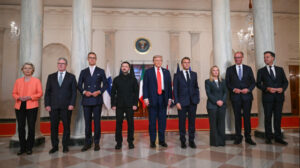
The position that Vladimir Putin is not sincere about a peace deal seems to have been reached, according to Politico, by European leaders “so their strategy is to caress the ears of Donald Trump and keep patting him on the back until he finally comes to the same conclusion and realizes that he will have to toughen his stance.”
According to the paper, the European side believes this is an approach that benefits everyone. “They will be happy to be proven wrong if the president of the US manages to negotiate an end to the war in Ukraine with meaningful security guarantees, but the primary goal is to call the Russian leader’s bluff and put pressure for tougher sanctions,” Politico adds.
The “clearest” line in this context appears to be that of French President Emmanuel Macron, who says – after the White House meeting – that Vladimir Putin “is not serious about peace and remains committed to his goal of destroying an independent, democratic Ukraine.”
“Indeed” agrees with Macro, Politico, noting of the Russian president that “instead of offering any concessions for a peace deal, he is simply demanding more territory from Kiev, including key Ukrainian defense lines that would allow him to penetrate deeper into the country. It also categorically rejects the presence of NATO forces to ensure the country’s security after the war – a critical condition for Kiev.”
According to five diplomats quoted by Politico,at the White House talks the European leaders there “largely agreed with Macron, They expressed deep skepticism about the Kremlin’s ability to negotiate in good faith, but were optimistic that Washington would punish Russia if Putin proved to be the biggest obstacle to peace.”
“It is clear that if we end up in a situation where Putin proves he does not want to end the war, that will force Trump to act and strengthen the arguments for sanctions,” said a diplomat from a country represented at a virtual European Council meeting on Tuesday.
“Europeans see the pressure of US sanctions as vital to the diplomatic process, and many argue that Putin was only forced to work with Trump in Alaska after Washington imposed high tariffs on India for buying Russia’s economic gas: oil. The dramatic next step would be to escalate similar sanctions to strangle Russia’s important trade with China.”
The paper continues.
A second diplomat confirmed to Politico that allies were eager to support the US initiative for a ceasefire, not because they necessarily believed it would work, but “because it would be a clear test of Russia’s intentions.” A third said that the security guarantees being drawn up would help Ukraine “negotiate from a position of strength”, while sanctions would ensure “that we have leverage with Putin”.
Behind closed doors, the Europeans appear to be more focused on pushing for tough new economic restrictions if and when Moscow refuses to end its invasion. “Everyone is doing the formalities,” said a fourth EU diplomat. “But we don’t know what Putin’s final plan is. What will motivate Putin to make concessions? I don’t know.”
Yet while Western countries are increasingly confident they can work with Trump and maintain a united front, they have also been forced to adjust their boundaries to accommodate him. After the talks in Washington, the EU appeared to soften its position that Russia must accept a ceasefire before negotiations can begin. “There was some hope that Trump might change his mind on the ceasefire issue. That did not happen,” a fifth diplomat said, expressing concern about the difference in positions. “However, overall it was a good step toward peace.”
More crucially, however, even Trump himself now publicly acknowledges that Putin may not be negotiating in good faith. “We’ll learn about President Putin in the next two weeks… It’s possible he doesn’t want to make a deal,” the US president told Fox News. “I hope that President Putin will be good, and if he’s not, it’s going to be a difficult situation,” the U.S. president concluded.
Ask me anything
Explore related questions




