





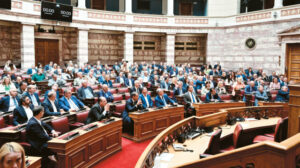
The possibility of changing the electoral law remains on the table – The two scenarios
Although summer is usually a time for circulating political scenarios within the government and New Democracy circles, the discussion about potential interventions in the electoral law is very real. Everyone involved has their own arguments, and the debate continues, despite Prime Minister Mitsotakis having closed it several times. Of course, proposals keep resurfacing, but sources familiar with the Prime Minister’s thinking insist that he has not shifted position, nor does he appear to have requested any concrete planning exercises.
In his recent interview on SKAI TV before the summer break, Kyriakos Mitsotakis once again dismissed scenarios of electoral law changes, despite the political fragmentation and the “Frankenstein” Parliament resulting from the presence of many medium and small parties. However, given the information circulating and the opposition’s pre-emptive reactions, political observers believe the issue will come up again during the Prime Minister’s press conference at the Thessaloniki International Fair (TIF). According to “Proto Thema,” Mitsotakis is expected to stick to his line from last year’s response: closing the matter, but not… completely. In any case, as his close aides confirm, Mitsotakis is not currently inclined to intervene in the electoral law, despite persistent proposals.
The Threshold and the Bonus
The Prime Minister’s associates, Maximos Mansion officials, and New Democracy MPs have differing views on what should be done, but generally agree on the need for some form of intervention. Given the need for political stability in a turbulent geopolitical environment, many argue in favor of changes, especially since ND remains far from achieving the kind of parliamentary majority it enjoyed in past elections.
The first idea involves raising the threshold for parliamentary entry from 3% to 5%, which would keep out smaller parties and lower the percentage required for a majority. Currently, if non-parliamentary parties collect about 10% of the vote, the majority threshold sits at around 36.5%. Supporters of this idea argue that many smaller parties would fail to cross the new threshold, and such a reform could even benefit opposition parties like PASOK. The counterargument, however, is that no one can predict the actual impact, as such a move might rally support for smaller groups if seen as an attempt to exclude them.
The second idea focuses on adjusting the bonus seat mechanism. At present, the leading party receives a 20-seat bonus once it surpasses 25%, plus one additional seat for every extra 0.5% it secures. Thus, with 30% of the vote, the leading party gains a 30-seat bonus—making outright majority difficult. Advocates suggest lowering the threshold for extra seats from 0.5% to 0.3% or 0.4%.
Parliamentary Concerns
While government officials are cautious due to the Prime Minister’s reluctance, MPs are much more anxious. “If ND went into elections under the current rules, many MPs would risk losing their seats—especially in four-seat constituencies,” a veteran pollster told Proto Thema. Indeed, in the 2023 elections, ND performed exceptionally well in such constituencies, even winning 4 out of 4 seats in some cases. However, such dominance would likely be reduced in major constituencies where all parties are entitled to representation, such as Northern and Southern Athens B, Athens A, and Eastern Attica.
Losses in Four-Seat Districts
It is considered certain that ND would lose seats in four-seat constituencies where it previously swept all seats, such as Kavala, Karditsa, and the Cyclades. Depending on performance, the leading party might win 3 seats (best-case), 2 (more realistic), or even 1 (worst-case). Excluding MPs who topped the 2023 preference vote, this would mean significant challenges for candidates such as Angeliki Delikari, Makarios Lazaridis, and Giannis Paschalidis (Kavala); Telis Spanos, Asimina Skondra, and Giorgos Kotsos (Karditsa); and Markos Kafouros, Filippos Fortomas, and Katerina Monogiou (Cyclades). Nationwide, concerns extend to MPs like Stavros Keletsi and Tasos Dimoschakis (Evros), Tasos Bartzokas and Lazaros Tsavdaridis (Imathia), Michalis Papadopoulos (Kozani), Nikos Tagaras and Marilena Soukouli (Corinth), Dionysis Stamenitis and Giorgos Karasmanis (Pella), Anna Mani-Papadimitriou and Spyros Koulkoudinas (Pieria), Katerina Papakosta and Thanasis Lioutas (Trikala), Giannis Oikonomou and Giorgos Kotronias (Fthiotida), and Alexandros Markogiannakis (Chania).
A notable case is Maximos Charakopoulos from Larisa, who has been vocal even during the summer recess, particularly on agricultural issues. In 2023 he placed third locally, competing with Christos Kapetanos, who is seen as centrally favored. With three ND MPs in Larisa, one seat is precarious under the current fragmentation. The same applies in Northern Athens B, where newcomer Pavlos Marinakis increases competition against Nikos Papathanasis, Dimitris Kairidis, and Zoi Rapti. In Southern Athens B, the race is especially tight for Giannis Kallianos, Sofia Voultepsi, and Anna Karamanli; in Western Athens for Maria Syreggela, Dimitris Kalogeropoulos, and newcomer Irini Agapidaki; and in Eastern Attica for Stelios Petsas, Vasilis Oikonomou, and Giorgos Vlachos. In Thessaloniki, competition involves Dimitris Kouvelas, Stratos Simopoulos, and Diamantis Golidakis, along with list MP Nefeli Chatziioannidou. Similarly, in Piraeus, the first constituency’s third seat, currently held by Nikos Vlachakos, is up for grabs, while in Piraeus B, winning 4 seats again seems unlikely—meaning tough battles for Giorgos Vrettakos, Michalis Livanos, Dimitris Markopoulos, and Giannis Tragakis (if he runs again).
Ask me anything
Explore related questions




