





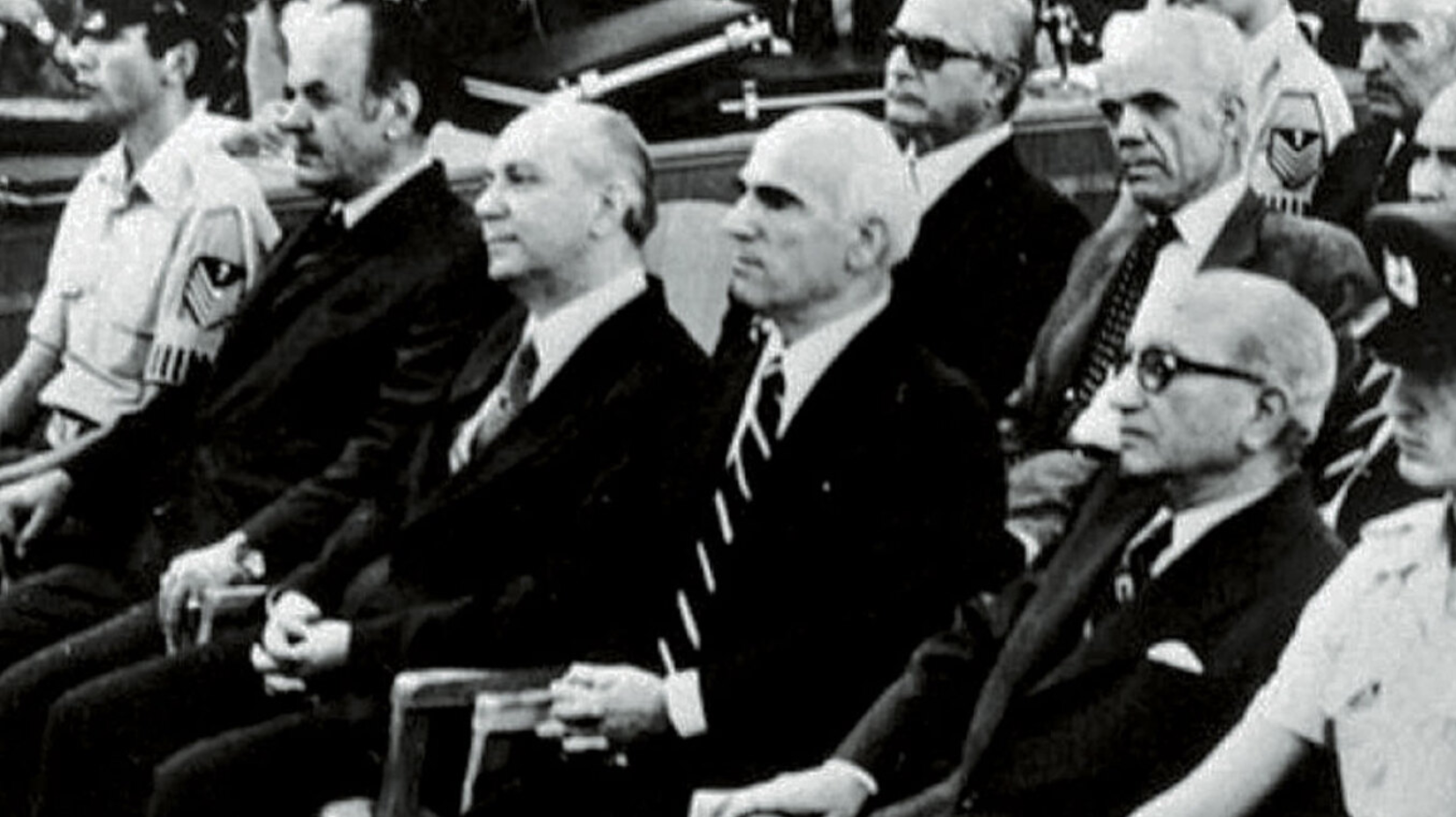
“When we say life, we mean life imprisonment.” This phrase by Konstantinos Karamanlis was spoken on Friday, August 29, 1975, exactly 50 years ago, before hundreds of officers and soldiers in Drama after the conclusion of the “Ptolemaios” military exercise, which he had just attended. It categorically clarified his personal intention and commitment that the conversion of the death sentences of the three ringleaders of the junta—Georgios Papadopoulos, Stylianos Pattakos, and Nikolaos Makarezos—into life imprisonment was final, and their sentences would never be further reduced, but would be carried out precisely as decided by the Cabinet on Monday, August 25.
It was a clear move by the then Prime Minister to defuse the pressure on the political scene, where, although he was the absolute ruler with the resounding 55% in the elections just 10 months earlier and 215 seats in Parliament, he sought a mild political climate and the shielding of Democracy also in the conscience of the then understandably suspicious public, which worried that this was a pardon for the coup plotters. With his statement, however, the matter was closed definitively and irrevocably.
The intervention
Six days earlier, at 1:15 p.m. on Saturday, August 23, the president of the Athens Five-Member Court of Appeals that tried the junta ringleaders in Korydallos, Ioannis Deyannis, called on the defendants and all parties to rise and announced the verdict: three of them were sentenced to death. Various other penalties were imposed on the rest. Glued to their radios and transistor sets, millions of Greeks heard the decision—live TV broadcasts were still rare—with a sense of justice served.
According to the newspapers of the time, “in the courtroom of Korydallos, at the Press Center of the ‘Grande Bretagne’ Hotel, in the streets of Athens, the announcement of the sentences was received with deep emotion and applause expressing the people’s satisfaction at the confirmation of the judicial sensitivity and integrity of the five appellate judges,” whose names were prominently listed: Ioannis Deyannis, Ioannis Grivas, Georgios Plagiannakos, Panagiotis Logothetis, and Panagiotis Konstantinopoulos. Alternate members were Ilias Giannopoulos and Dimitrios Tzoumas, prosecutors Konstantinos Stamatis and Spyros Kaninias. “Radios, newspaper extras, and foreign agencies transmitted the news of the historic decision, which was also a final condemnation of the tyrannical dictatorship,” they wrote.
However, this climate of satisfaction and emotion was soon dampened—or rather clouded—by a written government announcement just two hours later:
“In a Democracy, Justice is an independent and constitutionally guaranteed function. In a State of Law, however, the work of Justice is completed by the final process, also constitutionally guaranteed, which allows the moderation of penalties. In this final phase, a high sense of political responsibility must prevail. For Monday morning, the Cabinet has been convened, which will examine all issues arising after the issuance of the decision.” Meaning one thing: clemency for the three coup leaders.
This was followed by fierce reactions from opposition parties—a true political storm. The leader of the main opposition and president of E.K.-N.D. Georgios Mavros requested an emergency parliamentary session to discuss the matter, Charilaos Florakis of the Communist Party declared that “it is the people’s unwavering demand that the ringleaders be punished accordingly,” while Andreas Papandreou went much further, calling for immediate elections. The government defended its choice and, unwilling to further escalate, accused the opposition of “lack of courage.”
The Cabinet of August 25 formally ratified what had been announced, finalizing that Papadopoulos, Pattakos, and Makarezos would not be executed. It was also another step toward the abolition of the death penalty and the alignment of Greece with European standards. In a curious coincidence of dates, this occurred exactly three years after the last (and still to this day) execution of a death row inmate in Greece: on August 25, 1972, in Dyo Aorakia, Heraklion, Crete, the firing squad executed 25-year-old Vasilis Lymberis, convicted of setting fire to the home of his estranged wife, killing her, her mother, and their two small children.
“When we say life, we mean life”: Fifty years since Karamanlis’ historic phrase about the coup plotters
The 25-year-old Vasilis Lymberis was the last person executed in Greece on August 25, 1972, by coincidence exactly three years before the decision to commute the coup leaders’ death sentences to life.
The reasons
But why did Karamanlis decide to use a constitutional power to commute the three death sentences to life, even though this was contrary to popular sentiment demanding the harshest possible punishment for the officers who betrayed their oath and overthrew Democracy—especially the junta’s leadership trio?
The matter had primarily to do with the Prime Minister’s strategic aim to settle the accounts of Democracy with the dark past as quickly and as “bloodlessly” as possible. The country was democratizing with a new Constitution, which, despite harsh criticism from the opposition at the time, has proven resilient half a century later. Greece urgently needed institutional stability and full political normalcy to rejoin the European track and pursue EEC membership. The abolition of the death penalty, though not included in the constitutional reforms, was practically a prerequisite for Greece’s European prospects. If not legislated, at least an absolute freeze on executions had to be in place.
At the same time, the new page Karamanlis clearly sought required a quick resolution of outstanding issues with the junta regime. The trial of the ringleaders was exemplary and, contrary to expectations, was completed in just 26 days. The fast-track process, the conviction of 22 out of 24 defendants, and the simultaneous commutation of the death sentences for the three leaders into life imprisonment showed that Democracy punishes fairly—and when needed, harshly—but does not take revenge. It also prevented the reproduction of a climate of revenge among junta nostalgics in the Armed Forces. Not by chance, Karamanlis delivered his personal assurance—“when we say life, we mean life”—before officers in Drama, sending a dual message of Democracy’s moderation combined with the state’s determination in justice and order.
Ask me anything
Explore related questions




