





It’s Sunday afternoon, September 14, and the sun is setting behind the timeless rocks that bear witness to the long history of Kos — the island where Hippocrates was born, practiced medicine, and where the world’s first Asclepieion is located.
In an atmosphere of solemn awe, no one could hide their emotion at this ambitious journey that is beginning anew through the herbs and plants blessed by the Father of Western Medicine. “The Garden of Life” of Hippocrates, as it is called, aims to reintroduce all the herbs discovered by the Father of Medicine and to pave the way for reconnecting Hippocrates with his island — which has the potential to return to the international forefront.
The unique Hippocratic botanical garden created by “Ikos Aria” in Kos seeks not only to restore Hippocratic symbolism to the center of attention but also to create a vibrant cultural and educational space through a rare experiential encounter that has already drawn international interest.
This is a large-scale project to which a team of scientists, archaeologists, botanists, and cultural figures contributed — a significant cultural event that puts Kos back in the spotlight, inviting official bodies to follow.

The Island of Ancient Medicine
Perhaps it’s the energy of Kos, one of the most beautiful islands of the Aegean, with its northern winds mingling with the scents of herbs blooming once again. Perhaps it’s the timing that brings the Father of Western Medicine back to center stage. Either way, everything seems to be regaining a lost harmony.
By foregrounding its cultural identity and aiming to restore Kos as the island of Ancient Medicine to the global stage, a group of visionaries from “Ikos Aria,” supported by scientists from various fields, set out to create the ideal Garden of Hippocrates and make it accessible to the public through technology.
Visitors, with their mobile phones in hand, can scan the herbs in Hippocrates’ “Garden of Life” and listen to audio guides detailing the history of each plant and the Nymphs that inspired their names.
With this app — narrated by Hippocrates and the Nymph Flora (Latin for “flora”) — visitors are guided through the garden in an informative yet entertaining way. It presents the healing properties of the herbs, the core principles of Hippocratic Medicine, and the ancient customs and myths closely tied to them.
However, the project doesn’t stop at the garden. Its broader aim is to restore the prominence of Hippocrates’ figure and teachings — a man who connected medicine with philosophy.
The official presentation of the new garden at “Ikos Aria” took place on Sunday, September 14, with the participation of the project’s contributors, representatives of local authorities, and distinguished guests.
The event was a celebration of culture and sustainability, highlighting the close relationship between the Sani/Ikos Group and the island, and bringing together different organizations, such as the International Hippocratic Foundation, that can support this initiative.
The Garden of Life
Hippocrates’ “Garden of Life” hosts dozens of herbs and plants used in Hippocratic Medicine. The plants are organized thematically, inspired by mythological figures, ancient heroes, and healing traditions.
Pomegranate, myrtle, savory, laurel, fig, wild rose, almond, juniper, wild olive, rock samphire, tamarisk, chaste tree, and many more Hippocratic medicinal herbs take center stage in a journey that highlights humanity’s deep connection with nature and healing.
The Seven Corners
The garden is divided into seven “corners” (a number with magical properties in the ancient world), each inspired by figures that played a role in the practice of healing, linking mythology with philosophy and daily life.
These are the corners of Persephone, Athena, Aeneas, Panacea, Daphne, Aphrodite, and the sons of Asclepius. Through this experiential tour, visitors explore myths, history, and the healing traditions of the ancient world.
By reviving the importance of Hippocrates and the healing identity of Kos, “Ikos Aria” seems to breathe new life into the long-standing vision of the island’s International Hippocratic Foundation: to create an international center guided by Hippocrates, encouraging gatherings, hosting conferences that bring together doctors and scientists from around the world, and introducing the public to the secrets of ancient medicine.
Located east of the Asclepieion and just off the road connecting it to the town, the International Hippocratic Foundation has established a small museum with Hippocrates’ pharmacy, explaining all the secrets of Hippocratic Medicine. It also houses authentic editions of Hippocratic texts from the 17th century.

(Hippocrates’ pharmacy at the International Hippocratic Foundation, featuring fruits and dried parts of herbs)
Why Hippocrates
Born on the island of Kos around 460 BC, Hippocrates was not by chance the greatest healer and physician of antiquity.
Kos was already home to the Asclepieion, which still impresses visitors today with its imposing scale, dominating the island as its signature landmark. Hippocrates descended from the distinguished Asclepiads — the priest-physicians of Asclepius on Kos — who were renowned for their medical knowledge.
There is also a mythological kinship connecting Hippocrates to the demigod Heracles, the quintessential god of strength who relieved humans of their burdens — just as Hippocrates relieved humanity of illness.
On this island, with its unique energy and its fertile, benevolent atmosphere, the man who would transform medicine into a science first saw the light of day. That is why, to this day, physicians upon graduation swear an oath in his name.
In antiquity, medicine and healing were approached holistically, encompassing both soul and body. As a result, Hippocrates’ name became directly associated with philosophy.
A contemporary of Plato, Hippocrates’ name appears twice in the Platonic dialogues: first in Protagoras, where Socrates tries to convince a young man to travel to Kos to learn the secrets of medicine, and later in Phaedrus, where Hippocrates is cited as the one who teaches people the secrets of medicine and healing through an understanding of natural phenomena.
He was the first to separate medicine from superstition, linking it not only to philosophy but also to rational understanding and practice. He himself wrote that “the physician who is also a philosopher is equal to the gods,” emphasizing the human-centered nature of science, the fluidity of knowledge, and the principles that physicians must respect — elements that are clearly reflected in his oath.
Also a Surgeon
Even though some have questioned the authenticity of the Hippocratic Oath, its principles are directly tied to Hippocratic ethics.
His pioneering work profoundly influenced the development of scientific medicine through the ages, and its symbolic power remains immense.
Among the findings of the Asclepieion of Kos, the famous surgical toolkit with 24 instruments stands out, proving that many of the secrets of surgery were already known to Hippocrates and his successors.
Ancient inscriptions discovered on the site also reveal that the Asclepieion was granted pan-Hellenic recognition of its rights to “asylia” (asylum) and “ekecheiria” (truce) during the major celebrations of the Lesser and Greater Asclepieia festivals. These festivals involved sacrifices, musical performances, and athletic games.
It is no coincidence that Asclepius remained a revered deity even after Christianization, with busts of Hippocrates occupying prominent places in households as protectors par excellence.
The Next Steps
For all these reasons, the institutions of Kos, together with “Ikos Aria” and the International Hippocratic Foundation, have taken on the mission of bringing Hippocrates back to the center of attention.
With respect for nature, faith in the island’s inherent strengths, and a focus on sustainability, their next goal is for official government bodies — such as the Ministry of Culture — to join the effort.
“For us, sustainability means above all respect — for nature and for the places that host us. The ‘Garden of Life’ at Ikos Aria is a living monument to Hippocrates, linking the healing wisdom of the past with today’s experiential reality.
It was created to inspire, to educate, and to honor the values of the medical tradition of the Father of Western Medicine, who was born on the island of Kos and whose legacy continues to touch lives around the world,”
said Ms. Eleni Andreadi, ESG Senior Director of the Sani/Ikos Group, at the inauguration of the botanical garden.
“We invite our guests at Ikos Aria to connect with the place and its history, and to discover the philosophy of Hippocrates, which, 2,500 years later, remains more relevant than ever.”
The creation of the “Garden of Life” is part of the Sani/Ikos Group’s Ikos Green sustainable development program, which focuses on environmental protection, preserving Mediterranean biodiversity, and promoting authenticity and cultural development.
The official presentation of the “Garden of Life” took place with the participation of the project’s contributors, the mayor of Kos, Theodosis Nikitaras, distinguished guests, and members of the local community.
Among the guests were:
- Christos Zerefos, Emeritus Professor of the University of Athens, Secretary General of the Academy of Athens, and Director of the Research Center for Atmospheric Physics and Climatology;
- Stelios Zerefos, architect-engineer, who designed the garden together with landscape architect Eva Papadimitriou;
- Irini Vallianatou, botanist and scholar of Hippocratic Medicine, who, together with Nikos and Niki Koutsianas, founders of Apivita, Symbeeosis, and the Hippocrates for Life organization, curated the Hippocratic biodiversity of the garden;
- and the team of Professor Giannis Ioannidis from the Department of Informatics and Telecommunications of the University of Athens, who created the educational app “Educating Flora.”
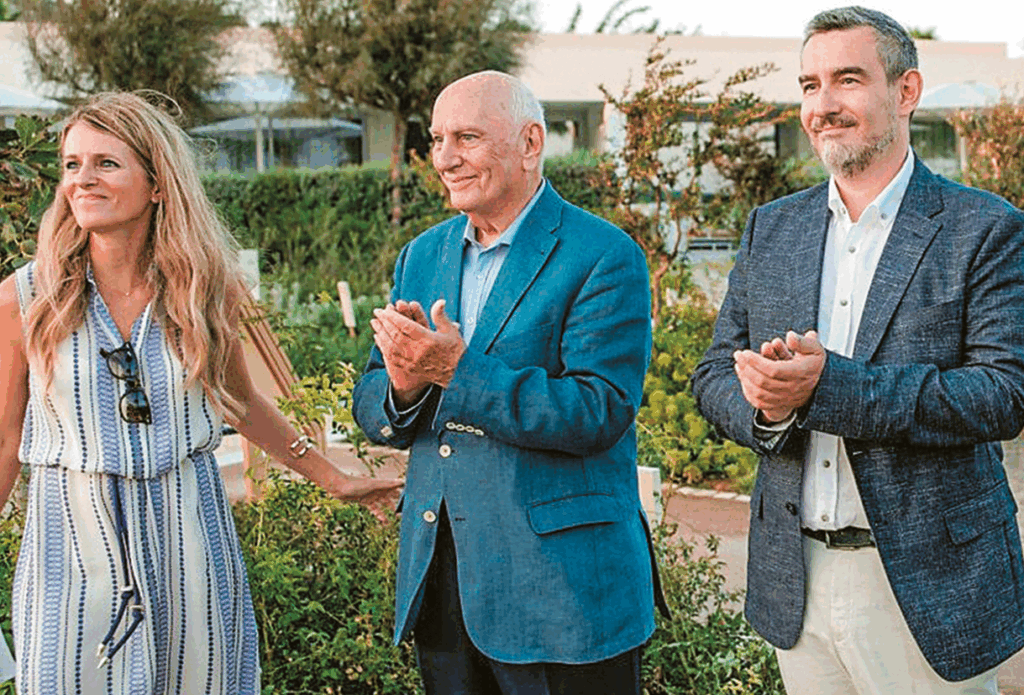
(The academic professor Christos Zerefos, the architect-engineer Stelios Zerefos, and the ESG Senior Director of the Sani/Ikos Group, Eleni Andreadi)
The event was also attended by the “Diazoma” Association, represented by its Secretary General, Professor of Classical Archaeology Vassilis Lambrinoudakis, who ensured the scientific accuracy of the content of the app, as well as Dr. Nikos Papantoniou, President of the International Hippocratic Foundation.
Highly informative guided tours were offered by archaeologist Anastasia Vassiliou in Greek, while journalist Helene Smith from The Guardian, who covered the event, enjoyed a tour in fluent English. Writer, museologist, and archaeologist Katerina Servi was on hand to answer questions and clarify any doubts.
Together, we had the opportunity to enjoy a meal inspired by the Hippocratic tradition, prepared with herbs from the “Garden of Life” at Ikos Aria — an innovative hotel group with an international presence and resorts in Mediterranean coastal destinations.
A pioneer in sustainable tourism, the Sani/Ikos Group has developed an ambitious sustainability strategy (ESG) and is a member of the United Nations Global Compact for businesses.
The next steps involve Ikos Aria’s support for the International Hippocratic Foundation of Kos, guided by the Hippocratic worldview, with the aim of restoring its symbolic prestige through the creation of new Hippocratic centers on the island.
Ask me anything
Explore related questions




