





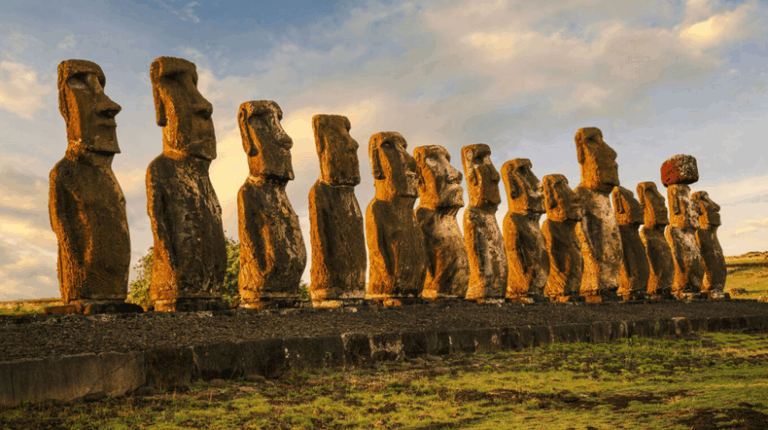
The origin of the iconic stone heads of Easter Island has long been one of the world’s greatest archaeological mysteries. However, scientists now claim to have solved an important part of that mystery.
Weighing between 12 and 80 tons, the enormous stone figures have puzzled researchers for decades, as they could not understand how the island’s ancient civilization transported them to their final locations.
According to the Daily Mail, using a combination of 3D modeling and experiments, scientists have confirmed that the statues actually “walked” to their destinations.
By studying nearly 1,000 of the statues, known as moai, anthropologists concluded that the Rapa Nui people likely used ropes to “rock” them in a zigzag pattern.
This technique allowed small groups of people to move the massive moai over long distances with relatively little effort.
One of the study’s authors, Professor Carl Lipo of Binghamton University, explained: “Once it starts moving, it’s not hard at all — people just pull with one hand. It saves energy and moves very quickly. The hard part is getting it started.”
Until recently, anthropologists believed that the moai were laid horizontally and dragged to their final positions — a process requiring immense strength and many people, especially for the larger statues.
But now, there is growing evidence that the Rapa Nui people had discovered a much smarter and simpler solution.
By tying ropes to both sides of a statue’s head and pulling alternately left and right, the statue could “rock” sideways and move forward with a motion resembling “walking.”
Professor Lipo and his colleague, Professor Terry Hunt of the University of Arizona, had already tested this theory on smaller models but wanted to see if it would also work for larger moai.
They first created a detailed 3D model of a moai to determine which features would support this type of movement. They found that the moai seemed intentionally designed to be able to “walk.”
Their large D-shaped base and forward-leaning posture helped generate the zigzag motion when rocked from side to side.
To test the theory in the real world, the researchers built a 4.35-ton replica moai based on their 3D model. Like the originals, it had a D-shaped base and a center of gravity tilted slightly forward.
With a team of just 18 people, they managed to move the statue 100 meters in only 40 minutes — much faster than previous attempts.
The researchers argue that this provides strong evidence that the larger moai were also transported in this “walking” fashion.
Professor Lipo stated: “The physics make sense. What we observed experimentally really works. And the bigger the statue, the better this method functions. It’s the only way they could have been moved.”
Even the island’s oral traditions mention that the statues “walked” from the quarries where they were carved to their final resting places.
To further support their theory, the researchers also studied the network of “moai roads” that crisscross the island.
“Every time they moved a statue, it seems they built a road too. The road is part of the transport process,” said Professor Lipo.
These specially constructed roads are believed to have been designed to aid in moving the statues, and their shape is ideal for the moai’s “walking” motion.
They are about 4.5 meters wide and have a concave profile that helps stabilize the statue and make it easier to move forward.
Some moai statues found fallen along the sides of these roads show signs that people tried to lift them back up by digging under their “feet,” another strong clue supporting the “walking” hypothesis.
Professor Lipo concluded: “This shows how intelligent the Rapa Nui people were. They figured it out. They deserve credit for what they accomplished — we have much to learn from them and their principles.”
What are the Moai statues?
The Moai are monolithic human figures carved by the Rapa Nui people of Easter Island, located in the Pacific Ocean and part of Chile, between 1250 and 1500 AD.
All the statues have disproportionately large heads and are thought to represent deified ancestors. There are 887 statues, most facing inland, with an average height of about 4 meters.
Only 53 moai are not made from tuff (compressed volcanic ash), while about 100 wear red “hats” or “topknots” made from scoria, known as pukao.
What do they symbolize?
In 1979, archaeologists suggested that the statues were designed to have eyes made of coral. The figures are believed to symbolize authority and power.
They may represent former chiefs and serve as repositories of spirits or mana — a supernatural, spiritual force.
They were positioned so that the ancestors would watch over the villages, while seven of them face the sea to help travelers find land. Yet, it remains a mystery how the massive carved stones were transported into place.
In their isolated location off the coast of Chile, it is believed that the island’s ancient inhabitants were eventually decimated by bloody conflicts as they fought over the island’s dwindling resources.
What they left behind were the iconic giant stone heads — and an island littered with sharp triangular pieces of volcanic glass, which some archaeologists long believed had been used as weapons.
Ask me anything
Explore related questions




