





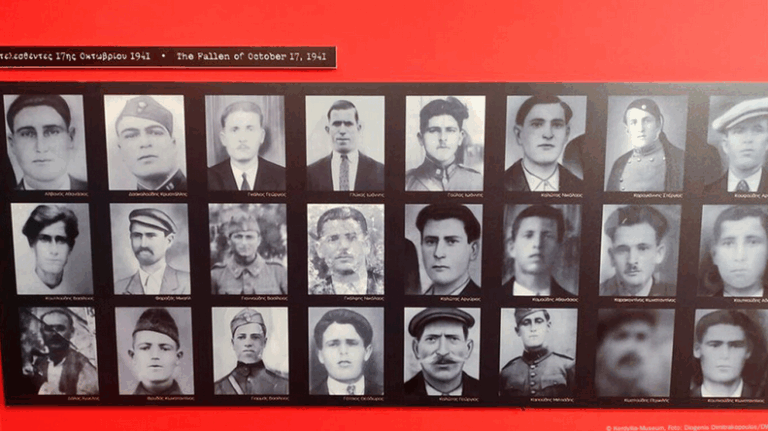
In the autumn of 1941, the villages of Ano and Kato Kerdyllia, two small settlements in the prefecture of Serres, were wiped off the map. Two hundred thirty-eight men between the ages of 15 and 60 were executed by German occupation troops in what became the first mass execution of civilians on mainland Greek soil. Today, the memory remains indelible through the last survivors and the residents of the village.
Anastasia Goula Remembers
“Take that down,” says Anastasia Goula instantly upon seeing the Nazi swastika displayed at the Museum dedicated to the Kerdyllia massacre. She was not even four years old at the time.
“They came early in the morning, knocked on our door, and woke up the whole family. My father got up. He didn’t even put on a shirt in his hurry—just threw his jacket over his shoulders and left. We never saw him again. No one knew what was coming. Everyone was saying their own thing, as they say in the villages.”
A German soldier appeared. “People of Efkarpia,” he said, holding a box of matches. He pointed to the school, indicating it would be burned, she recalls in her interview with Deutsche Welle.
At 9 a.m., on the signal of a flare, the men of the village were executed en masse by the Nazis, under the command of Captains Wendler and Schreiner. Then the houses were set on fire. Women and children were driven away, leaving everything behind.
“When we reached the stream, we heard the gunfire. That’s when we heard it all. Then they brought out the old men who spread the news that the others had been killed, and after that, there was smoke everywhere,” Goula describes.
A few days earlier, the Nazis had been searching the village for resistance fighters. “Do you have partisans?” the Germans kept asking. “We had no partisans in the village, not even by rumor. And if someone had an ideology, who knew? Everyone was on the right,” she emphasizes.
And afterwards?
“How could I be? Lost. Not knowing where my father was, where my grandfather was, where my uncle was. Having no one. We had nowhere to live, nothing to eat, nothing to wear.”
When they returned to the village, they cleared the rubble and ashes, building makeshift shelters of tin and stone. “A storm would come — the sheets of tin would fly off, the stones would rattle, and my mother would cry out, ‘My children will be killed!’ Then the Germans would come back to the village. They’d steal chickens. They’d shout. They’d curse.”
The question of “why” still haunts her soul.
“We keep wondering why. For nothing. Whoever says otherwise is lying,” she says disarmingly. Watching the wars raging today, she shares her message with simple clarity: “I think of what we went through. If only someone could make sense of it all — but it never will make sense. I wonder where we’re heading. I have children and grandchildren. What I lived through, I don’t want them to live.”
“A Silent Lament Over the Village”
George Galios, president of the local community of Neo Kerdyllia, carries within him the shadows of that day.
“Among the victims were both my grandfathers,” he says. “I didn’t live through the massacre, but I grew up in its shadow. My grandmother lived with us — she always mourned. She cried silently under her headscarf. As children, we didn’t understand, we only felt the sadness hanging in the air,” he recalls to Deutsche Welle.
The massacre, he says, was carried out “as an example.” The first acts of sabotage by partisans in nearby villages had alarmed the Nazis.
The villages’ name, linked to Mount Kerdyllion, where resistance fighters were active, gave the Germans a pretext for their brutal reprisals.
“The villagers tried to convince the Germans they had nothing to do with the partisans. They even went to Thessaloniki to explain — but by the time they returned, the tragedy had already happened,” he says, his voice breaking.
“For years, the story of Kerdyllia was unknown — a silent lament hovering over the village. Only in the 1980s did people begin to break the silence.”
He recalls with emotion the first visit of survivors and descendants to the newly built museum in the village. “They were overcome with sobs. Some fainted. It was as if they were reliving that moment. Even schoolchildren come now — they’ve heard that ‘something happened here,’ and they ask questions.”
“When I was teaching, I remember that not a single line in the History textbooks mentioned Kerdyllia,” says Ioannis Papasymeon, retired philologist and author of The Memory of the Survivors. “What happened here became the ‘Kerdyllia model.’ It was the first implementation of the order to execute all the men of a village as a warning.”
“Soon after, the Germans applied the same tactic across Greece,” he adds. “Kandanos in Crete came earlier, in the summer of 1941, but there the Germans did not execute all the men. In Kerdyllia, by contrast, there was a clear order: ‘No male is to be left alive.’”
Papasymeon remembers the testimonies of the women he interviewed: “It was the weeping I shared with them, the trembling hands lighting a candle, the black headscarf pulled down over their eyes.”
Some of the children he spoke with carried deep inner pain.
“One woman told me: ‘All the hardships we suffered have been forgotten — but one thing remains forever: the absence of my father. I never once in my life called out “father.”’
And another girl recalled: ‘We children used to gather on the hillside opposite the village and shout loudly, so that the souls of our loved ones could hear us.’”
He stresses that the memory of Kerdyllia must be passed to future generations.
“We must cultivate a historical education that transmits the emotion and memory of this place to the young. But it’s difficult. We live in a digital age where young people are detached from historical memory.”
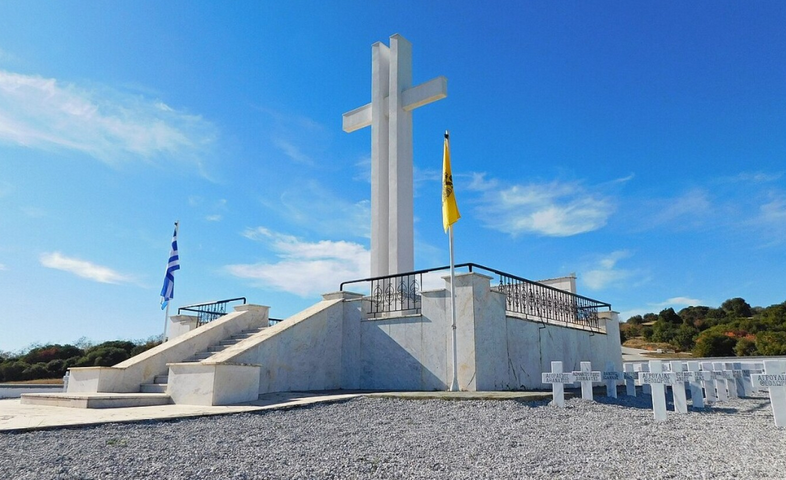
Every October in Kerdyllia, the earth seems to breathe differently, as if remembering.
The commemorative events and the memorial run held in honor of the villagers’ sacrifice serve as a history lesson for the young.
They do not seek revenge — they seek remembrance, so that this pain will not remain just a name carved in stone.
Ask me anything
Explore related questions




