





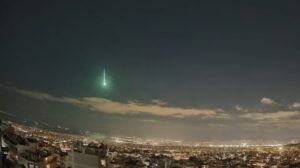
An impressive meteor was visible on the evening of Tuesday, November 6 over the skies of Greece, just after 8 p.m., surprising those who saw it.
As meteorologist Thodoros Kolydas reported, the phenomenon was captured on video by two cameras, demonstrating the path of the bright object as it entered the atmosphere.
Specifically, one of the videos comes from the webcam of the Meteoacharnes.gr weather station in Menidi, while a second video was recorded by the operator of the Ilioupoli Sky channel in Ilioupoli. Both capture the brief but impressive flash of the meteor as it descends to the horizon.
Is there a danger from meteorite falls?
In his post, Thodoris Kolydas also answers the question that is often asked in such cases: is there a danger to humans?
As he explains, taking into account the total land area of the Earth, its population, the average time spent in open space and life expectancy, the probability of a human being being hit by a meteorite larger than 1 gram is one in 1.5 billion – for the entire duration of his or her life.
“Therefore, there is no cause for concern,” he stresses.
However, he says there have been two documented cases of people who were actually at risk:
-
- On November 28, 1954, Annie Hodges of Alabama was nearly killed in her home when a 4-pound meteorite fell.
- In June 2009, 14-year-old Gerrit Blank, on his way to school, was slightly injured in the arm by a meteorite “the size of a small bean.”
The meteorites in history
In the same post, Theodore Kolydas recalls that meteors and meteorites have been reported for thousands of years, long before known ancient civilizations. As he notes, as early as the time of primitive man, meteorite falls have been the occasion for myths and beliefs, while ancient cultures of the Americas used meteoric metal to make tools and weapons.
In Ancient Greece, meteorites were called “thunderstones”, as the Greeks believed they fell from the sky in the form of thunderbolts. Pliny the Elder referred to them as Lapis Fulminis, noting that when they fell, they could split trees, break rocks, or kill people and animals.
In popular tradition, they were called “astropellets” or “speckles”, while another category, the “vaityles”, had special religious significance and were an object of worship, especially among Semitic peoples.
The video of the meteorite’s fall has already sparked a number of comments on social media, with many saying its light was visible in various areas of Attica and Central Greece.
Ask me anything
Explore related questions




