





The European Commission has issued a positive assessment of Greece’s draft budget for 2026 and its medium-term fiscal plan, as part of the autumn European Semester package published today.
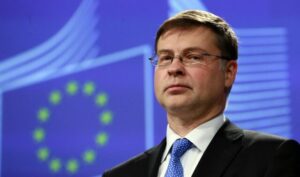
Economic Affairs Commissioner Vladis Dombrovskis presented the assessment of the 2026 draft budgets submitted by 20 eurozone member states (excluding Belgium, Spain, and Austria). Among these, 17 draft budgets were reviewed. For the 16 member states where the Council triggered the national escape clause, flexibility for increased defense spending was considered.
Twelve countries—including Greece, Cyprus, Estonia, Finland, France, Germany, Ireland, Italy, Latvia, Luxembourg, Portugal, and Slovakia—are deemed fully compliant with the Council’s budgetary recommendations and are encouraged to proceed with their planned fiscal policies for 2026.
Conversely, the Commission views the draft budgets of Croatia, Lithuania, and Slovenia as posing a risk of “non-compliance,” while the Netherlands and Malta face a risk of “material non-compliance.” These five member states are urged to take necessary measures to align their fiscal policies with Council recommendations.
Regarding other member states, the Commission considers seven countries compliant—Austria, Belgium, the Czech Republic, Denmark, Sweden, Poland, and Romania—while Bulgaria, Hungary, and Spain are assessed as being at risk of non-compliance.
Macroeconomic Imbalances and Fiscal Monitoring
The Commission has identified potential macroeconomic imbalances in seven member states: Greece, Hungary, Italy, the Netherlands, Slovakia, and Sweden. Additionally, Romania is classified as having excessive imbalances in 2025. For these countries, further assessments will determine whether policy actions are necessary. These evaluations will take place in the first half of 2026, with decisions presented in the context of the Spring European Semester.
Excessive Deficit Procedure
Nine member states—Austria, Belgium, France, Hungary, Italy, Malta, Poland, Romania, and Slovakia—are currently subject to the excessive deficit procedure (EDP). However, this procedure is temporarily suspended, meaning no new measures will be taken at this stage. Member states remain committed to reducing deficits below the 3% of GDP threshold. The Commission will reassess the situation in spring 2026, once the 2025 data are available.
Furthermore, the Commission has issued a report under Article 126(3) of the Treaty assessing compliance with deficit criteria for Germany and Finland. It concluded that initiating an excessive deficit procedure for Finland is “justified.”
Post-Memorandum Surveillance Reports
The Commission released post-memorandum surveillance reports for Ireland, Greece, Spain, Cyprus, and Portugal, assessing their economic, fiscal, and financial status, particularly their capacity to repay financial assistance. The reports confirm that all five countries maintain their debt repayment capacity.
Recommendations for Euro Area Economic Policies in 2026
Euro area member states are urged to ensure fiscal sustainability by adhering to the net expenditure paths recommended by the Council, including flexibility for defense spending where applicable. This approach aims to maintain an overall neutral budgetary stance for the euro area in 2026.
Member states are also encouraged to re-prioritize budgets to support strategic investments, address defense industry bottlenecks, and promote joint procurement. Additionally, full implementation of the Recovery and Resilience Plans by August 31, 2026, is recommended to ensure complete absorption of EU funds.
The Commission also calls for strengthening labor markets, promoting investments in innovation and strategic sectors, and improving the Single Market by simplifying regulations and removing barriers.
New Council Recommendation on Human Capital
For the first time, the Commission proposes a Council Recommendation on human capital, directed at all 27 member states. This calls for urgent action to address structural challenges related to human capital that could undermine competitiveness.
Member states are urged to prioritize education and skills development in strategic sectors critical to the EU economy, such as the clean transition, circular economy, industrial decarbonization, health and biotechnology, agriculture and bio-economy, defense industry, and space.
Outlook
The European Semester package is based on the Autumn 2025 Economic Forecasts, which indicate that the EU economy remains resilient with moderate growth—driven mainly by strong domestic demand, investment, a stable labor market, and falling inflation.
However, the EU continues to face strategic vulnerabilities and structural challenges, including low productivity, demographic pressures, and increasing public finance demands related to defense and the transition to a digital and decarbonized economy.
Strengthening competitiveness and maintaining sound public finances will be crucial to unlocking Europe’s growth potential and ensuring economic stability.
Ask me anything
Explore related questions




