





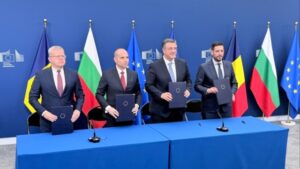
The trilateral agreement between Greece, Bulgaria, and Romania on the Aegean–Black Sea Corridor, a strategic rail and road axis linking the three countries via Alexandroupolis, was signed today in Brussels. The agreement was signed by the Commissioner for Sustainable Transport and Tourism, Apostolos Tzitzikostas; the Greek Deputy Minister of Infrastructure and Transport, Konstantinos Kyranakis; the Bulgarian Deputy Prime Minister and Minister of Transport, Grozdan Karadzov; and the Romanian Deputy Minister of Transport, Ionut Christian Sevoiu. It marks the strengthening of cross-border cooperation and the launch of a project of high geopolitical and economic importance for the region.
“The Memorandum transforms geographical location into a substantial strategic advantage and harmonises planning, timelines, and financing,” said Commissioner for Sustainable Transport and Tourism Apostolos Tzitzikostas, emphasising in his speech the crucial role of the Aegean–Black Sea Vertical Corridor in the European transport network. According to Mr. Tzitzikostas, the Thessaloniki–Alexandroupolis–Bucharest axis plays a central role in this new framework, which “will become one of the most important strategic arteries of Europe,” with critical significance for both connectivity and military mobility for the EU and NATO.
The Commissioner underlined that, with the active involvement of the European Commission, CINEA, and the European Investment Bank, it is expected that by the end of 2026 a complete joint plan for projects, corridors, and financing will be in place. At the same time, he stressed that this new cooperation lays the foundations for the most strategic transport axis in Southeast Europe—“a first line of defence for the security, economy, and resilience of the European Union.”
K. Kyranakis: Strengthening the critical North–South axis
In his speech, Deputy Minister of Infrastructure and Transport Konstantinos Kyranakis referred to the importance of the project, describing it as “a strategic commitment and not a formal process, as it strengthens a critical North–South axis vital for trade, strategic security, freight flows, and the cohesion of the EU’s internal market.”
As Mr. Kyranakis noted from Brussels, “the corridor will reconnect historic centres and ports in Athens, Thessaloniki, Sofia, Ruse, Constanța, and Bucharest, reviving a route that for centuries defined trade and strategic movement from the Aegean to the Balkans and Central Europe—and it will do so with modern European standards.”
He highlighted the importance of the project for military mobility and stressed that the agreement accelerates projects that “will make the corridor reliable, fast, safe, and sustainable. At the same time, it sends a political message in favour of extending the Trans-European Transport Network to Moldova and Ukraine, strengthening the EU’s geopolitical resilience.”
He also referred to the completion of the Greek sections, stating that “with national resources and European funding, including Cohesion Fund and CEF (Connecting Europe Facility) funds, we are advancing projects worth more than €1.3 billion by 2030 for the completion of the Greek sections of the BBA (Baltic–Black Sea–Aegean) Corridor, with a total value of €2.6 billion. In addition, €700 million in further infrastructure funding will be required.”
For their part, Bulgarian Transport Minister Grozdan Karadjov and his Romanian counterpart highlighted their cooperation with the Transport Commissioner and the Greek Deputy Minister on a project they described as based on Member State collaboration for infrastructure investment and military mobility. They stressed the importance of coordination, interoperability, digitalisation, and efficient border crossings for a more connected and secure Europe.
The signing ceremony was also attended by the Vice President of the European Investment Bank, Marek Mora, who discussed the financing of the project, praised the excellent coordination among the Member States, and emphasised the importance of implementing the corridor for military mobility on the EU’s eastern flank.
Ask me anything
Explore related questions




