





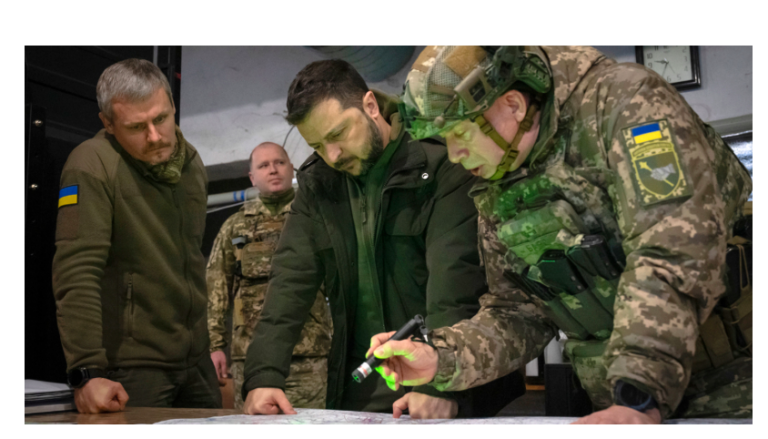
It is a high-risk, forced move born of American pressure, internal decline, and a war that has become a prolonged deadlock. His political “hegemony” is weakening, society is exhausted, and Kyiv now faces a moment where the front lines are no longer only in the east but also within the state itself.
The constitutional limit and the admission of a crisis
The Ukrainian Constitution clearly sets a five-year presidential term and allows elections only under conditions of peace. Martial law explicitly forbids any electoral process. To hold elections now, legislative acrobatics, constitutional reinterpretations, and a degree of political consensus—currently absent—would be required.
Yet even this is not the real obstacle. The obstacle is the admission that the institutional stability Zelensky relied on to keep the country united during the war is no longer enough. Pressure from Washington and the dual conflict—on the battlefield and within the political system—push him into a move that upends the very rules of wartime governance.
Washington changes the game — and Trump sets the framework
The U.S. government wants elections—not to strengthen Ukraine, but to secure a negotiating partner willing to enter peace talks under terms more conducive to reaching a settlement with Russia.
Zelensky’s statement that he is willing to proceed, but only with international security guarantees, is a delicate delaying tactic. He tries to appear cooperative, knowing that implementing elections is nearly impossible without paralyzing the front.
Washington’s intention is clear: acceleration. Kyiv responds with a move that looks both like a forced retreat and a trap for its allies:
If the U.S. wants elections, let it take responsibility for securing them.
The rivals — and the danger of militarizing politics
This electoral battle resembles none of the past. There are no campaigns, no structures, no normal political environment. But there are strong personalities.
- Valerii Zaluzhny — the only one who could truly beat Zelensky. With popularity above 70%, the image of a leader, and broad support in both the military and society, his entry into politics would create a duality of political legitimacy and military prestige — historically a combination that has toppled governments and regimes.
- Poroshenko — remains a strong pro-European figure but without the momentum to overturn the race.
- Tymoshenko — more a symbol than a credible contender.
- Local leaders and military commanders — may emerge as “surprise candidates,” especially if public fatigue turns into anger.
The problem for Zelensky is clear: the country may not merely be heading toward elections, but toward political restructuring that could result in a de facto transfer of power to military figures.
Polls — legitimacy not lost, but no longer enough
Surveys show Zelensky still enjoys high institutional legitimacy and significant personal approval. But voting intention has fallen to around 20%, reflecting a society that respects his role but no longer sees a clear strategy.
The most worrying finding: about 60% of citizens do not want elections now. They don’t see them as a priority — they see them as a threat. This makes elections not only a political risk but a fracture in social cohesion.
The dangers — and the risk of an uncontrollable crisis
Elections in a war zone are not just difficult. They are dangerous in multiple dimensions:
- destabilization of the front, as military units would have to be reassigned for maintaining order,
- massive targeting of polling stations by Russia for strategic and symbolic reasons,
- institutional rupture if the legitimacy of the process is questioned,
- and above all, the shadow of the unpredictable: a coup, an assassination attempt, an explosion capable of fully destabilizing the country.
In an environment where the state operates at the limit, where the military has gained enormous social — and economic — power, and where international pressure is increasing, such a shock could change the course of the war in just 48 hours.
The scenarios for the next day
With the current balance of power, four outcomes emerge:
1. Elections under international supervision
The Rada temporarily adjusts the framework, elections are held under Western protection, and Zelensky is re-elected—though weakened. Stability returns, but with cracks.
2. The “Zaluzhny scenario”
The former general runs, mobilizes society, and seeks power. This is the most unpredictable scenario. A wartime state handing authority to the military could either be strengthened or collapse. Zaluzhny, the only person in four years of war who publicly disagreed with the President at a moment when the Ukrainian people overwhelmingly supported him, would radically change the political landscape if he assumed power.
3. Retreat scenario
Social pressure and Parliament block the process. Zelensky’s proposal acts as a negotiating maneuver rather than a real path to elections. U.S. and European pressure intensifies. Russia continues to strike infrastructure and push deeper into Donbas. The narrative of a leader without elections weighs on every diplomatic effort.
4. Zelensky’s defeat
If Zelensky loses—especially to a military figure—Kyiv enters a transitional period, and Moscow will try to exploit the power vacuum. Ukraine would face the simultaneous challenge of a new leadership and frontline escalation.
Europe sees the rift widening
For Europe, Ukrainian elections—though not a domestic EU matter—are highly significant. They affect Western cohesion and Kyiv’s ability to remain strategically aligned with the West.
If Ukraine changes leadership under U.S. pressure, Europe loses its main interlocutor in the biggest security crisis of the post-war era.
If a military candidate wins, Europe will have to cooperate with a leadership that did not emerge from a traditional political process.
And if Zelensky is re-elected under crisis conditions, he will enter negotiations with reduced room for maneuver.
Ukraine at the threshold of a new era — again
A ballot box in war-torn Ukraine is not a democratic milestone — it is a tool of geopolitical pressure.
The possibility of a political mishap — institutional or physical — is real. And the impact will not be limited to Kyiv. Europe, which has invested politically, strategically, and economically in Ukraine’s resilience, now sees that the biggest threat to the country’s stability may not lie in Donbas but in its own political system.
The war is transforming into a political crisis — one that will shape not only Kyiv-Moscow relations but also the identity of the West for the next decade.
Ask me anything
Explore related questions




