





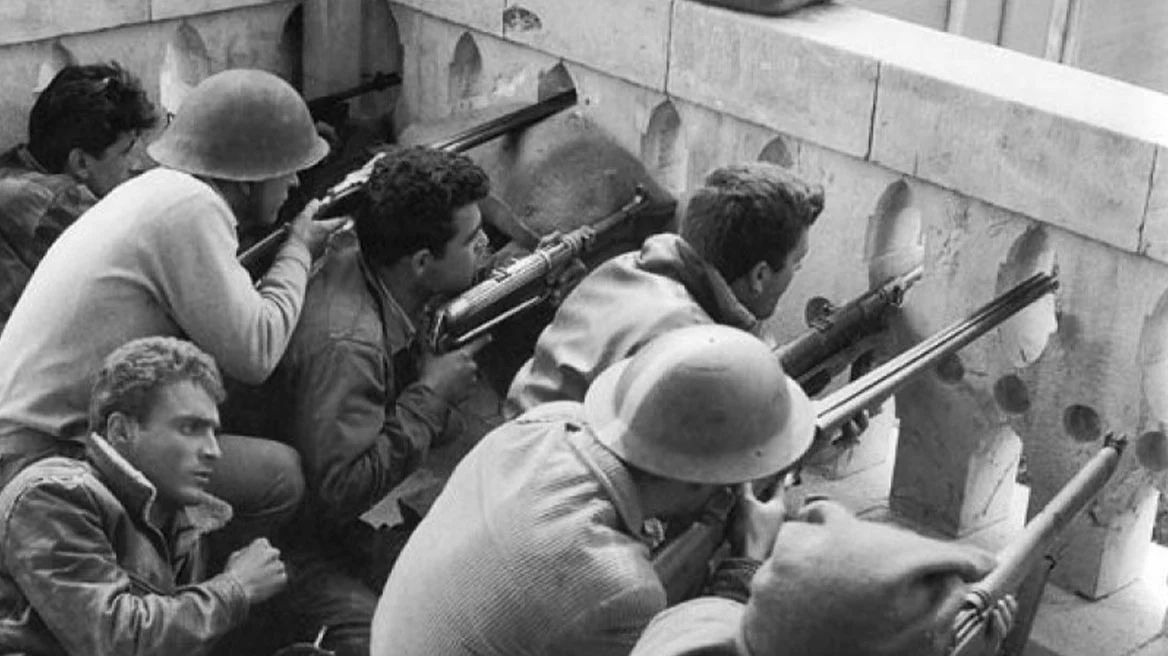
If you ask for a date that encapsulates the beginning of the end for the Republic of Cyprus as it was built under the Zurich–London Agreements, 21 December 1963 will always come first to the mind of anyone with even a basic knowledge of history. Not because partition was “born” that dawn by some magical means, but because that was when the delicate thread of trust was irreparably broken—and along with it, the possibility for the state to function without a supervisor looming above it: a guarantor power, an army, a paramilitary apparatus.
The narratives surrounding those days are many, often competing, often shaped to fit flags and memorials. Yet there are facts that do not change simply because each side “reads” them differently. There are dead people, there are homes left behind, there are people who moved with a single suitcase, there are neighborhoods cut in two, and a way of life that never returned.
And there is something else, perhaps more painful than the grand slogans. That after so many decades, we learned to live with the absurd as if it were normal. With checkpoints, with a stroll that stops in the middle of Ledra Street, with barbed wire in the heart of the capital, with a “line” you call green to make it easier to bear, as if the color changes reality.
The night that lit the fuse
In the early hours of 21 December 1963, in Nicosia, a seemingly routine “police” scene unfolded: a car check, tension and shouting that escalated into gunfire. Two Turkish Cypriots were killed, and within a few hours the city appeared to be slipping out of control. That incident, with all its details and dark corners, acted like a spark in a space already saturated with the smell of gasoline.
When shots begin to ring out in neighborhoods where Greek Cypriots and Turkish Cypriots live side by side, no “central order” is needed for fear to spill into the narrow streets. But the fear was not caused by an isolated incident. The carpet that absorbed the blood had been laid long before. That morning, fear found ready-made infrastructure: armed groups on both sides, networks, people waiting for a pretext—some to “protect,” some to “avenge,” some to implement plans that were never written into official announcements.
It is no coincidence that those days remained in Turkish Cypriot memory as “Bloody Christmas,” because that was the narrative imposed by Ankara. The clashes quickly evolved into a cycle of violence, with dead on both sides, with crimes that still weigh heavily today, and with Turkey using specific incidents as a permanent alibi for everything that followed, up to 1974.
The city was already boiling
Anyone who presents the explosion of 1963 as the result of a “random” incident is simply winking at a convenient oversimplification of history. The climate was already charged. In 1962, in Nicosia, explosions occurred at two Muslim mosques, Omeriye and Bayraktar, an event that poured oil on the fire and fueled mutual accusations of provocation.
In the aftermath of that case, the Turkish Cypriot journalists Ayhan Hikmet and Ahmet Gürkan were murdered. They had clashed with the establishment of their community and, according to many reports, were preparing to publish information about the real perpetrators of the mosque explosions. They knew they were Turkish agents of the MIT.
This detail is not merely some minor footnote lost in the sea of events of that era. It shows something we often avoid looking squarely in the face. The paramilitary world was not an “appendage” of the conflict. It was its tool.
At the same time, the functioning of the young Republic of Cyprus was being tested by a Constitution that many described as unwieldy and divisive, with separate majorities, vetoes, and an architecture that required good faith every single day, not just on anniversaries. This dysfunction was one of the reasons Makarios submitted the proposal of the “13 points” for constitutional amendments on 30 November 1963—a proposal rejected by the Turkish Cypriot side and which acted as a spark on the slow-burning fuse of the crisis.
Collapse of the state
After the clashes of December, the state began to function in a way that showed everyone was taking their own path. Turkish Cypriots withdrew—under pressure and guidance from Turkey, their leadership, and TMT (the Turkish Cypriot terrorist organization)—abandoning critical structures: the civil service, Parliament, the police, and institutions that were supposed to be shared foundations. At the same time, many were confined to enclaves, with restricted movement and the cultivation of a siege mentality that would shape an entire generation.
The numbers are harsh—not because they are numbers, but because behind them are people. During the crisis of 1963–1964, hundreds of deaths are reported on both sides and mass population movements, with tens of thousands of Turkish Cypriots concentrated in enclaves, because that was the scenario in Turkey’s grand plan. Here lies a point that unsettles us, and that is why we usually pass over it out of guilt and discomfort. Violence was reciprocal, regardless of who initiated the cycle of blood. There were crimes, massacres of civilians, acts that stain the official state and that are still used today as propaganda material.
The “Green Line”
On the eve of New Year’s Day 1964, the British assumed the role of supervisor between the opposing sides, in an effort to “freeze” the conflict before it became uncontrollable. In that context, during negotiations that lasted hours, a ceasefire line was drawn in Nicosia on a map with a green pencil by General Peter Young. The detail of the green pencil became symbolic—but the symbol was the least of it. The essential fact was that the capital acquired an internal, informal border that exists to this day.
The agreement of that period bears the signatures of the leaderships of both communities and the British side, but the reality that emerged was not a matter of agreement. It was a temporary measure that became permanent, as often happens in Cyprus.
The UN arrived—and stayed
In 1964, the UN established the United Nations Peacekeeping Force in Cyprus (UNFICYP), by decision of the Security Council, to help restore order and prevent new clashes. Resolution 186 was adopted on 4 March 1964.
A few months later, a report by the UN Secretary-General recorded a systematic assessment of property damage from the unrest, with references to hundreds of homes destroyed and thousands looted or severely damaged in dozens of villages.
These data are not cold “historical accounting.” They are tangible proof that, from that point on, returning to previous balances became almost impossible. When a home is lost, when a village empties, when property is looted, you do not easily return to the same café and the same neighborhood. Geography takes on a political character, and politics becomes a tendency to build—often on the ruins of the other. From then until today, UNFICYP has maintained a permanent presence on the island.
Readings of history
One of the most interesting—and harsh—findings of oral history research is that people do not always narrate events the way parties, leaderships, and school textbooks do. In testimonies of Turkish Cypriots displaced from the south to the north, the experience of loss frequently reappears, along with the sense that looting and destruction aimed to prevent return.
Similarly, within the Greek Cypriot community, testimonies about displacement—especially after 1974—show how refugeehood was transformed into an identity, even through official categorizations. For example, the distinction is recorded between the “refugees” of 1974 and the “tourkópliktos” (those affected by Turkish actions) of earlier periods—a linguistic detail that carries its own political and social weight.
Here lies a great Cypriot irony, one of those that does not need a joke to make you laugh bitterly. On an island divided by the force of arms, we ourselves learned to divide even our traumas into categories.
Christmas 1963 – Summer 1974
The decade that followed was not marked by waiting, but by continuous negotiation, crises, clashes, solution plans written and erased, and a gradual acceptance that coexistence had been transformed into conflict management. Partition, before becoming a scar on the ground in 1974, had already become routine in institutions, security, routes, and social contacts.
In 1974, after the coup and the Turkish invasion, the line took its present form. The scale of displacement was enormous. About 200,000 Greek Cypriots fled from the occupied north to the free south within a few days, while Turkish Cypriots in the south were also forced to leave for the occupied areas.
This displacement was not merely movement; it was a transformation of the social map. It meant new neighborhoods, makeshift shelters, schools operating in rooms filled with more noise from cries and pain than from bells. It meant Christmases with trees in relatives’ yards, with empty chairs, with homes left behind “for a few days”—until those few days turned into decades.
The clock that does not stop
There is also another side to the Christmases of partition, the most unforgiving one. It is the Christmas of families who did not know whether to set a table for a person who “might” return. The investigation into the fate of the missing continues to this day, with identifications of remains decades later and hundreds of families still waiting for answers.
Many of the missing from 1974 and the previous decade of intercommunal violence have been identified, but hundreds of cases still remain without answers as to where, how, and why. History teaches that partition is not only a political problem, but a daily management of loss.
Half a state with a whole problem
In 2004, the Republic of Cyprus joined the European Union and, formally, the entire island is European territory. In practice, the EU acquis has been suspended in areas where the Republic of Cyprus does not exercise effective control, as provided by Protocol 10 of the Act of Accession.
This legal reality is the contemporary translation of the old line drawn with the green pencil. The EU does not automatically erase lines, but it offers a framework of security, law, and economic perspective which, if we choose, can become part of the solution. Our future will not be decided by how many times we repeat that “we want a solution,” but by how much we can endure breaking the comfortable routine of non-solution and faits accomplis.
Same rhetoric, different faces
Today, the international community continues to support the bi-zonal, bi-communal federation as the framework for a solution, while the Turkish side, at the level of Ankara, insists on the rhetoric of “two states”—a position repeated publicly that affects the course of talks (which have not taken place for eight years) and poisons every effort to create conditions of trust. At the same time, we live in a paradox. You can cross the checkpoint, have a coffee, talk to people who could have been your neighbors in another era, and return to a reality where the “other side” exists but does not exist, is recognized but not recognized, is close yet politically unreachable.
Christmas every year
December 1963 is not just a memory. It is the point at which Cyprus moved from the idea of a unified state to the reality of separate security. From political confrontation to geographical separation. From disagreements over constitutions and vetoes to checkpoints and enclaves.
That is why the Christmas of partition is not only that of 1963. It is the Christmas of every year in which children grow up without knowing what the city was like before it was cut in two. It is the Christmas of every year in which the solution is postponed until… “conditions mature,” as if conditions ripen on their own, like fruit you simply sit and watch.
Partition is not a whim of history that just “happened” and stayed. It is the result of choices, fears, paramilitary tools, foreign interests—but also of our own limits. The more we treat it as a natural condition, the more we grant it the right to survive in the shadows.
History, however, does not care about holidays and festive dinners. It does not care if we are tired. It returns every year at this time and reminds us that the line in the middle of the city is defeat.
Ask me anything
Explore related questions




