





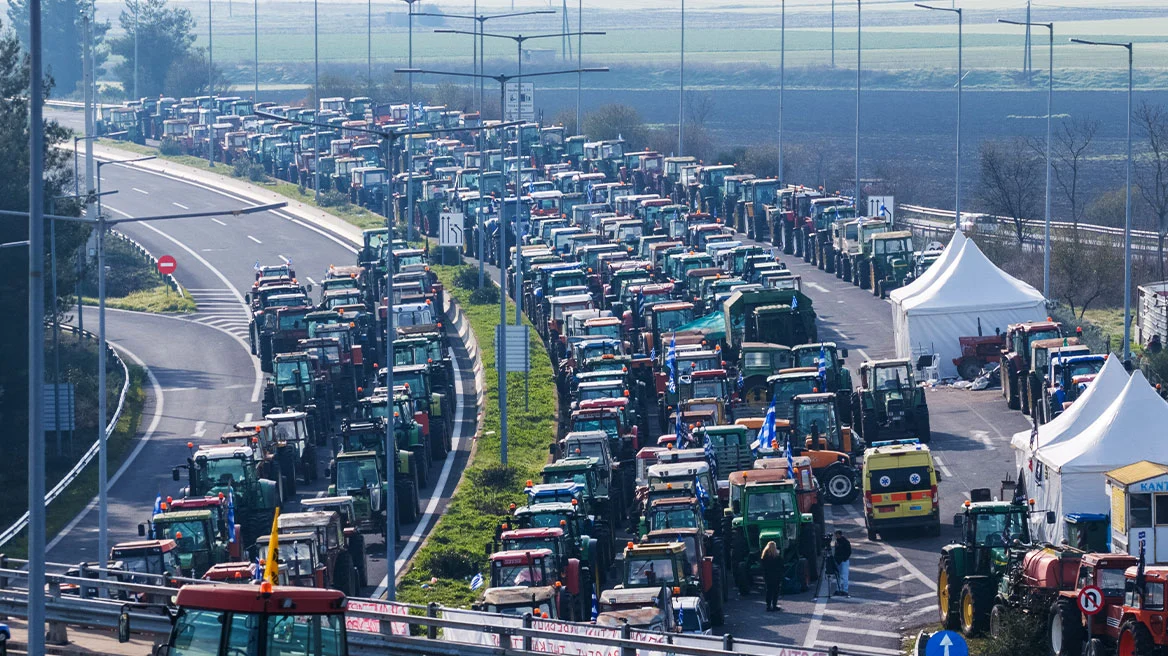
A chain of adverse consequences for the Christmas market, tourism and transport is being caused by the blocking of national highways by tractors: cancellations of bookings are reaching as high as 50% in popular destinations, leading hoteliers to say that “mainland Greece is bleeding,” since fewer visitors mean reduced turnover for food service, retail shops and all professionals, while those who decided to travel are living a nightmare on the roads with the blockades and are expressing their anger over the hours-long hardship, especially those traveling with small children. At the same time, workers in the transport sector are racing against time to ensure the smooth supply of the market, as routes can take even double the time, resulting in fewer services being operated, while fuel costs are higher due to the extra kilometers driven on detours.
Hoteliers are calling for a solution “here and now” for travelers who are enduring enormous hardship on the roads to their Christmas destinations. The president of the Hellenic Chamber of Hotels, Mr. Giannis Hatzis, referred in a social media post to a dire situation and called for a solution to be found within the day. At a time when bookings, especially in popular destinations, had reached 100%, cancellations and losses of up to 50% are now being recorded.
Hoteliers have stated that they support the farmers, given that “the hotel sector maintains a close and interdependent relationship with the primary sector.” However, as they have already stated in a letter to the government, it is critical that the forms of protest do not cause corresponding impacts on other sectors of the economy and on local society.
“We do not know who is responsible for the dire situation we are experiencing today. The only ones who certainly are not to blame are our customers, our members and our employees. We are asking that by the end of the day a solution be found and that smooth and safe traffic on the road network be restored, in order to put an end to the enormous hardship our fellow citizens are experiencing and to limit, as much as possible, the economic damage suffered by our members. At some point, we all have to take responsibility for what falls to us,” he concludes.
In the regional unit of Magnesia, where the destinations most affected are located, the cancellations seen by hoteliers over the entire previous period stand at 50%. The president of the Magnesia Hoteliers Association, Mr. Giorgos Zafeiris, stated: “We are waiting to see what happens today and whether a solution will be given so that travelers can reach their destinations. We are trying to address the situation very seriously and that is why we are waiting for a solution. However, we are seriously considering raising claims against the State as a first step.”
Wave of cancellations
The festive period has begun with mass cancellations and difficult conditions domestically in road-accessible mainland destinations. Tourism market stakeholders, who until last week were already observing cancellations in destinations with major losses since early December in the regional unit of Magnesia—at 50% (including the notable cancellation of conferences during the month in Volos)—report lower losses, at 30%, in the regional unit of Trikala.
Specifically, in popular winter destinations of Thessaly and Epirus, such as Trikala, Volos, Pelion, Karpenisi and Ioannina, booking cancellations are reaching or even exceeding 50%, with a significant portion of visitors changing plans due to access problems and uncertainty over travel.
“Mainland Greece is bleeding”
“Mainland Greece is bleeding right now,” says the Secretary General of the Hellenic Chamber of Hotels and president of the Drama Hoteliers Association, Mr. Angelos Kallias, noting that it is still early to fully measure the impact on the sector.
“However, the turnover that is being lost and will be lost during the holidays is the highest of the entire winter season in Greece, and in destinations which, as is well known, do not have the high revenues and prices of summer high-season destinations.
“We estimate that theme parks are losing 40% of their turnover. For hoteliers, if the holiday period is lost, we are talking about losses of as much as 40%–50%, because during this period prices are the highest of the winter season.” Mr. Kallias notes that there are large cancellations of even €3,000 from travelers who will never reach their destination. In addition, there were bookings of longer duration—four to five days—which are also being lost. As he says, even if the problem were solved today, bookings of four to five days would reasonably be converted into shorter stays of two to three days.
Drop of over 30% in Trikala
A drop in visitor numbers of over 30% is already being recorded in Trikala, one of the most popular holiday destinations, due to the farmers’ roadblocks. The “Mill of the Elves,” set up every year at the Matsopoulos Tower, is a magnet for families and school trips. As the president of the Mill of the Elves, the municipal organizing body of the Municipality of Trikala, Effie Leventi, told protothema.gr, the school trips expected last week were lost, as schools did not risk journeys of six or seven hours to reach Trikala.
She notes that this year the municipality had invested heavily in the Mill, expanding it with new spaces and activities, but visitor numbers are down by 30%, while excursionists visiting the city by coach, despite the hardship, avoid strolling around the city and overnight stays. They visit the park at the Matsopoulos Tower for two or three hours and then leave. Yet for Trikala, this festive period brings life to economic activity: food service, hoteliers and retail shops are all counting on these days to work.
Hoteliers and tourism bodies report that this picture has been forming for weeks, with bookings slowing dramatically and many already canceled as tourists fear traveling to areas with road blockades. Industry stakeholders stress that difficulties in road travel act as a deterrent for tourists from other regions or from abroad, affecting not only accommodation but also food service, commerce and the local economy as a whole.
“We believe that at this moment, in the situation we are experiencing, we are the most unfairly treated and unfortunately we can do nothing,” says Mr. Konstantinos Papapoulios, president of the Trikala Hoteliers Association. “We are not against the farmers, but it is a fact that through no fault of our own we are counting cancellations close to 40%, having already lost the entire previous period of December. We hope that until the very last moment—we have also started offering some discounts. However, it is very negative that morale has now been lost as well. At this stage we are trying to remain calm; we will wait for these days to pass and when we do the accounts we will see how we can recoup the losses, possibly by requesting payment suspensions, etc.”
The climate of uncertainty in the market is described by the president of the Arachova Hoteliers Association, Kalousa Nafpaktitou. “Cancellations are currently at 10%–15%, but the biggest problem is that the phones have stopped ringing. People are confused and divided by the farmers’ protests,” she told protothema.gr.
Among the more “fortunate” destinations is Kalavryta, where, as noted by the president of the local association, Mr. Kostas Dafalias, “there are no particular access problems from Athens, where most of our visitors come from. Therefore, for the coming weekend we have high occupancy, and the same applies to the following New Year’s weekend, where there is still some availability.”
Losses, but to a smaller extent, are also being recorded by hoteliers in the regional unit of Ioannina, since, as the president of the Ioannina Hoteliers Association, Spyros Sourelis, told protothema.gr, cancellations were offset by increased demand. In the city of Ioannina, losses are small, on the order of 5%–10%.
Ask me anything
Explore related questions




