






Andreas Drymiotis in Conversation with Dimitris Danikas
Scene 1
“Greek agriculture is fifty times less productive than the Netherlands”
Dimitris Danikas:
Don’t you think there’s chaos right now? With the farmers, the truck drivers… It feels like an unstructured movement against Kyriakos. That’s the impression I get.
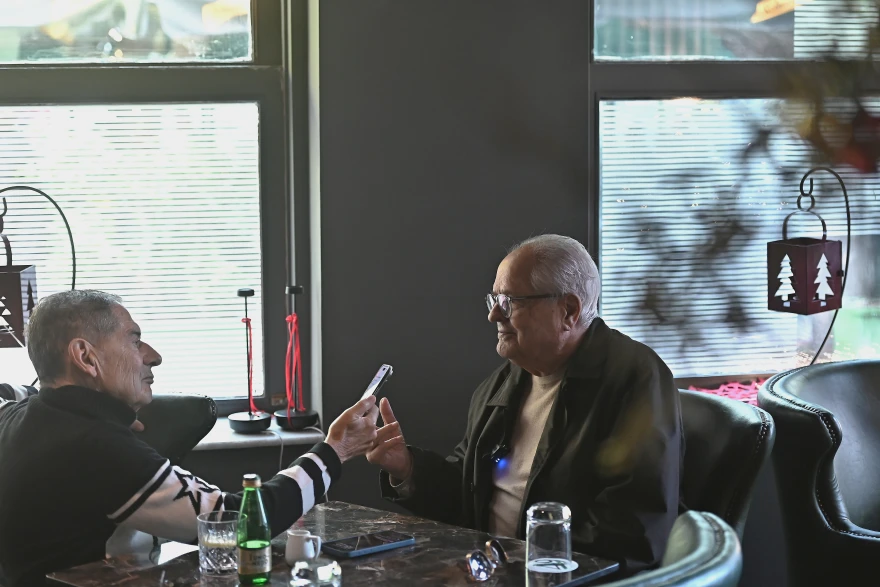
Andreas Drymiotis:
It’s not unstructured at all—it’s organized. Let’s start with the farmers. Farmers have been spoiled. For many years now, all their demands have been met, and they’ve learned a pattern: they mobilize around Christmas or early January, never during planting season. They threaten to block roads—which they do—come down to the cities, and extract as much as possible. This is nothing new.
I believe the first major episode happened under Hatzigakis during the government of Kostas Karamanlis the younger, when we handed out large sums of money—money the European Union later demanded back, because such subsidies weren’t allowed.

D.D.:
How much money have they received overall?
A.D.:
About €190 billion in subsidies so far. And essentially, there has been no improvement in productivity. We are fifty times behind the Netherlands.
D.D.:
And behind Israel as well.
A.D.:
Israel doesn’t count—that’s a different league altogether.
D.D.:
So what’s going wrong with Greek agriculture?
A.D.:
We’ve grown accustomed to easy money. This didn’t start today. It began with corn during PASOK’s time, and continued with cotton. Everyone grew cotton because it was easy, and they weighed it wet—or even with stones mixed in. They learned to live off easy profit. And once you get used to easy money, it’s very hard to switch to hard work.

I’ve also seen their demands. Just the demand that OPEKEPE should not be transferred to the Independent Authority for Public Revenue tells you a lot.
D.D.:
Why don’t they want that?
A.D.:
Because the Authority has made major reforms in recent years, to everyone’s benefit. The biggest reform is that it cracked down on massive VAT evasion. There used to be a huge gap between what shops collected and what they declared. In Greece, I estimate that gap was around 24%. In other words, out of every €100 collected, €24 were not declared.

Today, that figure has dropped to around 9%. How? Through card payments and the linking of POS systems to cash registers. Every card transaction is automatically recorded and reported. There’s no way to hide it.
I like to give credit where it’s due. Pitsilis has proven he does his job—full stop. This shows the path Greece must follow. If tax evasion is tackled properly, there will be money left over for those who truly need it. Mitsotakis has managed to do this without raising taxes.

D.D.:
But there are many people in need.
A.D.:
I’m not so sure, because the shadow economy is still huge. Yannis Stournaras once said: we spend €120 billion but declare only €80 billion. Where do the other €40 billion come from?
D.D.:
That’s not everyone, though. That’s people with money. Some people are genuinely struggling.
A.D.:
It’s everyone. If we don’t acknowledge the problem, we’ll never solve it. When the average declared rent in Greece is €255…

D.D.:
…while in reality it’s €600.
A.D.:
Exactly. And since many people own and rent apartments, we know there’s massive tax evasion there too.
D.D.:
How can that be addressed?
A.D.:
If I were Pierrakakis, I would allow the full rent to be tax-deductible. Then tenants would have an incentive to declare the real amount. More broadly, the way to fight tax evasion is to give incentives to consumers to declare their expenses, like in the U.S. All expenses are deductible, everything is tracked electronically, and the tax authorities receive the data directly from banks. This benefits everyone except the fraudsters.
Scene 2
“The wealthy steal in different ways”
D.D.:
The wealthy steal too.
A.D.:
No—the wealthy steal in different ways. But they don’t really need to steal.
D.D.:
Shouldn’t those who make billions be taxed more so part of their wealth goes back to society?
A.D.:
That’s a big discussion. Look at Bill Gates and Warren Buffett—two of the richest people in the world. Both have pledged to give most of their wealth back to society, and they already have.
D.D.:
That doesn’t really happen here.
A.D.:
It used to. The Zappeion belongs to Zappas. The Onassis Hospital to Onassis. We had benefactors—and we still do. The Niarchos Foundation, the Onassis Foundation, the model schools, the new Onassis wing for transplants. These are enormous contributions.
Taxing wealth is tricky. A wealth tax is essentially punishing someone for working hard and succeeding.
Scene 3
“I’m not particularly concerned about inequality.”
D.D.:
Inequality today is enormous.
A.D.:
I disagree. Go back 300 years. If you wanted music or art, you had to be a king. Today, you tap your phone. Fifty years ago, we had one radio at home. Bathing once a week required boiling water. No refrigerator—just an icebox.
Today, even a poor household has TVs, mobile phones, washing machines. Globalization and technology—things we like to demonize—have made a better life accessible.
What matters to me isn’t inequality, but whether today’s poor live better than the poor of 50 or 100 years ago.
Scene 4
“The biggest reform: abolishing permanent tenure”
D.D.:
If you were Mitsotakis, what would you do with the farmers?
A.D.:
I would have made far deeper reforms. Greece can do it—we’ve proven that. Wherever we dared, we succeeded. Pierrakakis did in three years what hadn’t been done in forty.
The biggest reform in the public sector—barely touched so far—is abolishing permanent tenure.

Anyone who has managed even five people knows this: the only real power of management is what the English call fire and hire. If you can do neither, they ignore you completely.
D.D.:
So you abolish tenure and fire people?
A.D.:
If they don’t perform, yes.
D.D.:
They’ll revolt.
A.D.:
“Those who do not work shall not eat.” That was said by Christ himself. If someone can’t be a civil servant, they can become a farmer or a livestock breeder.
Scene 5
“What misery! Polakis wishes Pierrakakis to fail”
D.D.:
When someone earns €800–900, what performance do you expect?
A.D.:
Have we ever calculated how many public employees we actually need? No one knows.
We must shrink the state. I’ll give you a real example…
Everywhere in the public sector, needs are created, staff are hired, and no one checks later whether that need still exists. If it doesn’t, the people remain—and get paid.
Scene 6
“Venizelos, Tsipras, Samaras, Karamanlis—all lost, yet want to return”
D.D.:
What’s going on with Samaras, Karamanlis, and Venizelos?
A.D.:
There’s talk that if Mitsotakis can’t form an outright majority, alternative scenarios will emerge—on condition that he steps aside.
D.D.:
Dendias? Venizelos?
A.D.:
Why not? This is another Greek peculiarity—and for me, a disgrace. Show me another country where prime ministers lose elections, resign as party leaders, and then try to come back. It doesn’t happen.
D.D.:
Are you talking about Venizelos or Tsipras?
A.D.:
All of them. Venizelos, Tsipras, Samaras, Karamanlis. The only one who tried and was utterly rejected was Giorgios Papandreou.
Scene 7
“A dog’s tail never straightens”
D.D.:
Tsipras won’t be the same. He’ll be centrist.
A.D.:
A dog’s tail never straightens.
Scene 8
“Mitsotakis should follow Thatcher and Reagan”
D.D.:
So the state is the problem.
A.D.:
Exactly. Look at Thatcher. Look at Reagan. They reduced the state and transformed their countries. If you are not willing to lose something, you can never win.
Epilogue
“Mitsotakis again, with an outright majority.”
D.D.:
Mitsotakis doesn’t seem headed for an outright majority—around 30%.
A.D.:
I wouldn’t be so sure. When voters stand alone with the ballot and think about instability, war, Turkey, and recent memories, they will harden their hearts and vote for Mitsotakis.
D.D.:
Your prediction?
A.D.:
Outright majority again. And better that way—coalitions are far worse.
Ask me anything
Explore related questions




